
When we started shaping the EuroSTAR 2026 programme, one question kept coming back to us:
What does testing at its best really look like today?
To help answer that question, Programme Chair Elmar Jürgens (CQSE GmbH, Germany) worked alongside our dedicated Programme Committee, bringing together their expertise, insight, and passion to create a programme that is both practical and inspiring.
The committee members – Fiona Østensvig (Gritera Quality, Norway), Willem Keesman (Sopra Steria, Netherlands), Richard Seidl (Consulting GmbH, Germany), and Sophie Küster (cronn GmbH, Germany) -each bring their own unique experience.
Together, they’ve designed a programme that tackles the real challenges testers face today, offers opportunities to learn and grow, and celebrates the collaboration that makes our community so strong.
AI in Testing: Practical, Thoughtful, and Human-Led
AI is everywhere in the EuroSTAR 2026 programme, but what’s refreshing is how it’s being discussed. Rather than “AI will replace testers” narratives, the sessions focus on practical collaboration between humans and machines.
Sessions explore how testers are already using AI in their work and what’s required to do this well. Tutorials such as AI-Driven API Test Automation and talks on training and guiding Large Language Models focus on real applications, not promises of full automation.
Other sessions take a more reflective approach, asking important questions about trust, bias, and responsibility when AI becomes part of the testing process. Across these talks, one message is consistent: AI can enhance testing, but it still relies on human judgement, context, and critical thinking.
Testing at its best means understanding both the power and the limits of these tools.
Context, Risk, and Understanding the System
Another strong theme running through the programme is context.
Sessions on context engineering, exploratory testing, and risk-based approaches reinforce the idea that quality cannot be separated from the environment in which software exists. These talks focus on helping testers understand why something matters – not just how to test it.
The Human Side of Quality
Alongside technical depth, the EuroSTAR 2026 programme continues to highlight the human skills that support great testing.
Talks exploring psychology in testing, communication and collaboration, and mental health in remote testing teams. Quality depends on conversations, relationships, and the confidence to ask difficult questions.
As testing tools become more advanced, these skills become even more valuable.
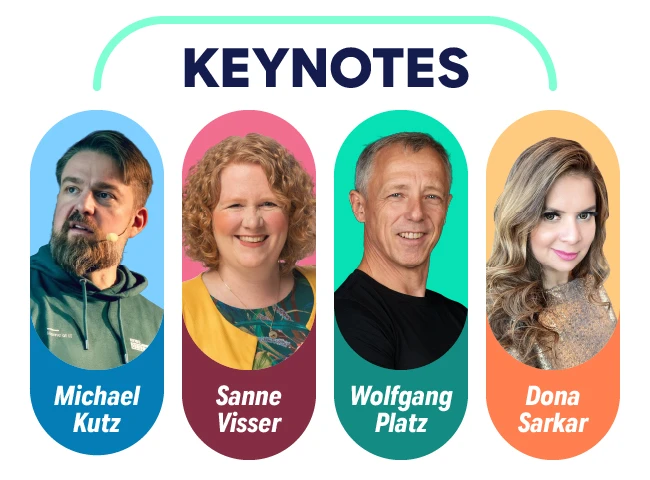
EuroSTAR keynotes are designed to challenge thinking and spark meaningful discussion — and the 2026 keynote line-up does exactly that, bringing insight, experience, and inspiration to the main stage.
The Jobs Not Taken
Dona Sarkar — Microsoft, USA
Dona Sarkar encourages us to embrace experimentation in our careers and work. Drawing on her role as Chief Troublemaker for Microsoft’s AI and Copilot Extensibility Program, she discusses how curiosity and bold experimentation can unlock growth, creativity, and impact. Explore the session.
Do It For the Plot
Sanne Visser — Bartosz, The Netherlands
Sanne Visser explores resilience, curiosity, and consistent effort in testing. Using software projects as a metaphorical story, she shows how engaging fully with challenges — even uncertain ones — fosters growth, learning, and meaningful progress in our daily work. Explore the session.
Three Decades of Software Testing – From Startup to Global Leader
Wolfgang Platz — Katharo Ventures, Austria
Wolfgang Platz reflects on his journey from early software development to founding Tricentis, Austria’s first unicorn. He shares lessons from three decades in testing, including innovation, leadership, and how testing practices have evolved to meet the challenges of modern technology. Explore the session.
With Great Trust Comes Great Responsibility
Michael Kutz — REWE digital, Germany
Michael Kutz examines the role of trust in high-performing teams and software quality. Drawing on his experience establishing agile practices at REWE digital, he highlights how autonomy, accountability, and responsibility underpin successful testing and development cultures. Explore the session.
What “Testing at Its Best” Means to Us
When we look at the EuroSTAR 2026 programme as a whole, a few things stand out to us.
AI is now part of everyday testing — and learning how to use it thoughtfully and responsibly is something we all need to consider.
Context, risk, and truly understanding the system still sit at the heart of quality.
And human skills? They’re not secondary. They’re essential.
For us, testing at its best isn’t about moving faster for the sake of it, or automating everything we can. It’s about making informed decisions, understanding what matters, and applying our skills where they have the greatest impact.
Looking Ahead to EuroSTAR 2026
EuroSTAR has always been about bringing the testing community together — to learn from each other, challenge ideas, and share experiences. The 2026 programme continues to do so, offering a mix of deep technical learning, human-centred topics, and opportunities for discussion.
We’re looking forward to welcoming the community to the Nova Spektrum in Lillestrøm and exploring what testing at its best can look like – together.