Autonomous testing is one of those phrases everyone nods at, but few people can clearly explain. Slide decks talk about systems that write their own tests, fix failures automatically, and keep pipelines green without anyone watching. Somewhere along the way, teams start wondering if they are falling behind simply because they don’t have “autonomy” yet.
Most of that anxiety comes from hype, not reality. The real question isn’t whether testing can become autonomous. It’s where autonomy actually helps teams do better work, and where it quietly introduces new risks.
Autonomy is a spectrum, not a switch
Testing doesn’t suddenly flip from human-driven to autonomous. It evolves in layers.
Most teams start with automation that focuses on execution. Scripts run faster than humans, but people still decide what gets tested, how coverage is shaped, and whether results can be trusted. This is familiar territory.
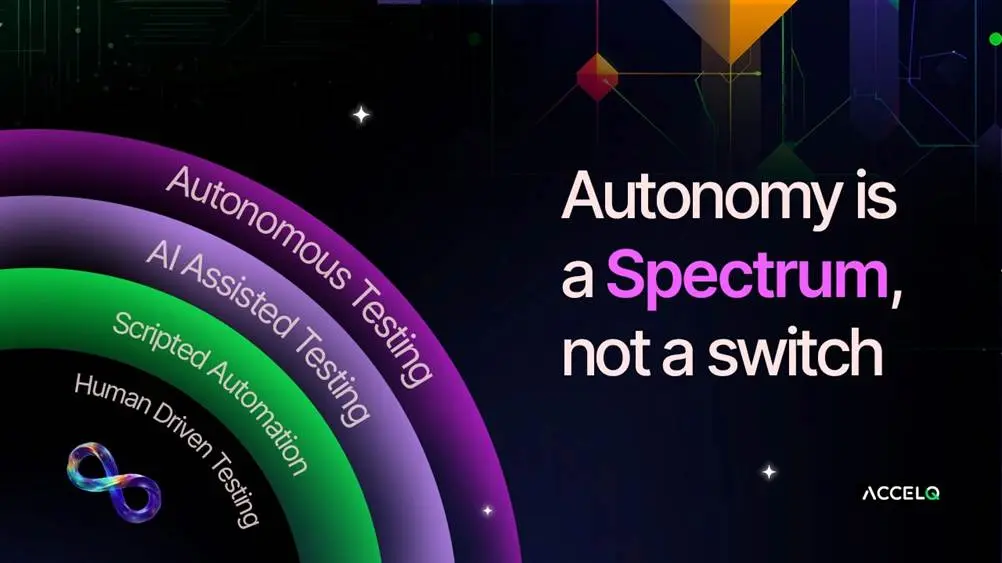
AI assistance adds another layer. Test creation speeds up, failures are grouped instead of dumped into long reports and maintenance effort drops. These gains are real, but they are still reactive. Humans remain firmly in control.
Autonomy begins only when a system can take on limited decision-making, within boundaries defined by the team. Not creative judgment, but practical judgment. Deciding which tests are relevant for a specific change. Flagging failures that look like noise rather than regressions. Noticing flows that are becoming so fragile they can no longer be trusted. This is usually where expectations and reality part ways. What is sold as autonomy often turns out to be faster automation with a new label.
Why Hype Breaks Down in Real Environments?
Autonomous testing struggles when context is missing.
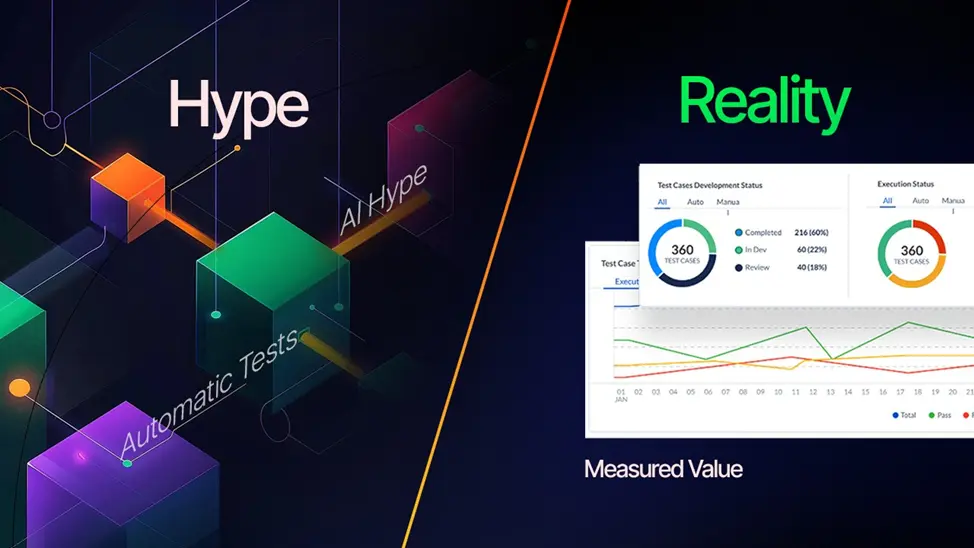
AI does not understand business importance on its own. It cannot tell which workflow carries regulatory exposure or which release is under executive scrutiny. Without that context, decisions become statistical guesses rather than informed choices.
Self-healing is another frequent weak spot. Updating locators can keep tests running, but it can also hide changes in behavior that actually matter. Pipelines look stable while confidence quietly erodes.
A green pipeline is comforting. A trustworthy pipeline is far more valuable. Autonomy that masks risk does more harm than good.
Where AI Genuinely Helps?
Used well, AI shines at recognizing patterns humans don’t have time to see.
It can connect failure signatures across pipelines and environments. It can reveal tests that only break under specific data conditions. It can point out entire suites that consume time without improving coverage. It can highlight areas where manual testing consistently finds issues automation misses.
This doesn’t replace testers. It sharpens their judgment.
One of the most underrated benefits of AI-assisted testing is how it changes team discussions. Less time is spent arguing about flaky failures. More time is spent talking about system behavior and risk. For many teams, that shift alone justifies the investment.
Autonomy Needs Boundaries to be Trusted
The most effective autonomous testing systems are deliberately limited.
They don’t decide what quality means; teams do.
They don’t invent test strategies. They optimize what already exists.
They don’t operate silently. They explain their reasoning.
Explainability is non-negotiable. If a system skips tests or classifies failures without showing why, teams will override it every time. Accuracy matters, but transparency is what builds trust.
Autonomy is adopted when people understand not just the outcome, but the reasoning behind it.
From Scripts to Systems
Traditional automation treats tests as isolated scripts. Autonomous testing treats them as parts of a larger system.
That system understands dependencies between services, data, environments, and user flows. It recognizes that a login failure ripples across dozens of downstream tests. It understands that a configuration change in one region shouldn’t invalidate results everywhere else.
This shift is subtle, but important. Autonomy works not because AI is smarter than humans, but because it can track complexity humans can’t reasonably keep in their heads.
This way of thinking is increasingly reflected in how enterprise platforms are being designed. At ACCELQ, autonomy is treated less as an end state and more as a support system for decision-making at scale. The emphasis is on observing system behavior, correlating signals across pipelines, and making change easier to understand rather than hiding it behind execution.
Capabilities such as adaptive test generation, intelligent handling of change, and agent-style execution through ACCELQ Autopilot are used to reduce noise and maintenance while keeping teams firmly in control of intent and strategy. Autonomy, in this model, is not about removing oversight. It is about making complex testing environments more transparent as systems evolve.
How Teams Should Evaluate Autonomy Today?
A simple way to cut through autonomous testing claims is to ask a few uncomfortable questions. What decisions does the system make without human input? What signals drive those decisions? How does it behave when signals conflict? And how easy is it to override decisions and learn from them?
Vague answers usually point to cosmetic autonomy.
Real autonomy shows up quietly. Fewer late-night reruns. Fewer ignored failures. Fewer production surprises. It reduces friction without asking for attention.
The Future is Assistive, Not Absent
The strongest testing organizations aren’t trying to remove human judgment. They are trying to protect it.
AI is well-suited to repetition, correlation, and scale. Humans are better at intent, ethics, and trade-offs. Autonomous testing works when it creates space for thinking, not when it pretends thinking is no longer needed.
The real value isn’t in replacing testers. It’s in freeing them from work that hides risk instead of revealing it.
That’s the point where autonomy stops being a promise and starts being useful.
Author

Geosley Andrades, Senior Director, ACCELQ
Geosley is a Senior Director, Product Evangelist and Community Builder at ACCELQ, leading global AI-driven, no-code test automation initiatives alongside product strategy and go-to-market programs. With nearly 18 years of cross-industry experience, he helps enterprises rethink how software quality is built, validated, and scaled for real-world impact. A strong advocate for intelligent, autonomous testing at enterprise scale, Geosley actively shapes ACCELQ’s vision through competitive analysis, analyst engagement, and forward-looking research—driving simpler, more reliable, and sustainable automation for modern digital ecosystems.
ACCELQ are Exhibitors at EuroSTAR 2026. Join us at EuroSTAR Conference in Oslo 15-18 June 2026