• Skip to main content
EuroSTAR 2027 - Sign up for early access

EuroSTAR Conference

Europe's Largest Software Testing Conference.

  • Programme
    • Call for Speakers
    • 2026 Programme
    • Community Hub
    • Awards
  • Attend
    • Why Attend
    • Bring your Team
    • Testimonials
  • Sponsor
    • Sponsor Opportunities
    • Sponsor Testimonials
  • About
    • About Us
    • Our Timeline
    • FAQ
    • Blog
    • Organisations
    • Contact Us
  • Book Now

Fiona Nic Dhonnacha

Say hello to AutomationSTAR

July 7, 2022 by Fiona Nic Dhonnacha

We’ve been bringing the software testing community together from all over Europe since 1993, to learn and connect, and actively work to improve and elevate the art of software testing. We’re always looking for ways to help the community, and we’re thrilled to announce our newest event, AutomationSTAR – a brand new conference all about automation in testing. The event takes place in Munich, October 17-18.

AutomationSTAR is a 2-day conference for software testers and test automation engineers, with English and German talks. This is where the future of test automation will be shaped. Learn from 25+ thought leaders, automation experts, and rule breakers, who will share ideas, and start conversations around automation in software testing.

Community is at the heart of AutomationSTAR, and this is a space to share different experiences, discuss the problems and issues you face, and find solutions together.

Learn from test automation experts

The AutomationSTAR speakers are the sharpest minds in test automation, and will share their expertise and knowledge through visionary keynotes, track talks, workshops, and half day tutorials. You’ll learn from real-life experiences, triumphs and successes, and walk away with new ideas to help YOU with challenges in your testing.

Talks will cover different levels of automation in testing, including methodologies such as DevOps, new technologies like AI, and lots more.

Whether you are new to coding, building a test automation project from scratch, or interested in codeless tools, AutomationSTAR is where you’ll find the answers. Our expert speakers are bringing you answers, to help you accelerate your delivery, get future ready, and achieve your goals.

So, get ready to skyrocket your test automation projects – check out the programme and join us in Munich.

view programme

Filed Under: EuroSTAR Conference, Test Automation Tagged With: 2023

3 methods of test book testing

July 4, 2022 by Fiona Nic Dhonnacha

Thanks to UNGUESS for providing us with this blog post.

How do you choose the right methods of test book testing? What are the possible methods? Let’s explore all the alternatives.

When it comes to functional testing, there are multiple options to choose from. Which option is right for your business will depend on the type of software you want to test, your target audience, and your overall testing goals. With that in mind, let’s explore the three possible methods of test book testing.

What is a test book?

Functional testing validates software against the functional requirements or specifications. Each company has unique goals they want to achieve with their software, and functional testing is an excellent way to determine whether you’re meeting those goals. A test book is simply the list of test cases that will be executed during functional testing. The test cases are designed with your specific software in mind. For example, if shopping giant Amazon wanted to test the functionality of its search function, they (or an external company on its behalf) would develop the test cases from the ground up. The test cases would be specific to the website’s design, the available filters, the shopping cart process, and so on.

The key benefit of functional testing is that it helps you close the gap between how your software should work and how it actually works. Sometimes software seems logical to the people who create it but creates confusion for end-users. And sometimes, the software simply doesn’t work as intended and needs to be reworked.

The 3 methods of test book testing

1.  Crowd testing

Crowd testing, sometimes called crowdsourced testing, tests usability, functionality and user-friendliness under real-world conditions.

Crowdsourced testing is a manual approach to software testing. Testers are real professionals who get involved only for the testing process, meaning they get paid by project and performance instead of being full-time employees.

 The Benefits of Crowd Testing

  • Real-world conditions: It allows you to test the software’s functionality using real end-users in real-world conditions. Due to the large number of users, you can test functionality at any time of any day.
  • A wealth of testing data: Crowd testers use their real devices and operate different operating systems, browsers, and other native software. This makes the testing data rich, both in terms of diversity of feedback and high coverage.
  • Fast, unbiased reporting: Testers give feedback on the go, which means you get a constant stream of valuable feedback. Additionally, while all competent testers must be impartial, crowd testers have a distinct advantage in this area. They have no stake in the success of your software, so their feedback is guaranteed to be honest. Honest feedback is critical when creating highly functional and user-friendly apps.
  • Target demographics: You can source crowd testers from a vast range of demographic criteria, including age, gender, profession, income level, hobbies, and more. Crowd testing is an excellent way to see how well your target audience perceives your software. This aspect is extremely important in UX Testing.

 In UNGUESS, we have created a vast community of testers (over 20,000 in Italy, our main market, and we can reach over 250,000 worldwide). Since they are highly profiled, we can select professional testers and/ or real users of your product. Our Customer Success Managers (CSM) write the test cases for the test book specifically aimed at testing our clients’ software. Testers submit the bugs they find and the CSM approves them only if they are unique and in scope. Our clients’ Dev team can receive an export of all the bugs, or can use a bug tracking tool integration.

2.   Test automation

In automated functional testing, a computer runs the functional testing for you using tools and scripts. Typically, the software is categorised into distinct areas of functionality, and a script is designed to test the functionality in a series of steps. For each step, pre-selected elements of the UI are interacted with. For example, the automated test software might fill in a text box, select a dropdown option, or push a button. After running the automated test, you can check the results to compare them with what should have happened.

At AppQuality, for example, we have a range of tools we can leverage for our clients’ test automation, depending on their specific software specifications. As for specifics, we often use Robot Framework – a robust open-source automation framework with a rich ecosystem of libraries and tools (we have talked about it here) and Seleniumlibrary (or other libraries). Again, this is just an example as we use different tools and frameworks depending on our clients’ necessities.

The benefits of automated functional testing

  • 24/7: A computer runs automated testing, so you’re not restricted by human testers who need to take breaks, sleep, or only work set hours.
  • Faster: Without having to rely on people (unless writing the code for the test Automation is necessary), you can execute your tests much quicker. On average, automated testing is 70% faster than manual testing—faster testing results in an early time to market for your application. Warning: with Test Automation you can only find what you are looking for. Nothing out of your path can be found.
  • Improves accuracy: When you eliminate humans, you also eliminate human error. Any errors can reduce the accuracy and reliability of your results.
  • Cost-efficient: Automated testing is often significantly cheaper than manual testing.
  • Ensures consistency: Automated testing can be repeated as you make improvements and tweaks to your software. This promotes consistency across every stage of your functional testing, making it much easier to compare the results of multiple tests objectively.

3.   FTE (Full Time Equivalent)

FTE (Full-Time Equivalent) or Third-party Test Factories can mean one of two things in the testing world:

  • The company hires a top tester who writes the entire test book and then executes the tests on the application, website, or other software.
  • The company writes the test book, and the tester runs the test cases for them.

FTE offers a high level of flexibility and allows companies to engage with the testing process in the way that best suits your company. Many companies don’t have the time or resources (skilled testers) to develop the test cases themselves and benefit from the help of an outside party for a short amount of time. Other companies have a clear idea of the tests they want to run but want an impartial expert tester to execute the test cases.

To learn more about FTE or Third-party Test Factories, see how it works and the possible results, read this article and the case study of buddybank.

The benefits of third-party test factories in functional testing

  • Objectivity: Testers are fair and unbiased in reporting their results. This can be difficult to achieve with in-house testing because employees have a vested interest in the software – they might overlook negative aspects of the functionality to appease senior management.
  • Specialisation: Testers have formal training and certifications in testing related disciplines. They have a deep knowledge of testing methodologies, best practices, and appropriate tools. They bring a level of professionalism to the table that results in highly accurate, fast, and reliable results.
  • Risk reduction: Introducing a third party can help reduce the risks associated with functional software testing. Testers can spot blind spots or errors in your software that you might otherwise miss.
     

Which method of test book testing should you use? 

It is impossible to answer that question out of the blue. It is crucial to understand the context, the goals, the available resources, tools and stage of development.

UNGUESS offers a Crowd testing platform (together with tens of thousands of testers), Test Automation technologies and knowledge and even the Body Rental approach.

If you want to know which method is the most suitable for your product, contact us and schedule a short call with our experts.

UNGUESS is an exhibitor at EuroSTAR 2022.

Filed Under: EuroSTAR Conference, Software Testing Tagged With: 2022

Speak on the EuroSTAR stage

June 29, 2022 by Fiona Nic Dhonnacha

The EuroSTAR Call for Speakers is open for our 2023 conference at Antwerp Zoo, Belgium. Nestled in the heart of Antwerp conservation zoo and embedded in nature, for 2023 we are going beyond conventional space – think sprawling architecture, rooms gleaming with natural sunlight, magnificent nature, and majestic animals.

If you’re keen to speak on the EuroSTAR stage and share your software testing knowledge and expertise in this incredible space, we’d love to hear from you! Our community is all about coming together and sharing knowledge – so whether you’re a novice or seasoned tester, this is your opportunity to share your real-life experiences, and help others learn and grow.

see call for speakers

2023 conference theme

This year’s theme is ‘Software Development is a Social Activity‘, in homage to Jerry Weinberg and his legacy. Often, the hard part of working in software isn’t the technology and the tools – the actual challenge is all the social interactions that go into the work in a team, company, or between companies and their customers.

People work together in teams, and our day-to-day lives are filled with social interactions and communication. How do we interact with the software? What are the tests performed communicating back to us?  How does a human communicate with a machine, and then back to another human? The tools and languages we use influence our work and the shape of the organizations, the interactions, and the communications.

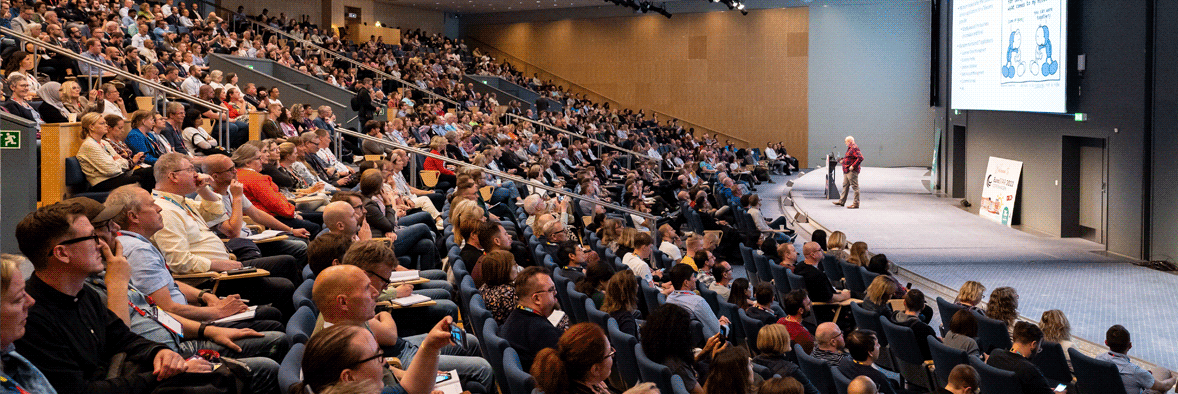
Speak on the EuroSTAR stage - a packed auditorium in a keynote talk at EuroSTAR 2022

Below are some suggestions on topics that are welcome. However, tools and technology submissions are welcome too – communication and interaction take many shapes and forms.

● Communication
● Software testing
● Test automation and its role in the work we do
● Team building
● Creating healthy organisations
● The pandemic, increased remote work, and its impact on how we work with it
● Communities
● Group dynamics
● Leadership & Management
● Recruiting good testers and developers
● Methods of collaboration
● Accessibility testing
● Internationalisation and localisation testing
● Diversity, equality, and inclusion

We’re so excited to see everyone at Antwerp Zoo, and we’re blown away by the inspirational setting – did you know that all profits made by the convention centre are invested into research and nature conservation worldwide?

If you’re feeling inspired, check out the full submission details, and start thinking about the story you want to share. We look forward to getting your submission, and seeing you speak on the EuroSTAR stage next June.

start submission

Filed Under: EuroSTAR Conference Tagged With: 2023, Call for submissions

Talking to developers about testing

June 21, 2022 by Fiona Nic Dhonnacha

Thanks to PractiTest for providing us with this blog post:

Let’s start by reminding ourselves why we need to talk with developers about testing.

According to the 2022 State of Testing report by PractiTest and Tea-time with testers, 86% of organizations now report working in an Agile or Agile-like approach. Close to 40% of organizations are working in DevOps methodology. And while the more traditional Waterfall approach is still practiced at 17% of organizations, it continues to decline.

This means that the traditional testing roles and teams, as we used to know them, are gradually disappearing, and instead, testing is becoming the responsibility of an entire agile team that also includes developers. Hence, it is of no surprise that in 77% of organizations testing is executed by testers and non-testers alike.

This shift often encounters resistance from developers with various claims about lack of knowledge on how to test, being too busy to do so, the perception that it’s a waste of their expensive time, or simply lack of desire to do so.

In order to help you bring everyone on board with the concept of product quality being the team’s responsibility we have prepared a 5 steps guide to help you:

Talking to developers about testing - communication

1. Communication

The business environment is no different than others: when it comes to human interaction, communication is the basis for a successful relationship. In order to get everyone on board, you need to start with making people understand that performing testing is not a punishment, but rather a contribution to the company’s bottom line, due to the ability to deliver faster with higher quality that will meet customers’ expectations. It requires executive sponsorship, to support the required change both in culture and in methodology.

Communication is a two-way channel, and as a result, it’s also about listening, understanding, and addressing the developers’ concerns. Pay close attention to the developers’ feedback and take it into account in order to maintain an open communication environment.

Talking to developers about testing - coaching and mentoring

2. Coaching & Mentoring

One potential reason for people to object to a change, is their fear of dealing with the unknown and the concern of not excelling in their performance. That’s why we need to dedicate time and effort to guide developers with essential information about testing. We need to convey to developers that testing is not ‘simple’ work. We want them to understand the software testing process, implement test management platform usage, and so forth.

In addition, invest some time in short pre & post briefing sessions. These meetings should include the developer of the tested feature, the testing developer, and a product team member. By doing so, we will bring a better understanding and efficiency to the process.

3. Shift left

Adopting Agile and DevOps methodologies has also created a shift in what is tested and when. We see a major shift left with the introduction of Behavior Driven Development (BDD) support and Test-Driven Development (TDD).

  • BDD/TDD are approaches that are focused on shift left. It aligns people and generates most of the tests before the testing is actually performed. Mistakenly, the common thinking is it’s used only for automation, but it can also be applied in manual testing.
  • Testing as a part of the user story – this means that user stories should also include testing elements.
  • Personas – a representation of the typical users that are going to make use of our development and their characteristics. For example, in an application that aims for the elderly, we need to think about them when creating the scenarios.
  • Testing sessions during development – you can have pair testing and have sessions while features are being written. It doesn’t have to be completely built to be shifted left.
  • Dashboard for unit/integration – include in your dashboard unit/integration test results like any other testing. This will place developers’ unit/integration tests at the same level as tests executed by testers.
  • Stability – the features shouldn’t be stable only before the release, it should be stable all the time. It is very important, it signals developers that they are already testing if they open their eyes.

4. Other testing

Sometimes it is easier for developers to relate to testing which isn’t the main core of the functional testing. The easiest way to use the “other testing” is simply to ask the developers and use their own ideas. It’s significantly easier to implement your ideas instead of someone else’s. We can also use developers’ knowledge to improve our automation framework and make the testing process closer to their hearts.

Specialized testing is another great way to leverage our developers’ knowledge to contribute to the testing efforts. Testing types like security, chaos, and performance are simpler to developers than testers. Developers would have a strong motivation to execute those specific specialized tests.

Talking to developers about testing - transparency and visibility

5. Transparency & Visibility

This is extremely important, and yet, it is amazing to see how often this is left aside. Transparency and visibility have a massive added value when we involve different people in the process.

  • End-to-end dashboards – if you are going to have multiple testing types such as unit tests, functional testing, and integration tests, you should have everything in the same place and give the same legitimacy to all tests. The moment you see that “my tests” are also included in the dashboards, that’s when you understand the importance of the tasks and your contribution to the mutual goal.
  • Count every test I have – regardless of the type or complexity.
  • Add testing to standups – a lot of time people do talk about testing in standups but we leave it to the last minute and don’t talk about challenges other than sharing ongoing activities.
  • Celebrate achievements – even in testing, if we have a developer that found a show stopper it is important to celebrate that because it has a positive effect on the staff members.
  • Testing retrospective – especially when a bug slipped and was found in production, it has a lot of value when we learn from it. Our victories and errors are equally important and valuable.

Summary

In conclusion, with most organizations working in an Agile or Agile-like environment, the software testing process is no longer exclusively assigned to testers, and other staff members like developers are taking part in the testing process. Developers have great expertise and in-depth knowledge that could substantially contribute to testing efforts. Therefore, you should follow the 5 steps mentioned above in order to effectively make them an integral part of the testing process.

Practitest is an exhibitor at EuroSTAR 2022.

Author

Joel Montvelisky, Co-Founder and Chief Solution Architect at PractiTest.

Joel Montvelisky, Co-Founder and Chief Solution Architect at PractiTest.

Joel has been in testing and QA since 1997, working as a tester, QA Manager and Director, and a Consultant for companies in Israel, the US and the EU. Joel is a Forbes council member, a blogger and is constantly imparting webinars on a number of testing and Quality Related topics. In addition, Joel is the founder and Chair of the OnlineTestConf, the co-founder of the State of Testing survey and report and a Director at the Association of Software Testing.

Filed Under: Software Testing Tagged With: 2022, EuroSTAR Conference

How to test mobile apps in the cloud

June 18, 2022 by Fiona Nic Dhonnacha

Thanks to Mike Wagner from Keysight for providing us with this blog post.

In 1973, Martin Cooper did something that no one had ever done before. He placed a call on the world’s first commercial cell phone. The Motorola DynaTAC 8000X might have been slightly smaller than a house phone with limited functionality and poor call quality by today’s standards, but this was a significant step in developing mobile device technology.

Mobile devices today are wildly different. They have multiple screen sizes, resolutions, and functions, with capabilities expanded by millions of apps to meet our specific needs at work and home. Brilliantly convenient for the user, but with different models, operating systems (OS), and manufacturers, ensuring your app works across each of these variables is challenging. Get it wrong, and your app goes in the trash can. In the US alone, 43% of apps are uninstalled after 30 days, according to Statista.

Testing mobile applications is the only way to ensure functionality before it hits the end-user. However, you need to execute thousands of test cases because there is no guarantee that an app performing on an Android device will work without issues on the latest Apple iPad or Samsung handset. Even simple problems with screen aspect ratios or orientation can occur on the same OS but different device models. So, what’s the answer?

Cloud-based mobile app testing

Cloud-based device farms optimize mobile app testing by executing test cases in virtual software environments. Mobile conditions are replicated using simulators, emulators, or on actual devices hosted in the cloud.

Compared to physical on-premise device farms, cloud-based device farms are easier to maintain and allow multi-site project teams to test applications on numerous devices in various real-user situations without setting up a physical lab. Competition is fierce, with thousands of apps released daily around the world. Testing app performance and functionality are essential to prevent bugs from entering production. If bugs are missed, costly delays occur, damaging the user experience and losing customers.

Benefits of cloud-based mobile app testing

One obvious benefit to cloud-based mobile app testing is that it is much easier to maintain than physical device farms, but there are a few more advantages that are at hand

  1. Cost-effective

Executing hundreds of different test scenarios across multiple OS, devices, and models is hugely expensive when acquiring and managing physical hardware yourself. Cloud-hosted testing platforms, such as Sauce Labs, offer monthly charges for a range of old and new devices, so you don’t need to constantly update yours when new models are released.

  1. Better availability

When your testing environment is hosted in the cloud, a massive number of devices, platforms, and OS are available via simulators and emulators. Real devices are also available to instantly access the latest models and features to execute accurate testing.

  1. Easily accessible

Quality Assurance and test engineers can access a device farm and execute tests from anywhere, which is helpful in distributed teams as it supports collaboration. By accessing mobile device farms in the cloud and from various geolocations, testing can occur 24/7, accelerating time to market.

  1. Enhance collaboration

Cloud-based device farms can be integrated with test management tools to accelerate feedback loops and software delivery. Various people are involved in software development, so good communication is critical to identify if they are any issues with a release so fixes can be made as quickly as possible.

  1. Increased productivity

Utilizing a device farm in the cloud allows parallel testing of various devices, rather than testing one after another, which dramatically speeds up test cycles. Testing is often a bottleneck to software development, so being able to execute multiple test scenarios unique to your end-users accelerates production deployments.

Mobile app testing in the cloud with Keysight’s Eggplant software test automation

Manually testing apps on multiple devices can be unreliable, costly, and slows down release cycles. With Keysight’s Eggplant test automation solution, you can accelerate the end-to-end testing of every user journey in your app across multiple mobile device types.

Eggplant’s flexibility allows integrations with mobile device farm providers, so your teams can access numerous devices and execute test cases specific to their end-users needs.

Using Eggplant test automation software, testers can expand test coverage incrementally to parts of an application with discovered issues via intelligent automated exploratory testing. The artificial intelligence and machine learning algorithms proactively explore areas close to these defects, as the probability of other bugs is high. Missed defects are costly to fix, especially when discovered in production.

Eggplant’s ability to increase test coverage helps reduce the chance of a buggy user experience, which can cause brand damage, dissatisfied end-users, and negatively impact an organization’s bottom line.

To discover how to optimize your app testing and accelerate releases, read our guide on mobile device testing in the cloud.

Keysight is a Platinum Partner at EuroSTAR 2022.

Author

How to test mobile apps in the cloud - Mike Wagner

Mike Wagner

Mike Wager is a Product Marketing Manager at Eggplant, a Keysight Technologies company. Over the last decade, he has brought product ideas and digital services to life for engineering technologies, SaaS applications, and software development. In his current role, Mike communicates the unique benefits of AI-driven test automation for enterprise applications, retail services, and mobile testing.

Filed Under: EuroSTAR Conference, Software Testing, Uncategorized

EuroSTAR 2022 Highlights

June 16, 2022 by Fiona Nic Dhonnacha

We’ve had an incredible 4 days at EuroSTAR 2022! Talk about returning to work exhilarated and full of energy from all the amazing sessions last week… we learnt from 70 speakers and hung out with more than 1000 software testers from all over the world to chat, share learnings, and make friends. Thanks to everyone who joined us – and helped us celebrate 30 years of EuroSTAR in style. We spotted this gorgeous comment on LinkedIn:

Looking back at the past 4 days at EuroSTAR 2022 in Copenhagen, it was not just a celebration of the 30th anniversary of the conference. It was a celebration of learning, courage and life.” 

Brijesh Deb, Netherlands  

Here are some of the highlights of this year’s conference.

Inspiring talks

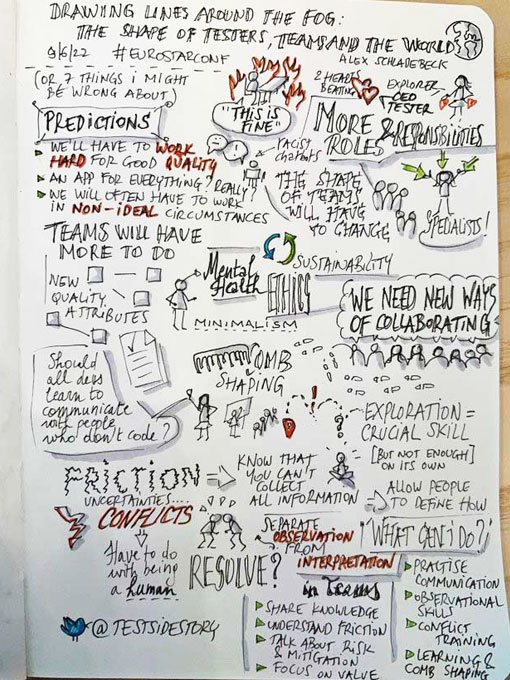
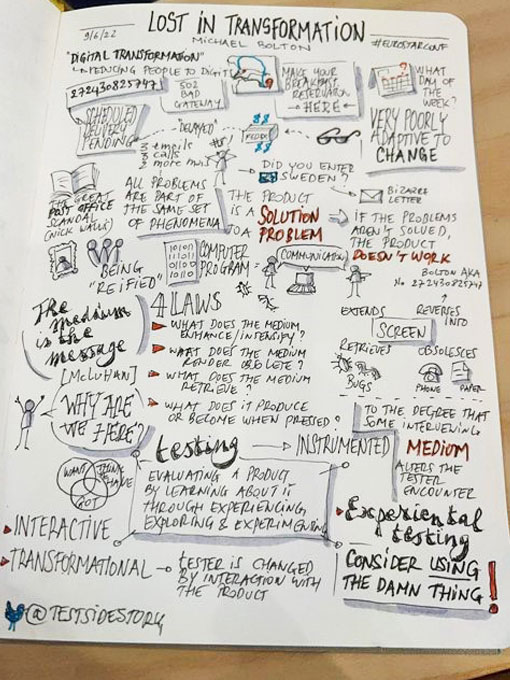
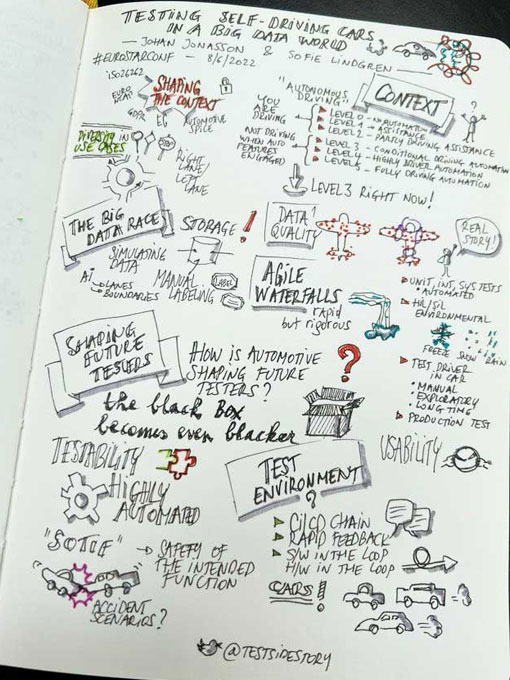
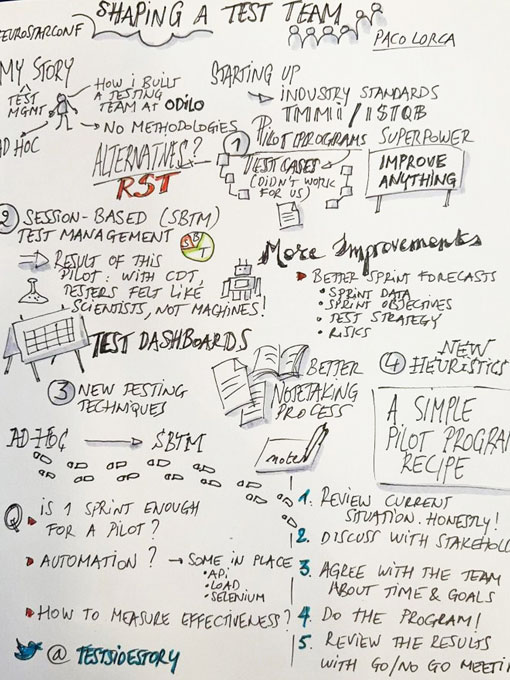
With 70 expert talks to choose from, attendees were spoilt for choice. There was even a thread on the conference app discussing how hard it was to choose between talks! Thank you to each and every one of our speakers – we’ve received some incredible feedback on your sessions. If you missed them, Zeger Van Hese curated some wonderful sketchnotes of some of the talks at EuroSTAR and our attendees posted lots of their highlights on social media using #EuroSTARConf – check them out. We will also be sharing blogs on EuroSTARHuddle.com with your questions answered. Rikard Edgren’s Keynote Q&A is now available.

Drawing Lines Around the Fog: The Shape of Testers, Teams and the World | Alex Schladebeck

The world is constantly changing, and everything is impermanent. After the last two years, we have been forced to come to terms with how quickly and drastically things can change. How will external changes shape our teams and our work? Alex looked at what factors are at work now, and what kinds of effects they will have on how we work, and the roles of testers and software professionals.

Lost in Transformation | Michael Bolton

More and more organizations are taking on “digital transformation”, leaning on software and machinery to perform jobs, make decisions and solve problems. The reach of what machines can do is extended by technological advancements, growing bodies of data, and by human ambition. As software changes, our testing has to respond. Michael Bolton shared what you need to address when going through a digital transformation.

Testing Self-Driving Cars in a Big Data World | Johan Jonasson and Sofie Lindgren

The competition in the automotive industry is fierce, and everybody wants to be the market leader in autonomous driving. Johan Jonasson and Sofie Lindgren shared the skills necessary for an AI and machine learning driven future, along with how to win the autonomous vehicle race, and the role Big Data plays in developing the next generation of autonomous vehicles, as well as similar industries.

Shaping a Test Team | Paco Lorca

To develop the next big thing, start-ups and and new IT companies will be creating one or more agile teams from scratch.  Paco Lorca talked through the challenges of setting up a test team from scratch, why industry standard procedures don’t always work in your context, and why exploratory testing and excluding traditional test cases may be a good thing to consider.

EuroSTAR 2022 Awards

We had an amazing Awards Evening at the spectacular Wallman’s Circus – it was a night full of fun, dancing, music, acrobats, great food – and of course, award winners. The EuroSTAR 2022 Testing Excellence Award went to Anne-Marie Charett, who joined us via video link from Australia to accept. This is the highest honour bestowed by our community, and we are thrilled for Anne-Marie.

Kimberly Snoyl is the 2022 RisingSTAR Winner, which you can read all about on EuroSTAR Huddle. In addition to the Testing Excellence Award and RisingSTAR Award, we also celebrate our EuroSTAR speakers with conference awards. Best Tutorial went to Rik Marselis, while Lalitkumar Bhamare won Best Paper. The Best Paper will be released as an eBook on EuroSTARHuddle.com this month – keep an eye out!

Sophie Küster’s talk ‘You Don’t Talk about THAT at Work‘ was the most highly rated track talk of EuroSTAR 2022 and she claimed the coveted Do-Over Session on Friday afternoon. Talking about mental health is so important and we are glad to see Sophie’s talk getting this recognition by the EuroSTAR attendees.

Community Spirit

EuroSTAR 2022 highlights - speaker couch session

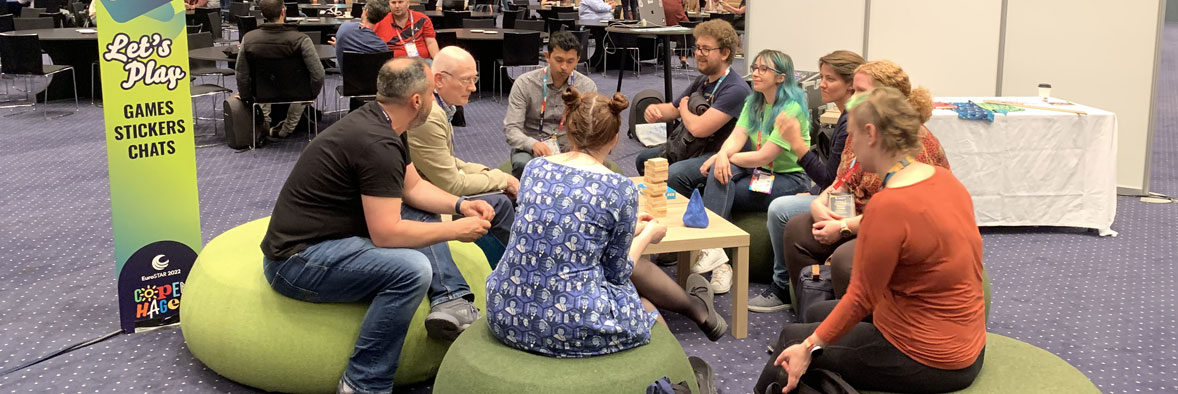
The Huddle Community Area was buzzing throughout the conference as everyone gathered in between sessions to chat, participate in games and challenges, and join some of our speakers at the speaker couch sessions. Thanks to everyone who joined in and embodied the conference community spirit. Fun fact – there were 13,868 messages sent via the app during the conference!

EuroSTAR 2022 highlights - volunteers

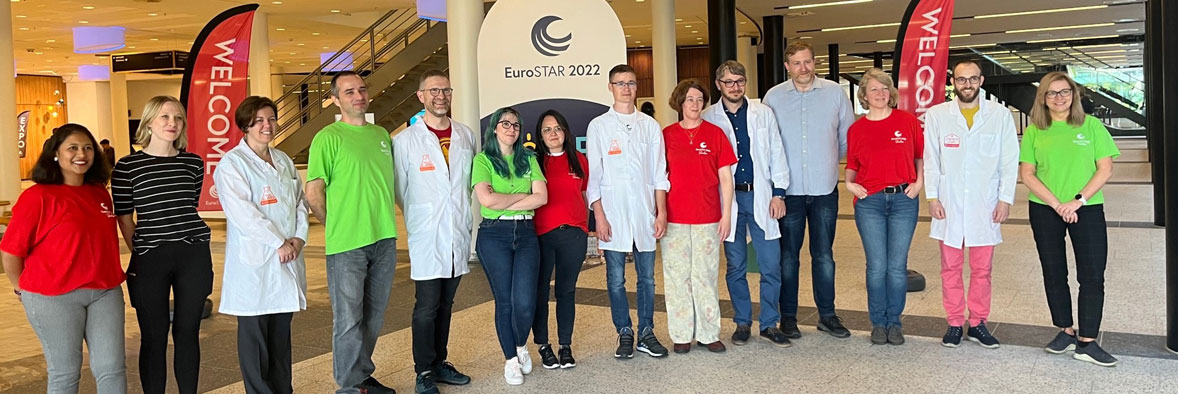
Of course we couldn’t talk about the community without mentioning our talented volunteers, who helped make the conference so amazing! They led the Community Huddle Area, assisted in sessions, and were on hand to help delegates with questions and photos! Thanks to everyone involved for their dedication and hard work.

Thank you to our Programme Committee

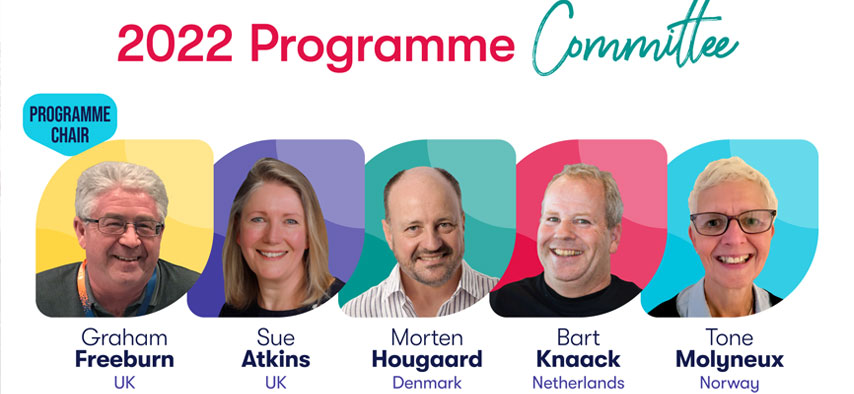
A massive thank you to our EuroSTAR 2022 Programme Committee; Graham Freeburn, Sue Atkins, Morten Hougaard, Bart Knaack and Tone Molyneux, for curating such a stellar programme of talks, and for bringing a wonderful mix of speakers together for us all to learn from. It was a truly special 30th EuroSTAR Conference.

Thank you all

We are truly blown away by how amazing our 30th conference has been. We’ve already received so much great feedback and kind words from delegates on how awesome it was! Thanks to everyone involved in this year’s conference, you made it very special, and we can’t wait to do it all again with you next year. See some of the photos uploaded by our attendees in the collage below.

We leave you with another heart warming comment from one of our attendees – this is what EuroSTAR is all about!

An incredible experience like never before in 1.5 decades of my QA career! An incredible opportunity to network, meet and share QA experiences with versatile test professionals in person! Interesting discussions, loads of fun & lots of food with fellow QA colleagues!”

Sudarsan Suriyanarayanan, Sweden 
A selection of the photos uploaded to the EuroSTAR App by conference attendees.

Filed Under: Uncategorized

Software testing platforms – the X factor in QA teams’ advancement

June 13, 2022 by Fiona Nic Dhonnacha

Thanks to Armando Wirshing, Director of Product Marketing at Katalon, for providing us with this blog post:

A common dilemma in software development is how the work of quality engineers, or testers, is often considered as simple as authoring automation and running it repeatedly. This notion is outdated and harmful to implementing a sustainable, end-to-end software quality process.

Establishing a cross-functional approach for QA requires capabilities that mirror and complement DevOps methodologies. Perhaps this is why over the past few years, some have coined the term DevTestOps. In reality, it’s more akin to how security takes part within the DevOps or software development pipeline and stands apart to provide another layer of independent validation to the process. Similarly, testing teams must cohesively support software development pipelines and provide independent validation and oversight.

Development teams use tools such as GitLab, Jira, etc., to plan, organize, and enable their processes. Operations teams leverage Splunk, ELK, AppDynamics, Datadog, etc., to monitor, analyze, and report on operations. Quality teams, unfortunately, have historically not had the benefits of a quality-focused platform to perform both core tasks and automate reporting and analysis. They often have to employ DIY tactics to their end-to-end quality platform, thereby reducing the overall value of their tool due to the amount of technical debt created by the DIY approach.

Experts know that CI/CD or DevOps is unattainable without test automation. Yet many teams struggle to implement true automated testing beyond unit testing within limited frameworks, leaving the vast majority of testing to continue manually.

Test automation, in general, is challenging, and test planning, authoring, maintenance, management, execution, and reporting/analysis all present individual challenges as quality teams level up in their maturity models. Fortunately, recent advances in testing technology are addressing many of those factors. However, teams must find the most practical tool or platform that fits the budget constraints and integrates seamlessly into the existing tools and services in the CI/CD or DevOps pipeline.

Quality organizations can learn from the DevOps industry usage of platforms that have key functional and reporting capabilities while enabling collaboration and integration into the software development pipeline. The following presents the key features and value of a modern test automation platform that delivers speed, scale, and value to QA teams and the business.ng

Essential features of a test automation platform

1. Automation and authoring

Ease of use and adoption

Creating a solid foundation of automated tests will ensure scalability and quality as the product expands. Two critical criteria to achieve this are effortless operation and flexibility in test scripting Amode. As teams typically consist o testers with varied experience in coding, test automation platforms should include advanced script creation functions for testers with strong coding skills and easy-to-learn low-code scripting modes. With every team member involved, the team’s overall capabilities and collaboration will significantly improve.

Low Maintenance and robust automation

The additional rework of some automated testing tools adds to the overall cost of automation maintenance. The platform should include “smart healing” capabilities that increase text execution quality and overall testing efficacy. These capabilities help eliminate false positives and reduce overall testing flakiness.

2. Orchestration and optimization

Centralized planning and self-service scheduling

A centralized testing calendar is necessary to smoothly organize and plan testing activities across all platforms and projects within an organization. For this reason, the tool should come with a built-in UI that gives all quality stakeholders, whether quality teams, software, or product teams, ownership of scheduling, scaling, and planning.

Operational reporting

Options to reduce testing time by running tests in parallel or adjusting test scheduling to allow emergency release is possible with effective reporting and visibility. A centralized command and control view of the process should enable such flexibility.

Software testing platforms  - visibility and understanding across testing and DevOps

3. Insights

Visibility and understanding across testing and DevOps

Effective quality processes start with collaboration across stakeholder teams. By incorporating intelligent and relevant insights into standard reports, a shared understanding of quality status is set from the organizational level to the individual project or build

The quality platform should integrate automated real-time reporting that generates insights on data from both quality activities and CI/CD pipelines. Data from Git repositories, test results, and project management tools can be centralized and analyzed for flakiness, requirements coverage, and release readiness across all projects and releases.

Actionable insights from AI

The industry is rapidly adopting AI reporting to gain more advanced insights into code coverage, test prioritization, release readiness, etc. Actionable insights generated by a proficient AI-infused reporting tool reduce analysis across data points and enable rapid decision-making. With AI-based analytics and insights, every decision that impacts the quality of your software will be more informed and decisive.

4. Scale

Multiple options for test execution

Having both on-premises and cloud environments is a must-have for organizations to be agile and address the changing demands of software delivery. Having multiple options for execution, whether on-prem or in the cloud with on-demand SaaS solutions, means your critical software deliveries will never be constrained by test execution capacity. Contrarily, using a tester’s environment to create and execute tests limits your ability to scale.

User platform coverage

An equally important capability alongside multiple environments is the ability to support the plethora of browsers, OSs, and available devices that end users leverage. This is further complicated by the variety of versions of each browser or platform. Not only do your IT or DevOps engineers need to keep up with new releases, but also some number of “N – x” versions that continue to be used.

Ability to support huge upsurge of workload

Large enterprises benefit from having a platform that allows instant scalability and parallel testing to maintain matching capacity without disrupting the release timelines of the business. In the case of a sudden upsurge in test capacity demand, a cloud-based QA platform comes in handy as it can satisfy rapid increases in demand for test execution

Unified world-class support

Even a minor issue can slow down your entire workflow and negatively impact the business. Having a single platform with a global community and 24/7 professional support from skilled staff can make a world of difference and yield long-term business success.

Author

Armando Wirshing, Director of Product Marketing at Katalon, Inc

Armando has extensive experience in the technology field, ranging from software supply chain, CI/CD, ITSM, Cloud Hybrid, to DevOps, Agile, Automation. His career has spanned from Mainframes to Cloud, Development to Operations, Delivery to Sales. He is dedicated to empowering teams and businesses to overcome challenges and in turn celebrate success

Filed Under: EuroSTAR Conference Tagged With: software testing tools

EuroSTAR 2022 kicks off tomorrow!

June 6, 2022 by Fiona Nic Dhonnacha

Since 1993, we’ve been bringing testers together at Europe’s largest software testing conference. That’s 30 years of expert talks and sessions, sharing new ideas, and forming thousands of friendships.

This year, we’re having an extra special celebration as we mark 30 years of the software testing community! We have 70 sessions from 70 incredible speakers, and a global community of testers. It’s all here, and it starts tomorrow – we can’t wait.

It’s not too late to get your ticket and join us – book right NOW and choose from 1, 3, or 4 day tickets.

get tickets

5 reasons to book your ticket now

Join a global community

It’s been two years since we met up with the software testing community in person, and we couldn’t be more excited to see everyone again, live in sunny Copenhagen! We’ll have lots of opportunities for you to make new friends, reconnect with some old ones, and expand your network. Every day, you can meet over coffee, converse in the Huddle area, & collaborate in tutorials. You’ll also get to enjoy the EuroSTAR at Night networking events – relax with drinks and conversation at the EXPO Community Networking party on Wednesday, and celebrate the best of the software testing community at the Gala Awards Night on Thursday.

Skyrocket your testing

The EuroSTAR programme is packed with talks from Europe’s testing trailblazers. Enjoy inspiring keynotes, tutorials, & track talks to get creativity flowing, with lots of actionable ideas to take home. Learn how to shape your testing with the best test design techniques, improve your testing abilities by uncovering your biases, learn how to develop your critical thinking skills, scale your team successfully, and LOTS more.

A group of EuroSTAR attendees at a tutorial

Solve testing challenges

Bring your toughest questions to our testing experts: our community loves a challenge, and you’ll connect with peers who have faced similar obstacles. Attend our dedicated Test Clinic for 1:1 help from our test doctors – they have a 100% success rate! Here are just some of the questions they’ve helped answer:

  • How do I set up a mobile device lab? What tools would you suggest?
  • How do I improve my influence over my managers?
  • How do I build in performance testing into my scrum teams definition of done?
  • Are there any tips to help improve working in a distributed team?

Strengthen your team

EuroSTAR is made for teams: boost your team’s performance, learn new skills, solve problems together, and of course – bond as a group. Share the learnings by splitting up and attending talks based on different skills and knowledge. We have incredible offers for groups – it’s your last chance to get your team together at Europe’s best testing event! Check out team offers here.

Discover new tools

Stay on top of what’s coming next in testing tools, check out the demos, and add new processes to your testing toolkit by visiting the EuroSTAR EXPO. It draws some of the biggest companies in the world! Of course, this means there’s lots of prizes and swag up for grabs as well.

It’s all happening at EuroSTAR 2022 in Copenhagen – see you there!

Filed Under: Uncategorized

  • « Previous Page
  • Page 1
  • Page 2
  • Page 3
  • Page 4
  • Page 5
  • …
  • Page 15
  • Next Page »
  • Code of Conduct
  • Privacy Policy
  • T&C
  • Media Partners
  • Contact Us

part of the