• Skip to main content
EuroSTAR 2027 - Sign up for early access

EuroSTAR Conference

Europe's Largest Software Testing Conference.

  • Programme
    • EuroSTAR Global Series
    • Call for Speakers
    • 2026 Programme
    • Community Hub
    • Awards
  • Attend
    • Why Attend
    • 2026 Photos
    • Bring your Team
    • Testimonials
  • Sponsor
    • Sponsor Opportunities
    • Sponsor Testimonials
  • About
    • About Us
    • Our Timeline
    • FAQ
    • Blog
    • Organisations
    • Contact Us
  • Book Now

EuroSTAR Conference

EuroSTAR 2021 Day 2 – Sketchnotes

September 30, 2021 by Ronan Healy

Woohoo, finally it’s that time of the year again – the EuroSTAR Conference is on. This year it took place as an online edition which gave people from all around the world the opportunity to take part in this amazing conference without needing to travel during the pandemic times.

Although it is an online edition, there was plenty of space to meet other attendees. You could do a speed meet sessions and talk to someone randomly for 3 minutes. You could join a lean coffee session and discuss interesting topics. You could get solutions to your problems from the Test Clinic. Or you could check out the demos of the sponsors and stroll through the Expo area.

The Programme Committee around the Programme Chair Fran O’Hara made an amazing job when choosing the speakers for this year’s edition and you could listen to talks from different areas of testing, speakers with different backgrounds and from different cultures. Let me summarize my first day at the EuroSTAR Conference 2021 by using my sketchnotes.

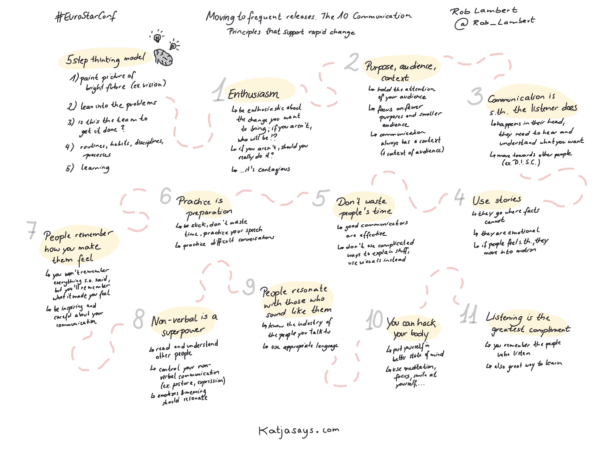
Moving to frequent releases. The 10 Communication Principles that support rapid change.

Rob Lambert
The first keynote of the day was held by Rob Lambert. Rob started by explaining the 5 step thinking model. First, you paint a picture of the bright future (like a vision). Then you lean into the problem and ask if the team is the right one to get it done. Afterwards it’s all about routines, habits, disciplines and processes, and finally there is a lot of learning.

He then talked about the 10 (+1) Communication Principles to support rapid change. These are:

  1. Enthusiasm
  2. Purpose, audience, context
  3. Communication is something the listener does
  4. Use stories
  5. Don’t waste people’s time
  6. Practice is preparation
  7. People remember how you make them feel
  8. Non-verbal is a superpower
  9. People resonate with those who sound like them
  10. You can hack your body
  11. Listening is the greatest compliment
Moving to frequent releases - the 10 Communication Principles that support rapid change

Quality is not about testing … it’s about value!

Gitte Ottosen
Gitte thinks that is not that easy to define what quality is, as it doesn’t mean the same to everybody. It is the value to some person, at some time, who matters. So you have to find out who the people that matter are.

More important, you have to think about what value means to you and get a common understanding throughout the whole team. You can do so by using the VOICE Model: Value, Objectives, Indicators, Confidence, Experience. As value is time dependent, you have to think about what you want to get out of the things you do right now – this will change over time.
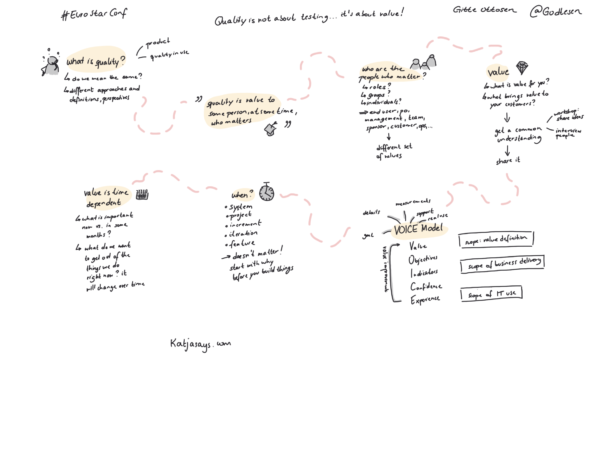
Quality is not about testing - its about value

5 myths and anti-patterns to refactor out with continuous performance

Paul Bruce
Nowadays, organizations want to deliver things quickly. They run into a more continuous future where they do smaller releases more often and share knowledge along the way. This only works if continuous performance feedback is given.

Paul used 5 myths/anti-patterns to explain how to get to having a continuous performance mindset:

  1. Prohibite Ubiquity
  2. Expedited Gridlock
  3. Mandated Ignorance
  4. Escape Philosophy
  5. Predictable Unreliability

Have a look at my sketchnote to learn more about the mantra and possible actions for each anti-pattern.
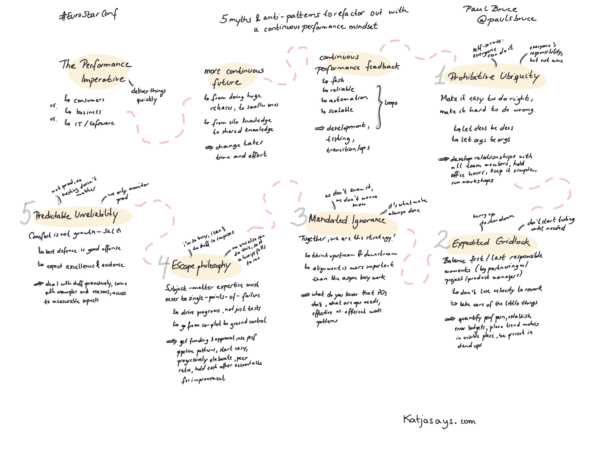
5 myths and anti-patterns to refactor out with continuous performance

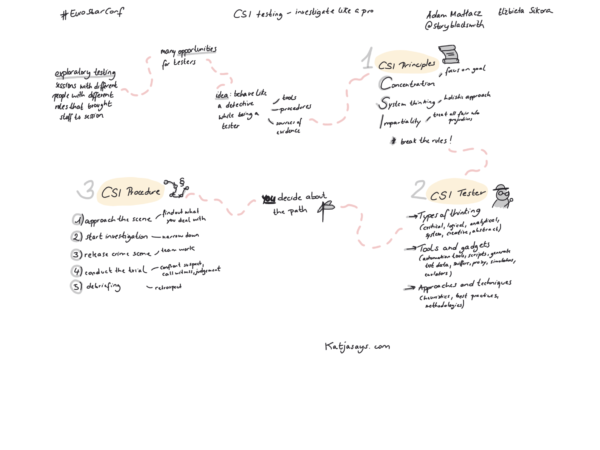
CSI testing – investigate like a pro

Adam Matlacz & Elzbieta Sikora
Adam and Elzbieta think that exploratory testing brings many opportunities for testers, especially when the sessions are held with people with different roles. While being a tester, you can behave like a detective when you are on a bug hunt. That’s how they came up with CSI Testing.

The CSI Principles are: Concentration, System thinking and Impartiality (+ break the rules). Focus on a goal, use a holistic approach and treat all fair without prejudices. A CSI Tester should build skills around different types of thinking, tools and gadgets and approaches and techniques.

The CSI Procedure would look like that:

  1. Approach the scene: Find out what you deal with
  2. Start investigation: Narrow down
  3. Release crime scene: Team work
  4. Conduct the trial: Confront suspects, call witnesses, judgement
  5. Debriefing: Retrospect
CSI testing - investigate like a pro

Lightning Strikes

Lightning Strikes are short talks of 5 minutes in which 2 slides are allowed. This year there were 8 speakers who were giving a lightning talk.

Lightning Strikes 1

Tariq King, Sanne Visser, Rob Meaney & Elise Carmichael
Tariq thinks that the world is full of bad software and by filling AI & ML systems with bad data and biases, the problem is being made even worse. By testing your software and using a holisitic approach, you can unlock a revolution and make a difference.

The essence of Sanne’s talk is, that you should always remember that there are different ways to get to where you want to get and that you should take a look around and think outside the box to not get stuck on the way things should be.

Rob shared two philosophies with us: Seek problems, solve problems share lessons, which is basically about sharing what you’ve learned with everyone and working in a holistic matter to enhance quality. The other one is: Fewer, smaller things together – which means fewer as in the variety/volume of work, smaller as in slicing things down more and together as in cross-functional teams that start and finish together.

Elise thinks that next to maintaining, analyzing and creating tests there is a huge portion of test debt, a backlog of work not done. She thinks that flipping the test pyramid upside-down helps you to refocus on the customer’s experience and therefore also reducing some of this debt.
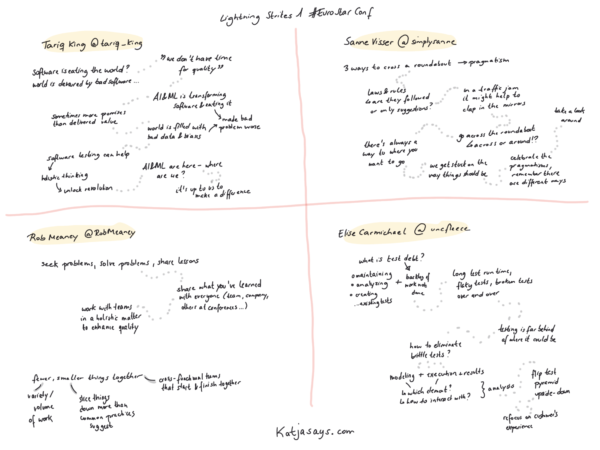
Lightning Strikes 1 EuroStarConf

Lightning Strikes 2

Raj Subrameyer, Dawn Haynes, Chris Armstrong & Sowmya Ramesh
Raj compared pre- and during covid work to each other and found that from having onsite interviews, working from home as a luxury, limited virtual meetings and mandatory travel it all transfered to no onsite interviews, work from home as a necessity, virtual meetings as a normality and travel not existing any more. This leads to a huge change in the future of work in which a social media footprint, personal branding, remote working, going the extra mile and re-tooling your skillset become crucial.

Dawn’s approach to finding and hiring awesome testers is usins these attributes of a CRACK tester:

  • Curious
  • Resourceful
  • Adaptable
  • Creative
  • Knightly

In short, Chris’ talk is about not overlooking any rules when doing test automation. A small mistake as letting someone and not the whole team decide on which tool to use might turn into a huge problem.

Experimentation is pivotal to success. Sowmya encourages us to be open to changes, so that we don’t lose any opportunities. But while experimenting, you should not forget to do extensive research, monitor and measure, improvise as required, document the lessons learned and implement with confidence.
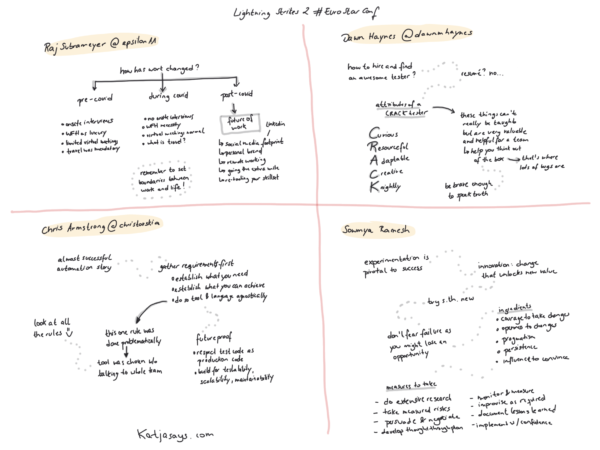
Lightning Strikes 2 EuroStarConf

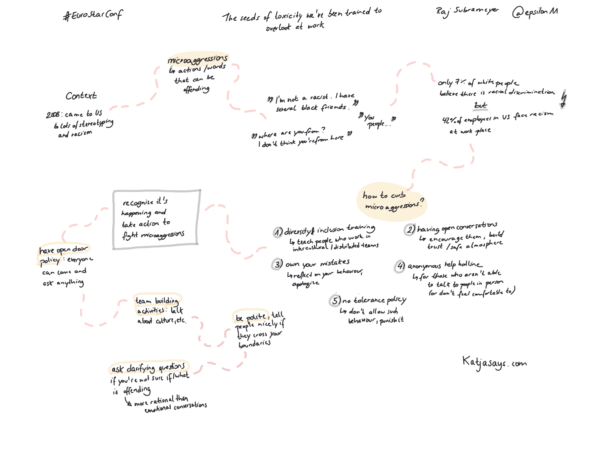
The seeds of toxicity we’ve been trained to overlook at work

Raj Subrameyer
Raj has been dealing a lot with stereotyping and racism himself – mostly microagressions (actions/words that can be offending). He discovered that those often appear at work places and should definitely be fought. He has 5 proposals on how to curb microagressions:

  • Diversity & inclusion training
  • Having open conversations
  • Own your mistakes
  • Anonymous help hotline
  • No tolerance policy
The seeds of toxicity we ve been trained to overlook at work

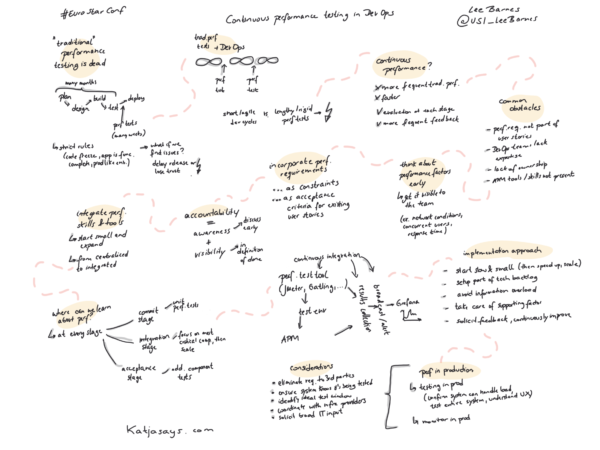
Continuous performance testing in DevOps

Lee Barnes
Traditional performance testing, which often comes too late and takes too long, is dead. Continuous performance, which means evaluation at each stage and more frequent feedback, is uprising. But you have to think about performance factors early on in your development process. Incorporate the requirements as contraints or/and as acceptance criteria for existing user stories.

Lee advises us to start small and expand to move from a centralized to an integrated performance team. Gather feedback and continuously improve.

Testing and monitoring in production is important, but don’t forget to consider to:

  • eliminate requests to 3rd parties
  • ensure system “knows” that it’s being tested
  • identify an ideal test window
  • coordinate with infrastructure providers
  • solicit broad IT input
Continuous performance testing in DevOps

The journey of testing software for DNA analysis

Aprajita Mathur
The last keynote of the day was held by Aprajita Mathur. She was talking about testing software for DNY analysis. The standard workflow for analysis of genome sequence data is:

  1. Alignment
  2. Reference Genome
  3. A) Somatic or B) Germline variant calling
  4. Variant filtering & annotation
  5. Data visualization & reporting

Machine learning applications help testing and can be supervised, unsupervised or predictive. While testing – also called Bioinformatics Analysis Pipelines – keep in mind:

  • Statistical models are used
  • The models are trained on data sets
  • The model is as good as the data or worse
  • You aren’t testing the exact output, but expected behaviour
  • You have to test in different situations
  • There are lot of changes, which lead to complexity, but also exploration and fun

Between testing software for DNA analysis and “normal” software testing there are a lot of common grounds. But to DNA analysis, there are also some challenges as Gold Standards, domain knowledge, population genomics and that nature always has its way.
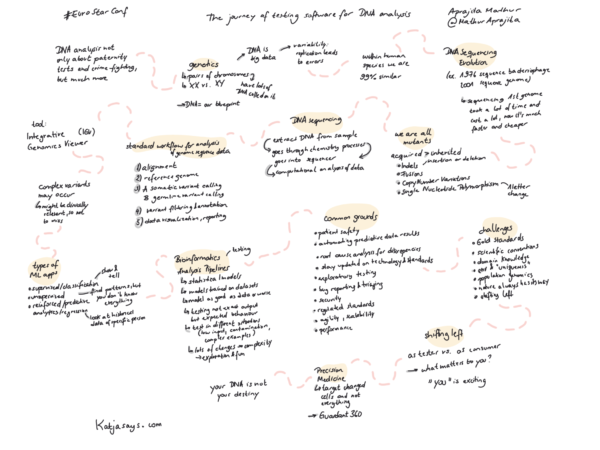
The journey of testing software for DNA analysis

As you can see, on the first day of EuroSTAR 2021 there were a lot of different topics already. From communication principles over performance testing and racism at work to testing software for DNA analysis – that’s what I call a huge variety. And there are so many talks that I haven’t attended and might re-watch after the conference.

About The Author

Profile Photo

Katja Budnikov is a software tester and sketch noter from Northern Germany. Katja is passionate about software testing and sketch noting! She loves attending events like EuroSTAR and sharing her experience and learnings with others on her blog Katjasays.com. Katja first started sketchnoting in 2016. First analogue with pen and paper and now digitally with an iPad and Apple Pencil.

In her work life Katja started out in online marketing, then specialized in search engine optimisation and is now a quality assurance specialist in both manual and automated software testing. Away from work Katja loves photography, especially taking photos of nature, including many of her dog Auri, a young Australian Shepherd, who is super cute and fun to take photos of. She loves to spend time with her dog and partner, going out for walks, traveling and eating cake at a nearby coffee shop with a beautiful garden.

Filed Under: EuroSTAR Conference Tagged With: EuroSTAR Conference

EuroSTAR Pay it Forward Initiative

July 13, 2021 by Fiona Nic Dhonnacha

At EuroSTAR, we believe in learning, and we know that our incredible community gets even better with different perspectives.

We love to welcome attendees from many different organisations and have been working on new ideas for collaboration. Enter the EuroSTAR Pay it Forward Initiative: to support those in education, whether studying or teaching, and give them an opportunity to connect with the global testing community at this year’s EuroSTAR conference.

How does it work?

It’s simple. From now until 31st July, for every booking made – we’ll sponsor an additional free ticket for a student of software testing to attend EuroSTAR & learn with our amazing community.

This means, thanks to YOU, a tester in the making will join us in September, to nurture their career, deepen their learning, make connections, and enrich our community. You can feel good knowing you are paying it forward! 

We’ll distribute these Pay It Forward tickets via universities and local software testing special interest groups. Let us know if you would like to recommend a university or individual student.

So get involved – Get your ticket today, and help our future testers grow and learn.

BOOK TICKETS

Filed Under: EuroSTAR Conference, Virtual Conference Tagged With: EuroSTAR Conference, Learning

Tips for Preparing an Online Talk

June 16, 2021 by Suzanne Meade

Speaking in front of an audience can be daunting and thrilling at the same time. There are many ways to become a better speaker or perhaps you are a great speaker and looking to fine tune your skills. Over the past year, speakers all over the world came to grips with virtual talks and began adjusting their approach to online. In November we hosted the very first EuroSTAR Online and it was awesome! Everyone learnt so much, both the attendees that joined us and the speakers who were giving virtual talks, a new experience for many!

This year, EuroSTAR Online is back and taking place 28-30 September. We are welcoming 57 speakers from 14 different countries and will be organising community sessions throughout the conference which will bring even more speakers to the virtual EuroSTAR stage.

A number of experienced EuroSTAR speakers have come together to share their top tips for preparing for your talk. We hope these help you!

Keep it short, keep it focused.

I know that all your ideas are totally brilliant, but you really do only have 20 minutes to get one idea across and embedded into your audience’s minds. With a typically tight schedule and an abundance of interesting information, you will need to be tactical about this.

Try this: Put each point you have onto a separate, rough slide, then practice talking through each slide. You will run over the 20 minutes. Now, think about your one central message, that one idea you need inside people’s minds at the end. Ask yourself – is the point on this slide absolutely necessary to that message? If not, ruthlessly cut that slide out. Also, cut it out, don’t trim it down, hoping that you can briefly cover this plus a myriad of other points. You most likely can’t.

If you think it tough to get your idea over in only 20 minutes, have a look at a few of the totally brilliant TED talks for inspiration; none of which are longer than this time.

The above tips are provided by Andrew Brown of Expleo. Check out Andrew’s talk on Software Quality and Human Factors – our next challenge at EuroSTAR 2021

Your talk is a distillation of your knowledge.

In general for presenting: Your presentation is a distillation of what you know. Remember you have a story to tell, which needs to be gripping. But to tell your story – to make the distillation – you need to know the back-story. In other words, you have more material in your mind and your notes than you will present, because you won’t have time. Having that background will help you tell your story. Writing a paper can give you the chance to expand on your ideas. Think how J K Rowling built up a whole world: her notebooks have details that didn’t make it into the books, and the books have details that didn’t get to the films.

Take time to set up your recording location.

For speaking on-line on zoom: Take a few minutes to get set up, as people are going to have to look at you and your backdrop for the duration of the talk. Check your camera angle, background, appearance before you start – for example if this is a zoom meeting, you can check your set up before the meeting by having a zoom meeting by yourself to see what you look and sound like. Plain background, and check there is nothing that shouldn’t be visible in the broadcast. Raise your laptop/device up so it is level with your face (I put my laptop on a shoe box) – then you won’t be filming the inside of your nose. Lighting from the side and front, not from the back, gives a good light to your face.

Isabel Evans provided the above tips and you can check out Isabel’s talk on Who are we? What are we doing? How are we doing it? at EuroSTAR 2021.

Imagine your talk is a Q&A.

Many speakers are much better in Q&A than presenting their topic from prepared slides, so turn this to your benefit: Imagine your talk is a Q&A and think about what questions your audience would ask. Structure your talk in a way like you would answer these assumed questions. You can even show or say out loud the question you are going to address as a kind of section intro. This way you can ensure that your talk will be more relevant. When you record/present the talk, imagine a person behind the camera as one who was asking the questions – it will appear more natural both for you, and also your audience.

Gáspár Nagy is a coach and trainer with Spec Solutions. Check out Gáspár’s talk on Living Documentation with BDD: Structure, Consistency, Traceability at EuroSTAR 2021.

Keep it Simple

Don’t try to squeeze too much in! I was really challenged with the shorter 20-minute time that works best for online talks compared with the usual longer 40 minute in-person track session. I created a shorter presentation focused on fewer key points, took some notes, and did a dry-run or two on my own to ensure that I did not run over.

Practice

Do a couple of dry runs so that you are certain about what you want to say, how you are going to get your message through. The better prepared you are, the less focused on your notes during the presentation.

Stand Up!

If at all possible, stand up during your presentation 🙂 I found that I got more energy when I was standing up, and using my gestures as I would normally do in a physical presentation.

Gitte Ottosen (Key2Quality) won the EuroSTAR 2020 Best Paper Award. Check out Gitte’s talk on Quality is not about testing… It’s about value! at EuroSTAR 2021.

Everyone has their own approach to speaking and these are just a few helpful tips for giving an online talk. If you are attending EuroSTAR and wish to get involved in hosting a Community session then keep an eye on your emails this summer. We will release all details of how to get involved and would love to welcome you. We will also be hosting a free community event Testing Voices on 29th June if you’d like to attend.

In the meantime, check out the full EuroSTAR Programme and get in touch if you have any questions.

Filed Under: EuroSTAR Conference Tagged With: EuroSTAR Conference

Programme Chair Blog: Which day is best for me at EuroSTAR?

September 19, 2019 by Suzanne Meade

Our 2019 Programme Chair, Isabel Evans loves literature and poetry and has been giving her take on the upcoming EuroSTAR Software Testing Conference through the medium of haiku poetry. See more about the beackground and haiku in our earlier Programme Chair blog 

EuroSTAR has been bringing software testers together for 27 years. The conference is led by the testing community, the need for connections and conversations. Each year it is like a homecoming for many of the most influential testers in our industry as they catch up with their EuroSTAR family and also meet new attendees, equally passionate about software quality. There are more than 350 companies attending EuroSTAR each year, many come every year but sometimes the people change. We are always conscious of creating a welcoming space for new attendees and alumni to network and be inspired.

A regular question from new delegates considering their first software testing conference is ‘Which day would be best for me to attend?’. A great question and of course we would say all four days 🙂 .. but .. if you have less time available, we do have single day and 2.5 day ticket options available.

Take a look at the conference programme and see what talks stand out for you. There are lots of topics to choose from and so much to learn from each of the incredible speakers. Isabel Evans is also on hand with some short haiku poems to give you insight in each day at the EuroSTAR Conference.

SEE 2019 PROGRAMME

Why go to the conference on Monday?

Monday – Full day – learn!

Seven tutorials – choose!

Immerse, educate

Why go to the conference on Tuesday?

More Tutorials

Tuesday, and keynotes and talks

A full day learning

Why go to the conference on Wednesday?

Wednesday, so much

To share – talks, workshops, keynotes

Confer, Discuss, Learn

Why go to the conference on Thursday?

On Thursday, we have

Talks, workshops, keynotes. All great!

All day! Join us! Do!

We hope this helps give you an idea of each day and as a added guide we have included a synopsis below.

SEE TICKET OPTIONS

Day by Day Schedule

The EuroSTAR conference programme is jam-packed of exciting talks from expert speakers. There are lots of ‘corridor track’ events and EuroSTAR Extras so stayed tuned for each announcement – Sign up to the EuroSTAR mailing list and don’t miss a thing!

[/vc_column_text][/vc_column][/vc_row][vc_row equal_height=”yes”][vc_column width=”1/4″][vc_column_text]

Mon, 11 Nov.

6 Full Day Tutorials

Sit Down Lunch

Evening Pub Quiz

[/vc_column_text][/vc_column][vc_column width=”1/4″][vc_column_text]

Tue, 12 Nov.

6 Half Day Tutorials

1 Keynote Talk

8 Track Sessions

Lightning Talks

Expo Opens at Lunch

Tester’s Party

Community Dinner

[/vc_column_text][/vc_column][vc_column width=”1/4″][vc_column_text]

Weds, 13 Nov.

2 Keynote Talks

Next Generation Keynotes

16 Track Sessions

2 Workshops

Expo Lunch

Networking Drinks

Awards Night

[/vc_column_text][/vc_column][vc_column width=”1/4″][vc_column_text]

Thu, 14 Nov.

2 Keynote Talks

10 Track Sessions

3 Workshops

Expo Lunch

Prize-Giving

[/vc_column_text][/vc_column][/vc_row][vc_row][vc_column][vc_row_inner][vc_column_inner][vc_column_text]

[/vc_column_text][/vc_column_inner][/vc_row_inner][/vc_column][/vc_row]

Filed Under: EuroSTAR Conference Tagged With: EuroSTAR Conference, speakers

  • « Previous Page
  • Page 1
  • Page 2
  • Code of Conduct
  • Privacy Policy
  • T&C
  • Media Partners
  • Contact Us

part of the