• Skip to main content
EuroSTAR 2027 - Sign up for early access

EuroSTAR Conference

Europe's Largest Software Testing Conference.

  • Programme
    • EuroSTAR Global Series
    • Call for Speakers
    • 2026 Programme
    • Community Hub
    • Awards
  • Attend
    • Why Attend
    • Bring your Team
    • Testimonials
  • Sponsor
    • Sponsor Opportunities
    • Sponsor Testimonials
  • About
    • About Us
    • Our Timeline
    • FAQ
    • Blog
    • Organisations
    • Contact Us
  • Book Now

Lauren Payne

The Silver Bullet for Testing at Scale

August 21, 2023 by Lauren Payne

Thanks to Testory for providing us with this blog post.

Testing has always been a bottleneck in the development process. Since product teams often sacrifice time spent testing, the workload testers face ebbs and flows.

Your company’s testers most likely know what it’s like to work weekends and evenings when there’s a release coming up. At points like those, they generally have to take on low-level work to make sure they check everything and deliver a high-quality product. But that overworks them and leads to burnout.

Product teams often think about the silver bullet: how do you scale testing (increase capacity) instantly without just throwing money at the problem?

Before we answer that question, however, we should take a step back and look at the big picture. What challenges are inherent to testing?

Testing requirements by role

CTOProduct managerHead of testing
Faster time to marketYesYes–
Budget optimizationYesYes–
Product Quality for CustomersYesYesYes
Peak loads––Yes
Routine tasks––Yes
Variety of testing enviroments––Yes

Every role has its own problems. How do you solve them all at the same time?

A few years ago, we took a systematic approach to testing challenges, eventually coming up with a product for the largest IT company in our region. The solution married a variety of ML and other algorithms with traditional IT tools (Tracker, Wiki, TMS) and thousands of performers scattered across different time zones. That eliminated the bottleneck. With a dozen product teams online, they could scale testing or remove it altogether based on need.

On the one hand, we’re constantly improving our algorithms to give better feedback faster. On the other, our automated system selects professional testers who guarantee that same great result.

Another advantage our system offers is that it stands up well to load spikes around the clock rather than just during regular working hours.

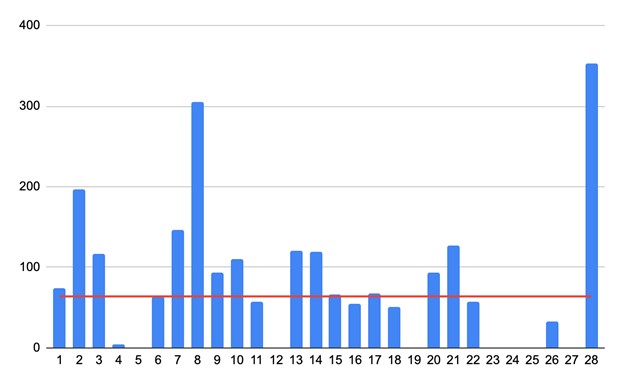
Let’s look at an example. In February 2023, a large customer handed Testory a process that included 2240 hours of work, 1321 of which were outside business hours.

As you can see on the graph, the load placed on testers was anything but even. There are a thousand reasons why that could be. Some peaks outpaced the capacity of a full-time team working regular hours, though expanding the team would have resulted in team members sitting around the rest of the time.

All that makes sense on the graph. The red line represents hours, with eight full-time employees sufficient to cover the total of 65. As you can see on the graph, the load was more frequently heavier, meaning that team of eight wouldn’t be up to the task, though there were also times were they wouldn’t have had enough work.

How does it work?

The customer embeds crowd testing in their development pipeline, calling the process from their TMS as needed and running regress testing in our product with external testers.

When they submit work for crowd testing, our algorithms scour our pool to select the best performers in terms of knowledge, speed, and availability, then distributing tasks so we can complete a thorough product test in the shortest possible time. We then double-check the result, compile a report, and send the report to the customer. That’s how we fit N hours of work into N/X hours.

The customer can scale up testing whenever they want, then scaling back and paying nothing when they don’t have work to do. It’s an on-demand service.

Performers enjoy an endless stream of work that’s perfect for their skill set in addition to some that pushes them to learn and grow. For our part, we offer testers special skill- and knowledge-based courses, stable payment that depends on how many tasks they complete, and the opportunity to work from anywhere in the world.

What’s the bottom line?

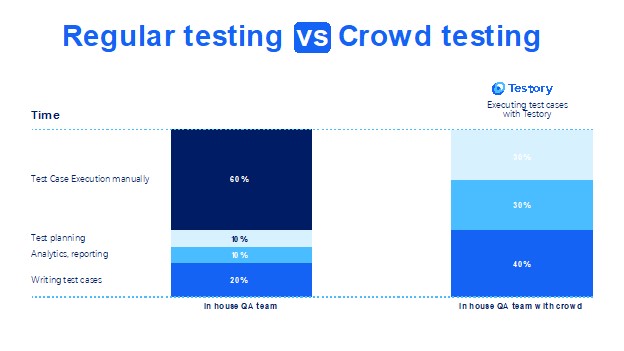
We free up resources our clients can rededicate toward interesting and higher-risk work, help out with peak loads, and streamline costs:

How can you get that for yourself?

Testory is a separate process and product born to help large companies. It’s for anyone trying to quickly deliver IT products that solve user problems. If you’re interested in leveraging our experience, get in touch, and we’ll build a roadmap for you.

Author

Mary Zakharova

Mary has been working with crowdtesting products for 6 years. She started her career as a community manager in a testers’ network.

In recent years, Mary has been in charge of the Testory product

Testory is an EXPO Exhibitor partner at EuroSTAR 2023

Filed Under: Software Testing, Uncategorized Tagged With: 2023, EuroSTAR Conference

How to Solve Your Recruitment Needs for Software Testers?

August 16, 2023 by Lauren Payne

Thanks to Talent2Test for providing us with this blog post.

The testing market is currently facing the same challenges as almost the entire IT industry. A lot of new projects are starting up, the challenge lies in finding the right profiles, with the right education for the right roles. Double match, win-win call it as you want. Often supplier and customer are fighting to get the upper hand in “winning the deal”: the best price, the best consultant,… and face each other’s agenda’s. These agenda’s prevent a smooth collaboration because one of both parties wants to win the deal.

From our years of experience in guiding and helping companies in their digital journeys, we developed a way of thinking that leads to a more profound collaboration. By noticing that, making a random match between request and offer is like flipping a coin, we decided to take the matter in our own hands and create a platform where both parties can meet each other and create a real win-win.

Our Answer to This Scarcity?

15 years ago, we started organizing classes for our customers. Throughout the years we started finetuning this setup and came to a format where the customer, the supplier and the consultant find the right way to go. Before the start we define the needs of the customer, what kind of profile do they need, which technologies do they prefer? Wat is the location of their offices? Based on this information, we start looking for possible candidates in collaboration with our brand “Cookie Crunchers”. The Cookies talk to the Juniors consultant’s and make a careful selection. The consultant does interviews with us as a supplier and with the customer to define if there is a match. We start the training, which is also a training based on the needs of the customer e.g. emphasis on manual testing, test automation…

Meet the friendly Carole, 23 years old, who decided this year: I want to delve into software testing. Today she is making waves as a software tester. How she achieved that, she is happy to tell!

A Leap of Faith

“During my studies Media & Entertainment I came into contact with a website for programming and front-end development, and this is where my love for IT arose. But after three years of studying, I just wanted to start working and gain experience on the job. On the advice of my aunt, I took the plunge and started applying for a job in IT without any degree or experience.”

Mission Accomplished

“Within two months I was allowed to start at a company as a functional software tester. I didn’t know anything about it, but I learned a lot in the process. Soon I felt like I could handle even more of a challenge. Quite coincidentally, I received a LinkedIn message from Merijn from Talent2Test: was I interested in a Software Testing Class? That’s how the ball started rolling.”

Software Tester of the Day

“After the class, I was able to start very quickly with a Talent2Test customer. I’m the only tester on the team so that takes a lot of responsibilities with it. It is a large, international company and there are many career opportunities. There is a lot of variation within IT and I speak English every day. I also have a very nice team that I can always turn to. When I started the Testing Class, I really wanted to go to automation, because I thought I had already seen the functional, but with my employer I really noticed that there are a lot of new functionalities and more involved.”

Career Boost

“I experienced the process at Cookie Crunchers very positively. The regular contact, follow-up and support; I had a really good feeling about it. There are also plenty of opportunities to follow training courses and take your knowledge to the next level. By starting at Cookie Crunchers, I now have so many more options and I’m glad I committed. The world of testing has opened up completely.”

Talent2Test – When Quality Matters

Want to know more about our junior classes? Are you looking for Software Tester? Or maybe you are a Software Tester looking for a new challenges or ways to improve your knowledge? Get in touch with Stijn, account manager.

a: Houtdok-Noordkaai 12, 2030 Antwerpen
m: +32 0497 64 10 25
e: Stijn.lekens@talent2test.be
w: www.talent2test.be

Author

Talent2Test

When quality matters, Talent2Test is your partner for software testing.

Talent2Test trains & supports and offer driven test engineers to help companies achieve the quality they need.

We have the flexibility of a local player, based in Antwerp. But also the ability to execute in an international environment. This due to the fact that we are part of the Nash Squared group.  

Talent2Test is an EXPO Exhibitor at EuroSTAR 2023

Filed Under: People, Software Testing Tagged With: 2023, EuroSTAR Conference

Test Automation Strategy – Everything You Need To Know

August 14, 2023 by Lauren Payne

Thanks to Solwit for providing us with this blog post.

Is it possible to implement test automation without a specific plan? What should a well-prepared strategy entail? In this interview, Michal Zaczynski, Software Testing Domain Expert, talks about the pros and cons of test automation and the benefits it can bring to businesses.

What are the short-term and long-term business benefits of automated software testing?

Business benefits can only be weighed by considering test automation, technology, and tools used in creating the product. Software testing always brings profits.

For a simple website without complex business logic, created using a popular platform, we can find out the results of automated tests even within a few hours using commercial automation tools. On the other hand, in the case of more complex test items and the multitude of automation tools or customized frameworks used, this time will significantly expand – even to 2-3 months.

Despite this, it is worth noting that this is not time wasted for business. The time saved by automated testing can be used to perform other, more complex tasks.

Among the most substantial long-term benefits is quick feedback on the quality of an application, the ability to test more often, releasing manual testers’ time resources, so they can focus on areas that still need to be tested, or the ability to repeat automated tests. All this leads to a significantly improved testing process and, ultimately, a higher quality product, assuming that the reported defects are remedied.

Is test automation required for all software projects, or are there situations where it is not?

No, it is not required, and there is no business case for doing so in many cases. This is particularly true for short-term projects, where automation can take longer than product development. Another example would include strictly hardware-related projects requiring manual actions, e.g., replacing a chip, rewiring expansion cards, etc. In this situation, the cost of setting up automated software testing equipment might be too high compared to the benefits. A project focused only on the graphical part of the application (UI), which changes.

Are there some criteria (maturity or otherwise) a company/project should meet to take advantage of software test automation?

That’s definitely an in-depth business analysis and defining realistic goals based on this that we would like to accomplish through software test automation.

Is an automation testing strategy always necessary, or can we do without it, and if so, why?

The test automation strategy should include, among other things:

  • defining the scope of automation and the level of testing,
  • defining the framework and tools for automation,
  • identifying test environments,
  • creating the tests themselves and running them.

It seems impossible to complete test automation by skipping any of the above steps. Even if you run a project that is very similar to the one already implemented, using the same technologies and resources, you still analyze the development possibilities subconsciously.

It is worthwhile to keep in mind that not having a strategy can also be a strategy.

What features should companies consider when designing an automation testing strategy?

These features are due to the steps included in the automation testing strategy, as defined in the earlier question. These are:

  •  Test type and level.
  •  The test team’s resources and skills.
  •  The desired features of the framework and automation tools (how they will be run).
  •  The purpose of test automation.

How do you know your automation testing strategy is actually effective?

A strategy is appropriate when it achieves defined objectives with an acceptable ROI. In light of these two pieces of information, we can say without a doubt that the automation path chosen is the right one.

What best practices or trends are you witnessing in the software testing automation field?

The context of recent trends suggests that many tools are adopting AI and taking a codeless approach to capture the market. Although they haven’t yet dominated the market, they are certainly growing in popularity. Their high license costs hinder their use, often linked to the number of automated tests created. It would also be worth mentioning the Playwright framework (open source), something the testing community has been hearing more and more about.

Many good practices exist, but they can all be combined into one – treat test automation like any other development project, following the same principles. This approach eliminates the need to re-solve old and familiar problems when developing applications or writing automated tests.

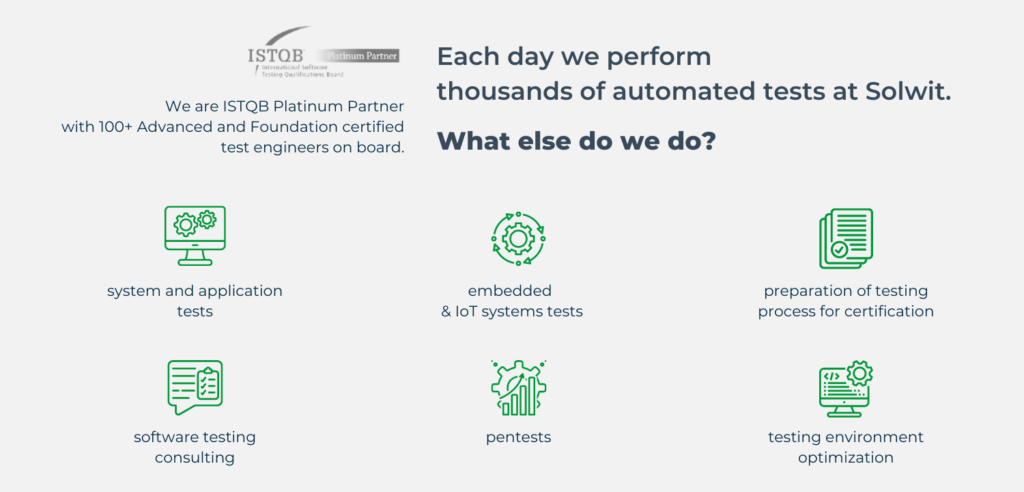
If you are seeking a technology partner to test your software, get in touch with us! We have successfully completed many projects that required the execution of automated tests, the choice of the right type of tests, the selection of the right tools, or creating them from scratch. We will be more than happy to tell you how to get it done. Set up a free consultation!

Author

Michał Zaczyński – Software Testing Domain Expert

Michał Zaczyński – has been with Solwit for over ten years. He’s a flesh and blood tester – his experience includes Quality Assurance activities, work with IEEE/ISO standards, and supervision of test projects. In his view, a competent specialist combines practical experience with theoretical understanding, seasoned with a dash of “that something” one must possess.

Solwit is an EXPO Exhibitor at EuroSTAR 2023, join us in Antwerp

Filed Under: Test Automation Tagged With: 2023, EuroSTAR Conference

Smarter Test Automation

August 9, 2023 by Lauren Payne

Thanks to Anne Kramer, Global CSM at Smartesting for providing us with this blog post.

Why did the smart tester refuse to use manual testing methods? Because they didn’t want to be called “dumb testers”!

This joke created by ChatGPT sums up well the prevailing spirit in software testing. To reach the goals, which are better products, cheaper tests and faster delivery, most organizations rely on test automation. But is this smart?

Yes, it is. However, it’s anything but smart to drive very fast with your eyes closed and that’s exactly what happens in many cases. People are automating come hell or high water, without really questioning how useful the tests actually are. In the end, automated tests can be repeated ad infinitum, and we are surprised that they still miss numerous defects. We are on the racetrack, but we are going in circles.

Similar to a car trip, test automation also needs a plan where to go. Test automation requires smart test design.

Shift Left!

A commonly accepted way to strengthen QA in general and test design in particular is Shift-Left Testing. Today, testing early and often is generally considered as being a good way to reduce risks, costs and to improve quality. The earliest possible time to consider testing is at the beginning of development, when requirements are defined.

This is how Acceptance Test-Driven Development (ATDD) came up. Test scenarios serve as specification by example and replace detailed requirements descriptions. Behavior-Driven Development goes one step further and facilitates automation through the semi-formal Gherkin syntax. The user story’s acceptance criteria are directly described through acceptance test scenarios.

Visual ATDD

But acceptance testing is far more than just acceptance of individual user stories. Functional system testing should verify that the system under test can be used in a larger context. It is important to check entire workflows, thus covering several user stories in a row. Here, the semi-formal Gherkin syntax reaches its limits. Long scenarios are difficult to understand and even more difficult to keep up-to-date.

To solve the problem, we have to design our system tests incrementally, following a test-driven, top-down approach. To keep the overview and to cope with complexity, visual representations are extremely helpful. If we add to that the principles of Model-Based Testing (MBT), we get Visual ATDD, a lean and agile version of MBT.

Yest® by Smartesting

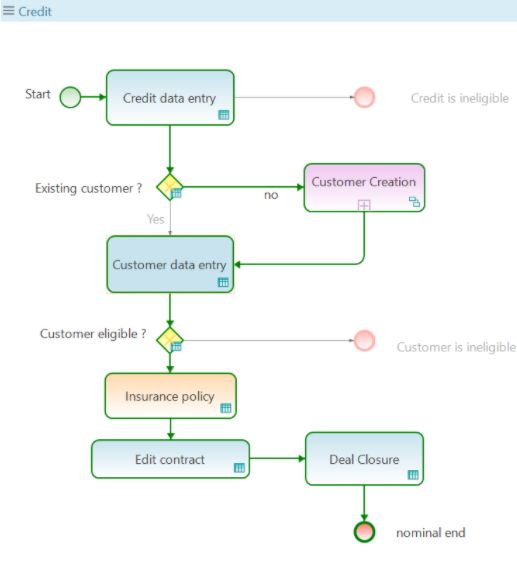
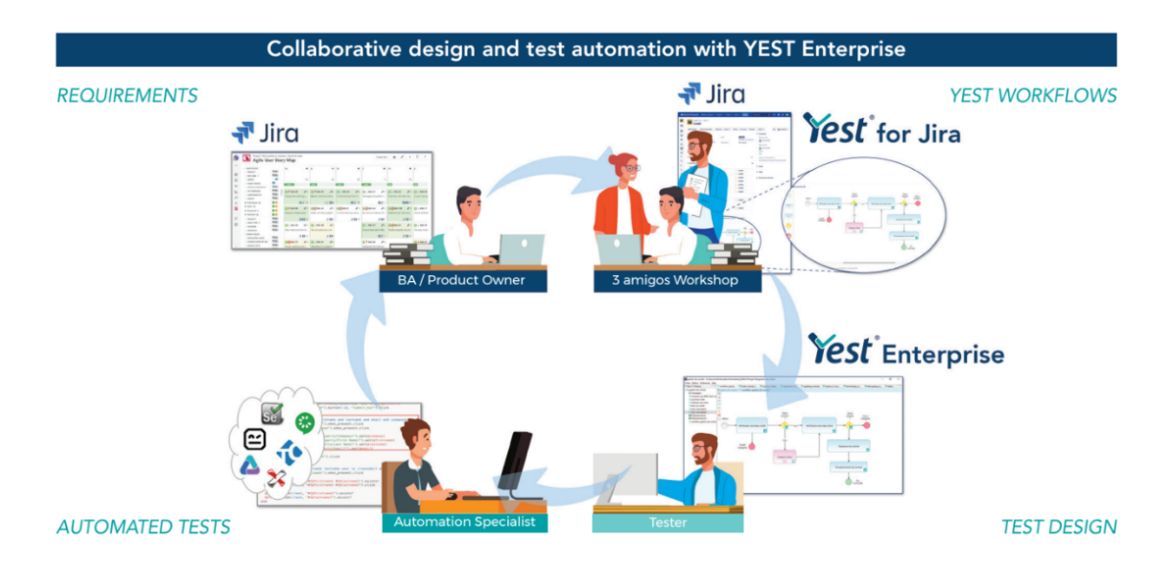
In Visual ATDD, system and end-to-end (E2E) tests are specified graphically and grow incrementally from sprint to sprint. With Yest®, Smartesting’s visual test design tool, you may also add the business rules in tables linked to the graphical workflows. Yest® then generates manual or automated tests and publishes them into the test tool of your choice. A large number of accelerators facilitate the maintenance of existing tests to keep them compliant with potentially modified workflows.

Shift Right!

But shift-left is not the only way to smarter test automation. Since the beginnings of Agile, the wheel has continued to spin. The DevOps idea came up and with it the maxim “Shift-Right”. Why should we stop testing with delivery? Let us perform tests and evaluate quality under real world conditions. Continuous deployment pushes this concept to the extreme. Once a new feature passes the quality gate composed of automated regression tests, it is released, but it may be rolled back immediately if problems are observed in the field.

Testing in production has many advantages. By monitoring an application in its users’ hands, we can quickly discover errors, bugs, and performance issues and fix them before they cause any more damage to our customer’s satisfaction. We can also test two versions of the design of a feature to see which one works better for our users (A/B testing) or even learn how our users appropriate our application.

Usage-Centric Testing

Usage-centric Testing complements the shift-left approach by using the knowledge of user’s behavior to design more accurate tests. In particular, it allows us to define targeted regression test suites covering relevant usage scenarios from end to end – targeted, because they cover what really users actually do.

In fact, when writing acceptance tests, we test how we think our users are going to interact with a new feature. In best cases, the feature has been designed in the most user-centered way possible. But even so, our end-users are… human beings. And as human beings, their behavior is not predictable and they tend to appropriate our products in ways we weren’t expecting. For example, we never expected smartphone owners to use their expensive high-tech device as a flashlight. If we never validate our assumptions, we take the risk of keeping irrelevant E2E tests that we still have to run and maintain

Gravity by Smartesting

Gravity is Smartesting’s solution usage-centric testing platform. It collects anonymized usage data from web applications and analyzes them using machine learning techniques. The software detects patterns in users’ behavior and compares test coverage of those patterns obtained in the development environment against product usage. In the end, it allows you to generate automated regression tests using Cypress. Thus, you obtain a regression test suite which perfectly reflects the actual usage of your application.

Perform the Split!

Shift-left or shift-right is not an either/or decision. They are two sides of the same coin. Both aim at creating smart tests; SMART in the sense of the well-known acronym for five quality characteristics: Specific, Measurable, Attainable, Relevant and Timely.
With Yest® you obtain few, but highly relevant tests that specifically cover the workflows and business rules you collectively wish to check. Traceability and coverage indicators provide quantitative measures of how good your tests are. Thanks to the numerous accelerators, the tests may be specified incrementally and sprint goals are attained. Shared in Jira and, on top of that visual, the graphical workflows represent a first validation of the expressed requirements. You get timely feedback from all kinds of stakeholders.


Gravity, on the other hand, concentrates specifically on the relevance of E2E tests. It hardens your regression tests by using information from productive systems. In a DevOps approach, Gravity allows you to monitor usages and to detect deviations timely. It also measures the coverage of real-world usages through the existing test suites and generates relevant automated test scripts to increase this coverage to achieve right testing.

YEST® is a visual-based tool for designing and automating functional tests in Agile.
By accelerating the production of business-relevant tests, YEST® significantly and measurably reduces the costs of creating and maintaining manual and automated test cases (30% for design and 50% for maintenance).


The free YEST® for Jira add-on allows teams to share and capitalize on their functional knowledge via graphs and forms the basis for collaboration between business teams, QA teams and software developers. Interested? Contact us for a demo.

Gravity helps Agile/DevOps teams to deliver high quality software faster.
Dedicated insights and AI will enable them to design and dimension their E2E test suites to efficiently cover the real application use in production. You can try Gravity for free at https://www.gravity-testing.com/

Author

Anne Kramer, Global CSM – Smartesting Solutions & Services, Germany

Anne is an expert in test design approaches based on visual representations and works as Global Customer Success Manager at Smartesting.

Smartesting is an EXPO Exhibitor at EuroSTAR 2023, join us in Antwerp

Filed Under: Test Automation

Orchestrated Testing Within Continuous Delivery

August 7, 2023 by Lauren Payne

Thanks to Sixsentix for providing us with this blog post.

Over the last few years, the market has put great effort into delivering solutions as fast as possible. The software has transitioned from having a supportive role in business to becoming a crucial part of the business itself. For instance, e-banking platforms have enabled clients to complete the job on their own. For many companies, this meant building new layers of software applications on top of the previous system of record, like CRMs or ERPs.

So, what’s the motivation behind this? Firstly, they are trying to differentiate themselves from the competition with faster and more flexible solutions. Secondly, they are disrupting the market with new innovative solutions. To go back to the banking example, many financial institutions are nowadays creating new brands (companies, applications, services, etc.) to target new segments of the market or even to create new niche markets.

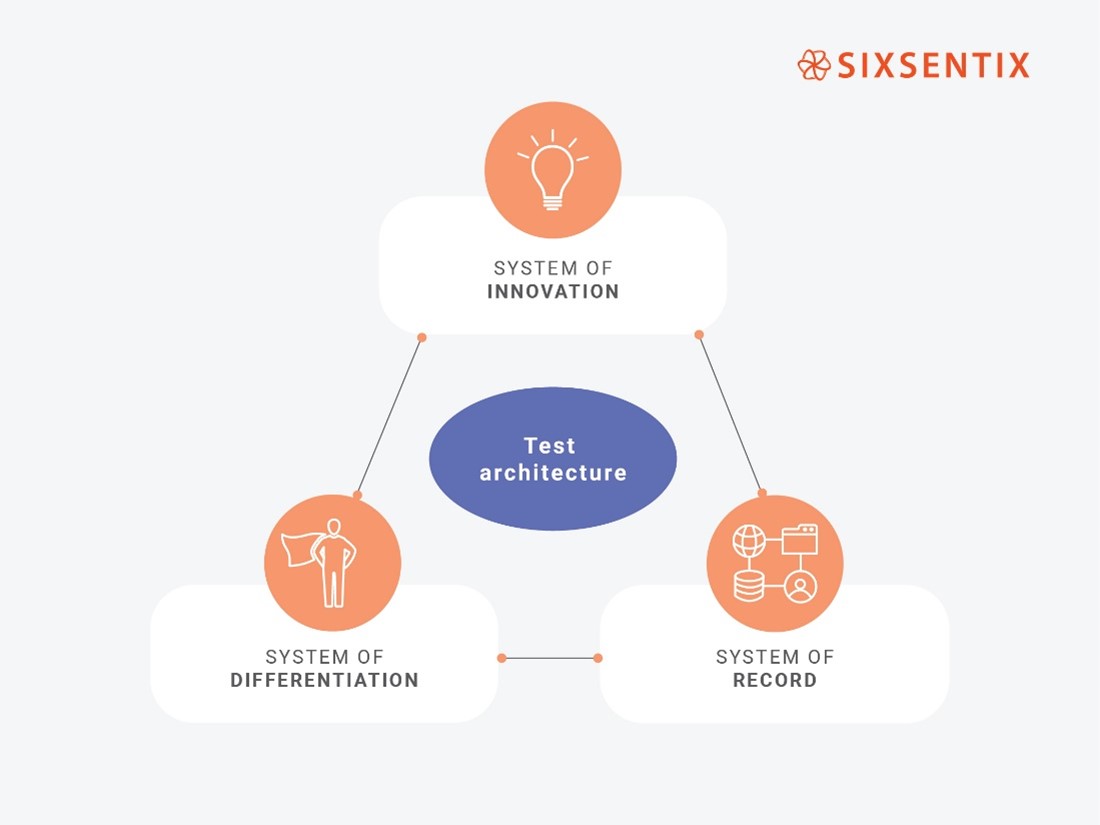
The Problem: Excessive focus on the system of innovation (and disregard for other systems)

On the one hand, utilizing the systems of records to create a new service can be challenging to facilitate a quality release in a short period of time. For example, systems of record can be heavily impacted by regulatory mandates or using legacy technologies with old software architecture patterns.

Then, companies have rolled out the Agile Delivery Frameworks used in the systems of innovation, expecting to have the same outcome. But is this really possible? Are all the organizations able to become the next Spotify? In our experience, it’s not so easy. There are some serious challenges that need to be overcome:

  • The systems coexist, but some of our clients do not even notice that.
  • The same Agile Delivery framework does not suit all the systems, even in the same company or organization.
Source: Ketut Subiyanto

The Solution: Orchestrating testing between all systems

On the other hand, a new app can be done overnight within system innovation. Thus, time constraints, as well as the level of dependencies, are crucial attributes for a faster release among the three system platforms.

So, what do we do? Should we slow down the innovation to onboard the systems of differentiation and record onto our model? Definitely not!

Sixsentix’s approach is to use QA and specially the test architecture discipline as the orchestrator between systems. The main purpose of test architecture is to prepare the systems of differentiation and record to keep up with the pace of the system of innovation or even increase it! Our client portfolio consists of mid-sized and large companies from diverse business domains with one thing in common – most of them have developed new systems of differentiation and innovation very quickly. Here are some of the crucial lessons we’ve learned so far:

  • Risk-based testing brings two main benefits when testing applications within the system of record. On one side, it plays the role of guardian of quality for the system of record. On the other side, it helps the system of innovation to get faster evidence and, consequently, make early decisions whether to release to production or not.
  • Each system needs a different type of testing strategy, and each test strategy must consider the coexistence with the other systems. One testing strategy (i.e., approach, infrastructure, tooling) does not fit all the systems.
Source: Sixsentix’s adaptation of Gartner’s PACE Layered Application Strategy 

The Sixsentix Way: Using test architecture service to bridge the gaps

To further illustrate these ideas, let us consider the situation at one of our client companies, where we identified a lot of dependencies between the system of innovation (i.e., mobile apps) and the system of record (i.e., core business CRM).

  • Before implementing our test architecture service, we spotted the following symptoms:
  • Overload of delivery backlogs
  • Dependencies between agile teams consumed almost all the development capacity
  • Delivery objectives (time to market) could not be accomplished
  • Detection of side-effects in production environment
  • Huge effort on consolidating test evidence for audit-relevant systems

But after implementing the service, we could observe a number of improvements:

  • Quality Assurance supports faster releases with risk-based testing
  • Test automation degree was massively improved, allowing Continuous Testing
  • Audit-relevant test evidence is delivered efficiently thanks to methodological test coverage
  • Throughout business-facing testing, the dependencies are better understood and therefore the backlogs of all three systems are better aligned and prioritized
  • On an organizational level, shift-left has been enabled
Source: Envato

This perspective on frequent SDLC challenges is the result of Sixsentix experience, by consulting and operationalizing QA solutions at large scale organizations. If you wish to find out more about how test architecture can help bridge gaps between the three systems, find us at the Sixsentix booth. We look forward to discussing this topic and exchanging ideas about QA and software testing with you at the EuroStar conference!

Author

Sixsentix

Sixsentix is a leading provider of Software Testing Services, QA Visual Analytics and Reporting, helping enterprises to accelerate their Software Delivery. Our unique risk-based Testing and QACube ALM Reporting and Dashboards, provide business with unprecedented quality and transparency across Software Delivery projects for faster time-to-market. Sixsentix customers include the largest banks, financial services, insurance, telecom providers and others. Sixsentix Onsite, and Nearshore (SWAT) services deliver optimized testing outcomes at significantly lower costs and help customers with scalability to keep pace with digitalization.

Sixsentix is an EXPO Exhibitor at EuroSTAR 2023, join us in Antwerp.

Filed Under: Test Automation, Uncategorized Tagged With: EuroSTAR Conference

Why Crowdtesting Should be an Imperative Pillar of Quality Assurance

August 2, 2023 by Lauren Payne

Thanks to MSG for providing us with this blog post.

Users are looking for products that inspire – or at least don’t bother them

Future generations – all of them digital natives – will no longer enter their business relationships as traditional customers. The changed demands and the constant transformation through digitalization are turning customers into users. But where no human interaction can create trust, dispel doubts, and answer questions, the product alone is in the spotlight and must have the ability to convince in a very short time and with a reduced attention span.

Attractive, easy to use and – best of all – with a higher range of functions.

Constantly available and nearly unlimited offerings are no longer disruptive but common standards. This applies to products, services, and public offerings at the same time. So, whatever your offer is, you must make sure, the users find it attractive, easy to use and with a suitable range of functions.

The users – not a homogeneous mass

Another challenge is to meet the different target groups and to create a digital infrastructure that covers their different needs equally. Those of Generation Y and Z, which have the purchase power and demand of the future expect modern forms of interaction, purchasing products and services fully digital. The future “everything is now” generation, which is no longer tied to long-term contracts and is used to getting whatever they are looking for on demand.

The competition among web-offerings, which compete without ties and with the promise of a “change of supplier in minutes”, meets this need. The time span to inspire or disturb new users is accordingly very short. Not at least because the tolerance for errors also decreases with the rising use of digital products. By now, most users have gained so much experience with apps and online products that they have a clear expectation of functions and usability. If these expectations are disappointing, they simply download the next app. And even if this is sometimes tied to opening an account, today this can be done quickly enough and with reasonable efforts.

The subjective experience counts

As good as product design and functionality may be, the product experience is and remains subjective. Every product will always create a subjective use case for the user, and this must work to store a positive experience.
A subjective use case could be that a user carries out his transactions exclusively while commuting on a mobile device and expects for instance a banking app to be compatible with his mobile device. The app should be so intuitive to use that external distractions do not disrupt the user flow and ideally the data flow should adequately handle the switch from 3G/4G mobile networks to WLAN networks. If all this fits, the experience is consistently positive.

This in turn not only brings the advantage that the individual user is satisfied, but providers also benefit from the fact that an experience is always communicated to others.

Position yourself on the market through assured quality

By assessing the product quality, you may influence your positioning on the market towards an outstanding product experience. This inherits the following to be ensured:

  • The smooth functionality of the product on the most popular devices in the market.
  • The provision of the appropriate range of functions with the right characteristics for the target group.
  • Covering as many subjective use cases as possible to avoid negative surprises after go-live.

While the first point can still be tested internally and in the laboratory, for example with emulated devices, as part of a verification, the other two points can only be tested as part of a validation.

Crowdtesting offers solutions

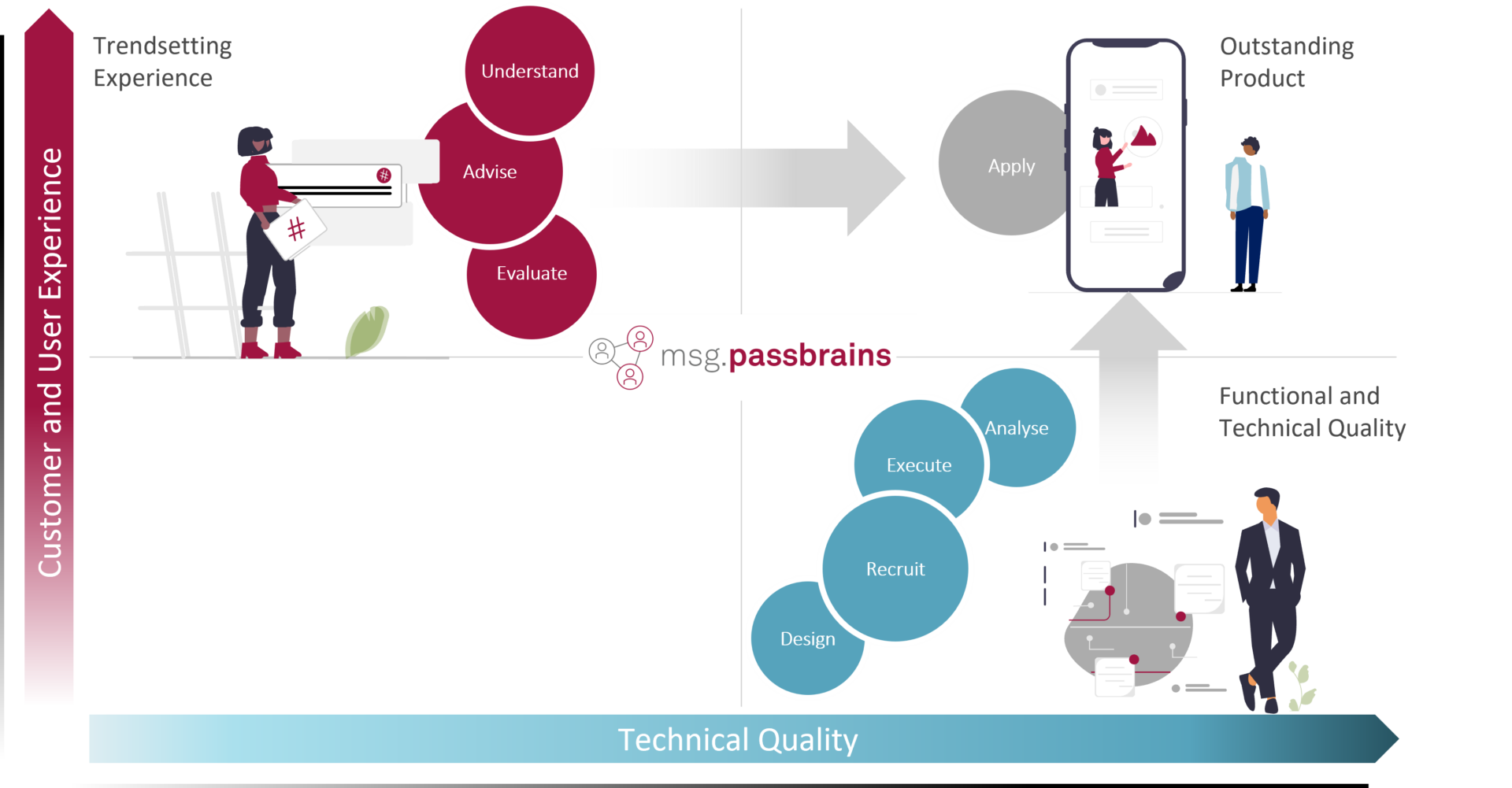
Crowdtesting is the validation of digital products involving your target group – remotely via the internet. Leaving this rather rigid definition behind, this method offers good tools to meet the three challenges of digital assurance. It allows positioning towards the upper right quadrant of digital excellence and thus can serve to stand out from the masses with an outstanding product.

Figure. 1: The quadrants of digital excellence

Crowdtesting helps you to cover subjective use cases and perceptions in any phase of the life cycle. You get a direct insight into whether your target group feels heard and can adapt at any time. In addition, with the variety off devices and mindsets added to your testing process you will be enabled to find functional and technical issues which wouldn’t be uncovered in the lab. And if there are no functional problems, that’s worth a pat on the back for your development and builds confidence in your product.

Feedback will always be a part of this testing process and even if the insights and “bugs” gathered in this process may not be fixed, they can be incorporated into the further development of the product. In the meantime, the results help customer support to prepare for possible enquiries and to create meaningful FAQ lists.

Conclusion – Crowdtesting is useful in any phase of a products lifecycle

It gives a good insight into the technical and functional stability of your product and provides the opportunity to understand the (future) users from the beginning and develop with a focus on their added value. You don’t have to wait for feedback from customers who may be disappointed once, not return to your site at all and not using your app a second time.

Author

Johannes Widmann

Johannes Widmann has been working in the field of software quality and digital assurance for over 22 years. He is a dedicated desciple of crowdtesting since 2011 and has built up passbrains, one of the leading service providers for crowd-sourced quality assurance. Since January 2021 passbrains is part of the msg group.

MSG is an EXPO Exhibitor at EuroSTAR 2023, join us in Antwerp

Filed Under: Quality Assurance, Uncategorized Tagged With: 2023, EuroSTAR Conference

No-Code & Low-Code: The Inclusive and Effective Way to Test Automation

July 31, 2023 by Lauren Payne

Thanks to Maveryx for providing us with this blog post.

The field of software testing has seen significant happenings in recent years, with the emergence of new testing methodologies, tools, and techniques. One of the most relevant trends in automated testing is codeless (no-code and low-code) testing, which enables users without or with low programming skills to create and execute automated tests without writing a single line of code.

Automated testing has traditionally been highly technical, requiring specialized skills and expertise in programming languages and testing frameworks. Unfortunately, there need to be more testers to do this job. For this reason, we assisted in the progress of the codeless testing, where non-technical (business) users can participate in the testing process.

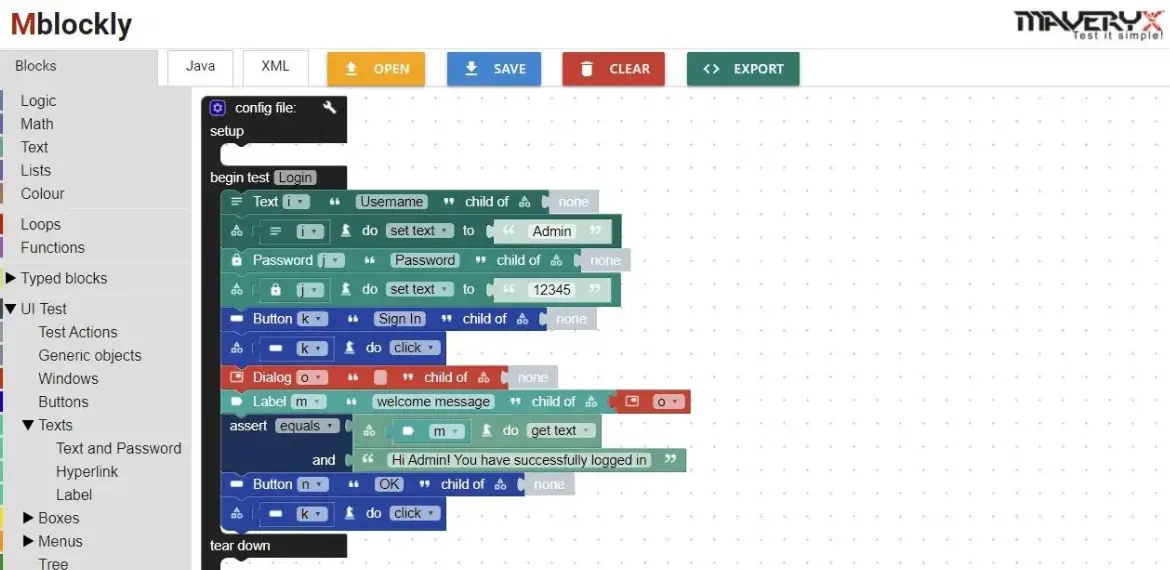
Low-code testing typically provides users with a visual interface that enables them to generate automated test scripts by dragging and dropping components (test code snippets).

Fig. 1: Low-Code IDE

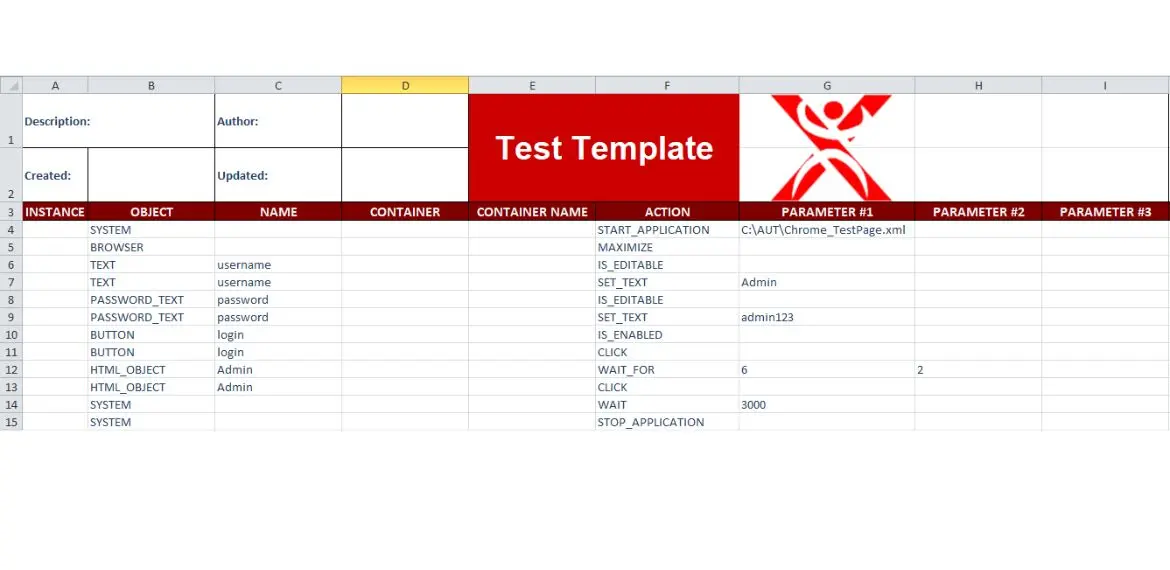
No-code testing tools provide users with predefined keywords that enable them to create tests using natural language, like writing a document.

Fig. 2: No-Code by Keywords in Excel

So, what are the benefits of a codeless approach to automated testing?

Productivity: no-code and low-code testing enable users to create tests quickly and easily, in most cases, without writing a single line of code. These increase productivity and reduce the time and effort required to develop the tests.

Reduced costs: no-code and low-code testing eliminate the need for specialized testing resources, such as expert testers or programmers, which can significantly reduce the costs associated with software testing. Also, they significantly reduce the time to create tests; saving time means saving money.

Faster time-to-market: more people involved in software testing and more (automated) tests enables organizations to test their software quickly, reducing time-to-market and increasing the speed of delivery.

Extensive functional coverage: codeless testing allows organizations to write more tests faster, thus improving their test coverage and enabling more frequent and extensive testing, which can help identify defects and issues earlier in the development process.

Easier maintenance: codeless testing, but more in particular no-code testing, makes it easier to maintain tests over time, with users able to update and modify tests using natural language without the need for coding expertise or specific technologies.

Easier collaboration: in particular, no-code testing tools enable teams to collaborate more effectively, with non-technical team members able to contribute to the testing process without requiring specialized skills or the knowledge of a specific technology. Also, no-code testing allows non-technical stakeholders to participate in the testing process, enabling a broader range of users to contribute to software testing.

Combining a codeless approach with intelligent object recognition at runtime technology (without GUI maps, object/image repositories, code instrumentations, recorded actions, and so on) can further boost test automation.


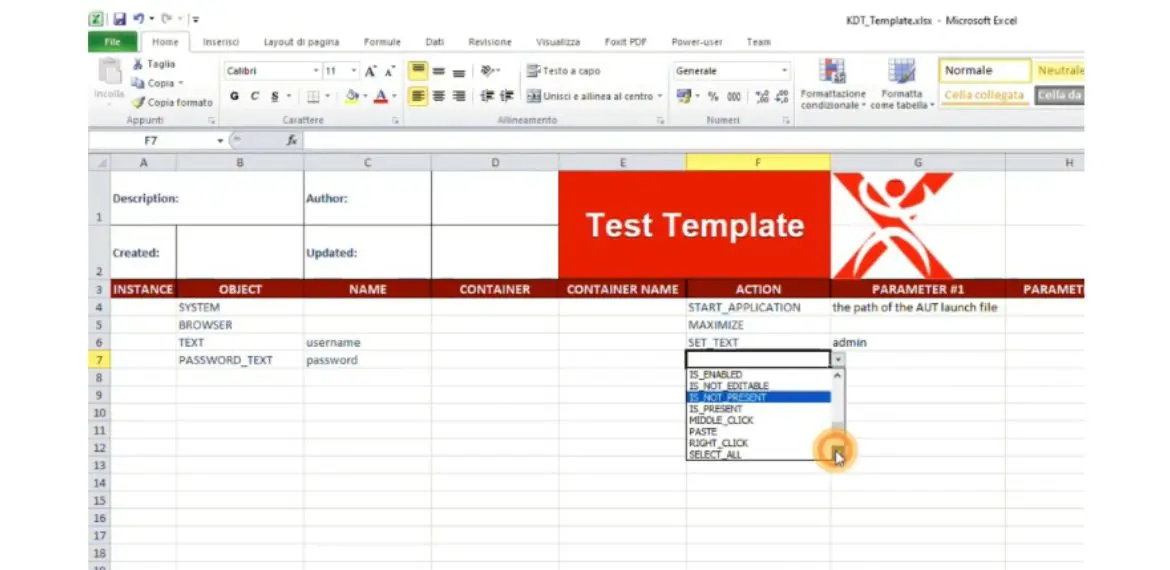
For example, the Maveryx Test Automation Framework offers both codeless test creation and runtime inspection. Users can create No-code automated tests by Keywords. For example, everyone using Excel can participate in test automation.

Fig. 3: No-Code test creation

Also, this framework provides low-code blocks programming IDE, supporting testing through the drag-and-drop of visual blocks.

Author

Alfonso-Nocella-Maveryx

Alfonso Nocella Co-founder and Sr. Software Engineer at Maveryx,

Alfonso led the design and development of some core components of the Maveryx automated testing tool. He collaborated in some astrophysics IT research projects with the University of Napoli Federico II and the Italian national astrophysics research institute (INAF). Over the decades, Alfonso worked on many industrial and research projects in different business fields and partnerships. Also, he was a speaker at several conferences and universities.

Today, Alfonso supports critical QA projects of some Maveryx customers in the defense and public health fields. Besides, he is a test automation trainer, and he takes care of the communication and the technical marketing of Maveryx.

Maveryx is an EXPO Exhibitor at EuroSTAR 2023, join us in Antwerp

Filed Under: Test Automation Tagged With: 2023, EuroSTAR Conference

Testing and QA Key to Cloud Migration Success

July 27, 2023 by Lauren Payne

Thanks to iOCO for providing us with this blog post.

In the global rush to go serverless and in the cloud, many organisations neglect quality assurance and testing – an oversight that can seriously impair performance and increase organisational risk.

There are numerous reasons for this, but a key one is that cloud migrations are complex projects usually managed by infrastructure teams. Those tasked with driving it aren’t always quality focused, and their views of what QA is might differ significantly from what QA should be.
Should the organisation neglect thorough testing as part of its application cloud migration plan, the smallest mistake left undiscovered, could cause major failures down the line.

Lift and shift migration, the most popular approach and the second-largest cloud services sector by revenue, should not be seen as a simple copy-and-paste operation. Without a concerted effort, accurate planning and coordinated migration testing, a copy-and-paste approach could have devastating consequences for scalability, databases, and application and website performance.

Cloud Migration Testing and QA Priorities and Pillars

Thorough cloud migration testing uses quantifiable metrics to pinpoint and address potential performance issues, as well as exposing opportunities to improve performance and user experience when applications are in the cloud. However, teams should be cautious of scope creep at this stage – adding new features during migration could have unforeseen impacts.

Proper testing and QA rests on four key pillars – security, performance, functional and integration testing.

Security testing must ensure that only authorised users access the cloud network, understanding who has access to the data, where, when and why users access data. It must address how data is stored when idle, what the compliance requirements are, and how sensitive data is used, stored or transported. Suitable procedures must also be put in place against Distributed Denial of Service (DDoS) attacks.

To realise the performance and scalability benefits of the cloud, testing must validate how systems perform under increased load. Unlike stress testing, performance testing verifies the end-to-end performance of the migrated system and whether response times fulfil service level agreements under various load levels.

Functional validates whether the application is ready to be migrated to the cloud, and whether it will perform according to the service level agreement. In complex applications, it is necessary to validate the end-to-end function of the whole application and its external services.

Even in basic applications where microservices architecture is not required, we see some sort of integration with third-party tools and services, making integration testing important. Therefore, cloud migration testing should identify and verify all the dependencies to ensure end-to-end functionality, and should include tests to verify that the new environment works with third-party services, and that the application configuration performs in a new environment.

With well-architected testing carried out, the organisation can rest assured that cloud migration risks have been mitigated and opportunities harnessed across security, operational excellence, reliability, performance efficiency, cost optimisation and sustainability.

A Testing and QA Framework for AWS Cloud Migration

As an AWS certified partner provider, iOCO has tailored our Well Tested Cloud Framework (WTCF) for cloud migration to align with the AWS Well Architected Framework, to ensure customer migrations to the AWS cloud are not only successful, but actually exceed expectations. iOCO resources will lead and manage execution from initial assessment, risk identification and recommendations; through a comprehensive set of checklists and guidelines across each of the four QA pillars; to full migration testing.

In tandem with the AWS Well Architected Framework, iOCO’s WTCF is designed to fast-track AWS migration testing using clear and structured guides and processes and customised options to suit the organisation’s budget and needs.

Author

Reinier Van Dommelen, Principal Technical Consultant – Software Applications and Systems at iOCO

As a seasoned Technical Consultant with a wealth of experience, Renier Schuld has a proven track record of delivering successful IT projects for a diverse range of clients. He excels at bridging the gap between business and technical requirements by identifying and implementing systems solutions, guiding cross-functional teams through the project life-cycle, and ensuring successful product launches.

Renier’s expertise in Testing is extensive and includes developing functional specification documents, designing test strategies, creating and executing test scripts to ensure accuracy and quality, developing project and organizational software test plans, providing user support, and building automated test frameworks. He has a passion for continuously improving processes and ensuring that quality is always top of mind throughout the project life-cycle.

iOCO is an EXPO Exhibitor at EuroSTAR 2023, join us in Antwerp

Filed Under: Quality Assurance Tagged With: 2023, EuroSTAR Conference

  • « Previous Page
  • Page 1
  • …
  • Page 6
  • Page 7
  • Page 8
  • Page 9
  • Page 10
  • …
  • Page 12
  • Next Page »
  • Code of Conduct
  • Privacy Policy
  • T&C
  • Media Partners
  • Contact Us

part of the