• Skip to main content
EuroSTAR 2027 - Sign up for early access

EuroSTAR Conference

Europe's Largest Software Testing Conference.

  • Programme
    • EuroSTAR Global Series
    • Call for Speakers
    • 2026 Programme
    • Community Hub
    • Awards
  • Attend
    • Why Attend
    • 2026 Photos
    • Bring your Team
    • Testimonials
  • Sponsor
    • Sponsor Opportunities
    • Sponsor Testimonials
  • About
    • About Us
    • Our Timeline
    • FAQ
    • Blog
    • Organisations
    • Contact Us
  • Book Now

software testing tools

First Steps to Approach Test Automation

June 11, 2021 by Fiona Nic Dhonnacha

Test automation is a top priority for today’s companies. All, or almost, are betting on this aspect to reduce the effort of carrying out manual tests, avoiding the turnover of people in the projects, motivating employees, and saving time in the commercialization of products and services. But before jumping into the automation topic, several key aspects must be considered to fulfill the goal we establish.

The first thing to do is to analyze those three important areas need to be included in any test automation process: tools, test environment, and scope; although it is not necessary to do it in this order, because they are related.

Tools

The first step is to consider which tool meets our needs. The important thing is to analyze our needs and observe the types of validation, architecture, and tools that allow us to build, manage and report the automation project. The process of selecting an automation tool for web or mobile is not the same if we are thinking of an SAP system. Therefore, in this case, it is necessary to take a more specific approach concerning technical support and tools that suit the type of system chosen.

Test Environments

We need software, licenses, and infrastructure, in addition to a log of executions and parameterization. Therefore, it is necessary to define the test data management strategy and the requirements for continuous testing. In many cases, it is important to keep in mind that to get these sandboxes up and running, we need a lot of data. This is an aspect that cannot be ignored.

Scope

In terms of reach, what we must evaluate is what we want to automate. The initial assessment should aim to define which business processes we are going to automate. To do this, we must identify what kind of applications we have, the repetitive tasks and what we want to automate. Likewise, we have to define at what level we will implement test automation.

With these three fundamentals well established, we can observe some additional steps, such as the identification of the pilot application, the definition of small validation steps, which must be carried out step by step to manage expectations properly, and the automation criteria, which are used to identify the stability of the application in a test state. In this sense, we have to be sure of what will be used and evaluate the application’s life cycles; if it will be used for a long time, if it is obsolete or if the test time is acceptable.

Return On Investment

Last but not least, we must look at ROI (Return On Investment), taking into account both automation costs, with the remaining costs that we will have. The important thing here is to estimate the break-even point for the development, support/maintenance effort, and the tasks that must be performed manually. We will find the balance when we reach approximately 80% profit (considering the use of automation) and 20% effort (that would be the total amount to automate 100% of the reach).

In this sense, each organization must define the levels of automation that it will implement, and its level of scales, starting from 0 that corresponds to having no automation, and gradually going through levels 1 to 4. The first level corresponds to a basic level; the second at a more productive level, where we already have a roadmap, defined objectives, and KPIs; the third with a more consolidated automation framework, in which we already work on processes and not just on applications; and a fourth, and last, more advanced, in which we have already introduced artificial intelligence. These levels give a priority reference to guide us and the ideal is to have a detailed scale of priorities. Thus, as we increase coverage by 60-80%, investment starts to decrease. This is an important aspect to consider before starting.

Ultimately, it is important to focus on the future uses of test automation, based on good market practices, as well as how to get the ROI we want to achieve and good ways to measure it.

Noesis are exhibiting at EuroSTAR 2021 Online. Looking to learn more on test automation? Check out the EuroSTAR 2021 programme, and join us September 28-30th.

Author

Eduardo Amaral, Quality Management Director at Noesis

Quality Management Director at Noesis – Portuguese QM Services Market Leader, Eduardo worked as analyst/developer, project manager, program manager and service delivery manager. He has a background and certifications in several areas, including quality assurance, project/program management, process management and product management. Over the last 21+ years, Eduardo has been involved in a variety of software project development lifecycles and solutions integration, at high levels of complexity and customer experience exposure, performed in some of the major national and international companies, from different business areas – Industry, Banking, Insurance, Telco, Retail, etc.

Filed Under: EuroSTAR Conference, Test Automation Tagged With: software testing tools, Test Automation

Smarter Testing. Superior Outcomes. Achieve Both With Micro Focus.

October 25, 2019 by Fiona Nic Dhonnacha

EuroSTAR is Europe’s No.1 software testing conference. Whether your thing is testing, devOps, agile or QA, you’ll be among Europe’s testing stars. The Micro Focus team looks at what delegates can expect.

This year’s conference theme is ‘working well’, and we will be busy at booth 6 proving how our Application Delivery Management solutions can transform your testing environment. We’re bringing our a-Game – and some of our best solutions – to the show.

Visit us at booth 6

See how to minimize risk and maximize user satisfaction by testing early and often with our industry-leading, integrated portfolio for continuous and comprehensive testing of web, mobile, and enterprise applications. The results – smarter testing.

From development through to production, you and your teams will have the benefit of specific, actionable feedback on your applications’ security, functionality, performance, and application readiness status. Ask for a demo in booth 6 and leave the conference with a plan to deliver smarter testing and superior outcomes!

Check out the best in:

  • Micro Focus Functional Testing
  • Micro Focus Performance Testing
  • Micro Focus ALM Octane

Intelligent test automation

Our Functional Testing solutions deliver AI-driven test automation across an unparalleled range of technologies; on the most popular browsers, mobile devices, operating systems, and form-factors; from the cloud or on-premises; to deliver the speed and resiliency required to support rapid application changes within a continuous delivery pipeline.


Optimized application performance

Do you need to test applications and complex scenarios on-premises or in the cloud? Stop by and see how to achieve superb quality at scale. Performance Testing must be part of your DevOps pipeline AND your definition of “Done.”  We help customers confidently test the complex load, stress, and performance scenarios that their applications require while simultaneously providing comprehensive analytics for root cause analysis and accelerated identification of performance issues. Test any application type and protocol on-premises or in the cloud while incorporating real or simulated services and networks.

ALM Octane

Enterprise Agile and DevOps software development faces many challenges and organizations want to improve application delivery processes across the entire application life-cycle. The powerful capabilities in ALM Octane include:

  • Delivering at enterprise scale and optimizing application delivery
  • Providing full application visibility and traceability
  • Increasing application quality
  • Reducing integration costs and achieve better value flow
  • Achieving DevOps management, scalability, automation and intelligence

Stop by and be in with a chance to win

We’re also participating in the “passport around the expo” and the “Expo-Prize giving”, so when you are not hearing from peers in the sessions, be sure to stop by for your chance to win some Lego! Haven’t got your EuroSTAR ticket yet? For a limited time you can use code MICES19 at checkout for a 10% discount.

——————————————————————————————–

Author: Gil Cattelain, Product Marketing Manager, Micro Focus

Micro Focus product marketing manager

Gil has 20+ years of experience in software marketing, including recent time at Echopass and Genesys as Director of Digital Marketing where he specialized in digital marketing for the cloud-based contact center market.

His expertise also includes director of corporate marketing at Matrix42 and product marketing at Novell. He has also held positions as international public relations manager and channel marketing manager.

Gil holds a B.A. in political science from Brigham Young University and is fluent in French.


Filed Under: Application Testing, Test Automation Tagged With: applicat, software testing tools

How to bring the whole software project right inside your Jira

September 5, 2019 by Fiona Nic Dhonnacha

In general, Jira is considered to be project management software, but not everyone knows that it can also serve as a functional testing tool. While Atlassian suite may not be a dedicated solution for executing tests, it may turn out to be the most convenient for you and your team, if extended with the right app. As testing process is complex and includes the work of many people, including analysts, developers, and testers, it’s important to make the communication between the stakeholders maximally transparent. Performing not only tests but the whole software development in a single place helps each member keep track of all the changes implemented throughout the process. And this is not the only advantage!

The Atlassian product was originally created for bug tracking, therefore it seems to be a smart idea to use it for tests, which in the first place aim at spotting and fixing defects. So, how to implement testing into a software project into Jira? There are three ways of doing that: standalone, with Confluence, or a dedicated testing app.

How to bring the whole software project inside Jira?

When the process isn’t very complicated, standalone Jira Software might be the right solution, as it allows to manage both requirements and test cases on the elementary level. The team should agree with the Jira Admin on special issue types for requirements and test cases that need to be set up. Jira lets us use tasks and subtasks to build simple structures and seamlessly link the issues between each other. This speeds up relations tracking and makes cooperation between the stakeholders easier.

If the project requires some more space, it’s a good idea to use Confluence. External testing tools often don’t include requirements management, and Confluence permits to precisely describe them. Underestimating this initial phase often cause problems later on, so it’s worth a while to use a special product requirements page in Atlassian software and save time and money in the end.

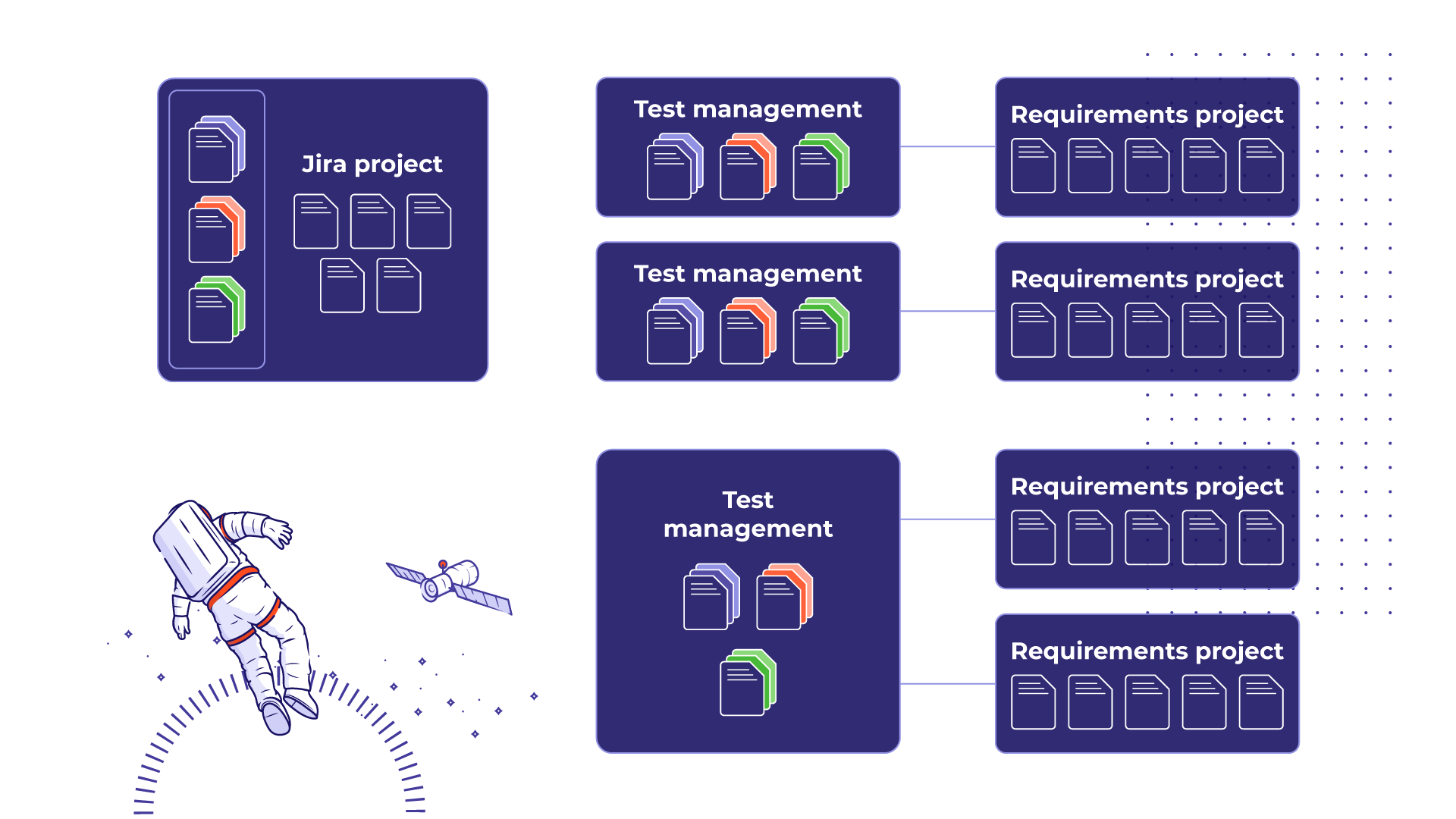
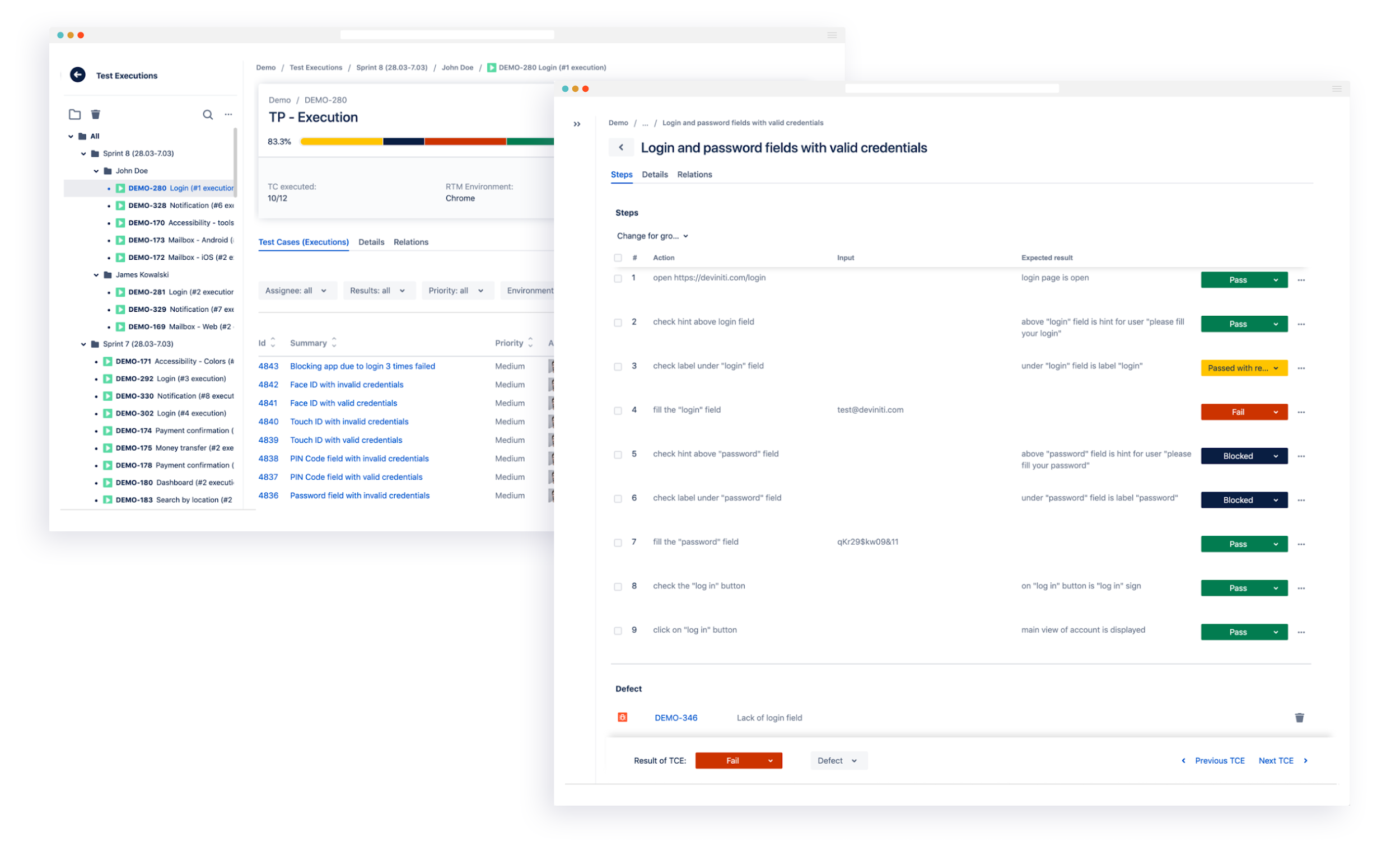
The third option to successfully execute the whole software project in Jira is adding a dedicated app from the Atlassian Marketplace. One of them is Requirements and Test Management for Jira (RTM). The app adds five modules to the software project which allow you to manage requirements, test cases, test plans, executions, and defects, and organize all these elements into transparent tree-structured views. This kind of solution provides you with plug-and-play configuration, full traceability of the objects and implemented changes, and also makes it possible to generate necessary test reports.

If your team uses Jira Data Center and needs more flexibility, another app of ours – TestFLO – gives you this possibility. You can choose if you prefer executing the whole process inside one Jira project or store requirements separately. The app allows creating test case repositories for cross-project testing as well.

Test management tools for Jira answer the problems of even most demanding teams, and their high-level tracking system prevents possible bugs in the final product. Read more on bringing test management process inside Jira on Deviniti blog:

  • Why using Jira as a testing tool is a good choice for your project
  • 6 steps to set up requirements management and testing in Jira
  • How to write effective test steps

—————————————————————–

  • Author bio: Katarzyna Kornaga is a Content Specialist focusing on requirements and test management at Deviniti – an Atlassian Platinum Solution Partner based in Poland. Kate discovers the mysteries of software development in order to share the knowledge with the readers interested in the subject.

Filed Under: EuroSTAR Conference Tagged With: software testing tools

How to Improve the Test Data Management Process with Data Simulation

July 10, 2019 by Fiona Nic Dhonnacha

Good test data is hard to come by. Learn how to use data simulation to improve the test data management process and save valuable time normally spent waiting for test data.

Good test data is hard to come by, and test teams are often left waiting for test data to be produced for them. According to a recent survey from Sogeti, up to 60% of application development and testing time is devoted to data-related tasks, and many project overruns are due to inefficiencies in test data provisioning. In general, up to 20% of the average software development lifecycle is lost waiting for data! 

To improve this process, testing teams can use service virtualization to augment traditional test data extraction. With this method of data simulation, testers can quickly build meaningful test data by capturing realistic test data from interactions between components in their existing system (real and virtualized), and building data models that can be shared and controlled directly by testing teams.

How do you benefit from data simulation?

The process is as follows:

  1. Define monitors: Monitors are proxies that intercept and record the data traffic between users and servers.
  2. Capture: Test data is captured by monitors and recorded from existing testing via functional, performance and security testing already in place by the development team. The application under test likely has dependencies on various types of services such as databases, legacy mainframe systems and many others. As test automation is executed the transactions and data between the application and services is recorded by the monitors and stored in the virtual service repository.
  3. Create: The captured transactions and data are sent to the service virtualization engine to create simulated virtualized services with associated test data.
  4. Deploy: The created services are stored and deployed to a virtual service repository allowing for later consumption.
  5. Manage: Orchestration of these virtualized service is required to make service virtualization work in a
    CI/CD workflow.
  6. Consume: Test data management and integrated orchestration of these virtual services means automated API and service-level testing is robust, easily repeatable and easier.

How does it work in practice?

A good example might be replacing a reliance on a shared database by swapping it with a virtual service. This allows for parallel and independent testing, that would otherwise conflict. With data simulation, testers can generate, subset, mask, and create individual customized test data for their needs.

By replacing shared dependencies such as databases, service virtualization removes the needs for the infrastructure and complexity required to host the database environment. In turn, this means isolated test suites and the ability to cover extreme and corner cases. Although the virtualized dependencies are not the “real thing,” some actions (e.g. an insert and update operation on a database) add some complexity to virtualization.

After capturing transactions and data, there is full control over the contents of the data from within the data manager. In addition, a model is abstracted automatically from the data based on database extraction or through the interactions observed during the recordings. This create model, as illustrated below, allows for better understanding of the data structure and relationships. This understanding is key to the next steps of masking, generating, and subsetting.

Quickly getting secure, real data for testing

Test data is hard to procure and a risk to manage. A solution based on secure, real data capture provides the best way to get the data you need, as fast as you need it. Service virtualization helps teams capture this data earlier in the development process, to be easily used for testing. With this modern approach to test data management, testers can securely store and manage test data, customize data sets for their needs, reduce the risk and liability of using production data, and reduce overall project risk and costs. For more information, you can download the free whitepaper: Tired of waiting for test data? Here’s the solution to your test data management headaches.

Chris Colosimo is a Product Manager, with expertise in SDLC acceleration through automation. Chris strategizes product development and deployment of Parasoft’s Continuous Testing solutions (Parasoft SOAtest, Virtualize and Continuous Testing Platform). Being a service virtualization and API testing subject matter expert and focusing on the concept of Continuous testing at speed, he works with developers and testers to discover constraints, evolve process, and facilitate the change management required to adopt agile and DevOps principals throughout an organization. Keen to share his knowledge and vast experience he frequently writes blogs and can be followed on Linkedin.

Filed Under: EuroSTAR Conference Tagged With: software testing conference, software testing tools, Test Automation

Expo Hero Winners

June 24, 2019 by Suzanne Meade

The EuroSTAR Conference experience is second to none. For over 25 years, EuroSTAR has provided a welcoming space for the largest European gathering of testers and quality assurance professionals.

In addition to the unbeatable learning sessions, EuroSTAR encompasses the largest Software Testing Expo in Europe. Within the Expo, each company that exhibits also contributes to the overall atmosphere of the conference. Over the years, many Expo partners have helped to enhance the delegate experience with unique activities and experiences.

This year, we wanted to ‘up the game’ so we put it to the testing community of test tool and service providers to tell us what unique activities or experiences they could bring to #EuroSTARConf 2019. We raised the stakes by offering an Expo exhibitor package worth €5,500!

Wow did the community respond!!!

We received so many entries and suggestions it was a massively difficult decision for the team to decide the winner. Eventually after hours locked away in a boardroom (with no coffee!!!), the winner was announced …

2019 EuroSTAR Expo Heroes
mabl logo

We are delighted to be welcoming mabl to the EuroSTAR Software Testing Conference in Prague. We loved their energy and approach to the challenge and know our delegates will too! The team at mabl really thought about the experience element and they also took note of our 2019 conference theme of ‘Working Well’.

Working Well is about balance. Software engineers, QA professionals and testers need to be able to “balance” speed and quality, particularly in DevOps. To help emphasise the need for balance (and keeping it fun), mabl are going to have a balance board at their Expo booth.

Yes, you read that correctly! All EuroSTAR attendees can try it out and see if they can balance successfully! There are raffle tickets given to all successful balancers with a cool prize up for grabs at the end. The longer you stay on, the more raffle tickets you are given! How fun is that?

We loved this idea and how it fits with the conference and our eternal search for balance in this hectic working world. We hope you will join us in Prague and pay a visit to the mabl booth in the EuroSTAR Software Testing Expo.

mabl balance board

mabl will be joining a wide range of test tool and services providers at EuroSTAR – check out the additional Expo partners.

If you haven’t been before, the annual EuroSTAR Software Testing Conference is an amazing celebration of the craft of testing in Europe. It is the largest conference on testing in Europe with the biggest variety of topics. The conference takes place in November in a different European city each year. The conference is held over 4 days with over 60+ sessions including tutorials, workshops and talks as well as non-stop networking.

At EuroSTAR, we believe in the power of community and we help the testing community to build powerful connections!

Filed Under: EuroSTAR Conference, EuroSTAR Expo, Test Automation, Uncategorized Tagged With: Expo, software testing conference, software testing tools, software tools, Test Automation

  • « Previous Page
  • Page 1
  • Page 2
  • Page 3
  • Code of Conduct
  • Privacy Policy
  • T&C
  • Media Partners
  • Contact Us

part of the