• Skip to main content
EuroSTAR 2027 - Sign up for early access

EuroSTAR Conference

Europe's Largest Software Testing Conference.

  • Programme
    • Call for Speakers
    • 2026 Programme
    • Community Hub
    • Awards
  • Attend
    • Why Attend
    • Bring your Team
    • Testimonials
  • Sponsor
    • Sponsor Opportunities
    • Sponsor Testimonials
  • About
    • About Us
    • Our Timeline
    • FAQ
    • Blog
    • Organisations
    • Contact Us
  • Book Now

EuroSTAR Conference

One Platform, Endless Possibilities: Introducing BrowserStack Test Platform 🚀

May 26, 2025 by Aishling Warde

Software testing has evolved. Engineering teams today are navigating an increasingly complex landscape—tight release cycles, growing test coverage demands, and the rapid adoption of AI in testing. But fragmented toolchains and inefficiencies slow teams down, making it harder to meet quality expectations at speed.

We believe there’s a better way.

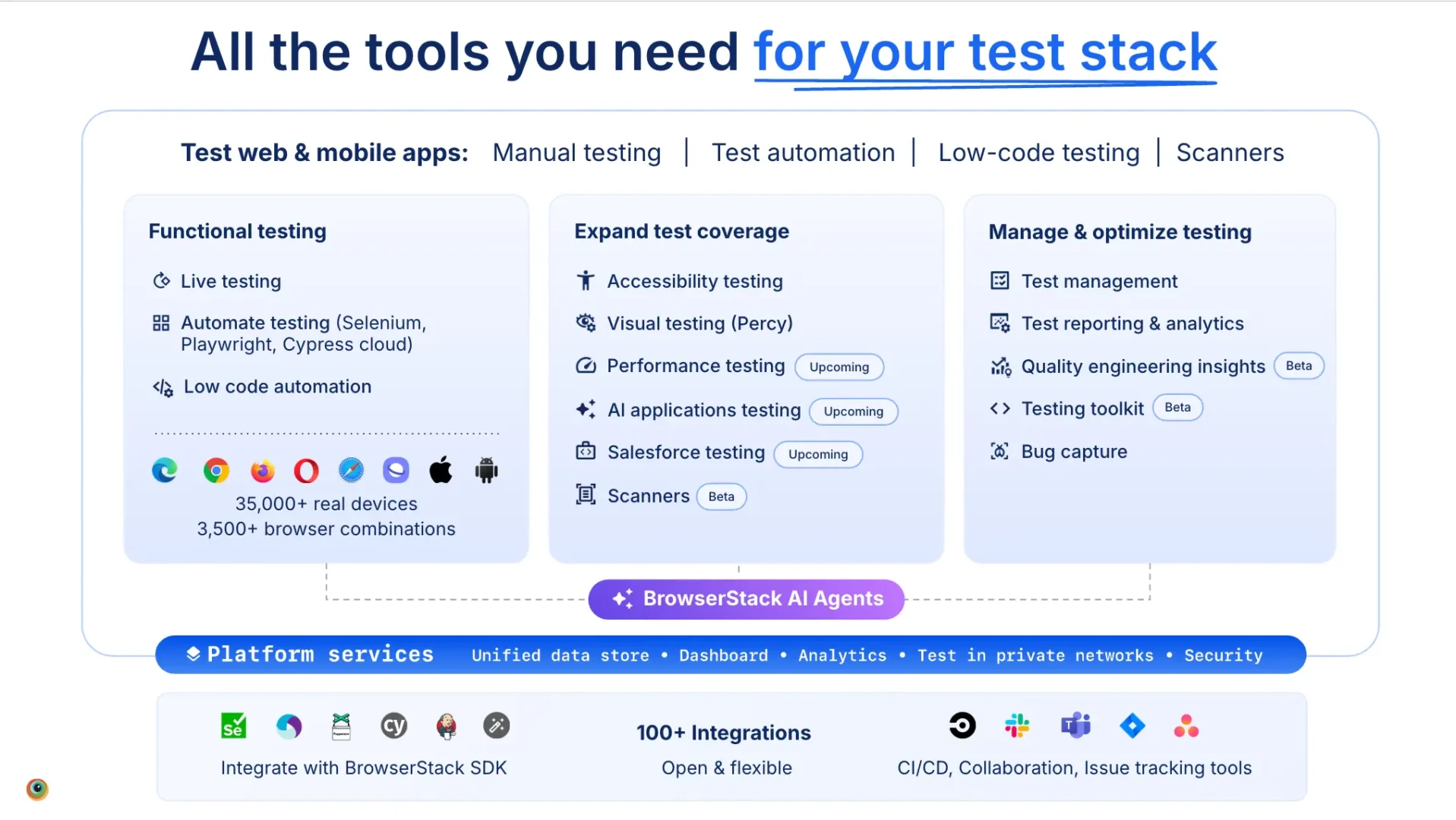
Today, we’re thrilled to introduce the BrowserStack Test Platform—an open, integrated and flexible platform featuring AI-powered testing workflows that enable users to simplify their toolchain into a single platform, eliminating fragmentation, reducing costs, and improving productivity. Built to enhance efficiency, the Test Platform transforms how teams approach quality, delivering up to 50% productivity gains while expanding test coverage.

The Challenge: Fragmentation Meets AI

Traditionally, QA teams have had to juggle disconnected tools for test automation, device coverage, visual regression, performance analysis, accessibility compliance, and more. The result? Fractured workflows, hidden costs, and a lot of context switching.

We wanted to change that. Our goal was to bring every aspect of testing—across web, mobile, and beyond—under one roof, complete with AI-driven intelligence, detailed analytics, and robust security features. By unifying the testing process, teams can dramatically improve productivity, reduce costs, and focus on delivering what truly matters: stellar digital experiences.

Introducing BrowserStack Test Platform

1. Faster Test Cycles with Test Automation

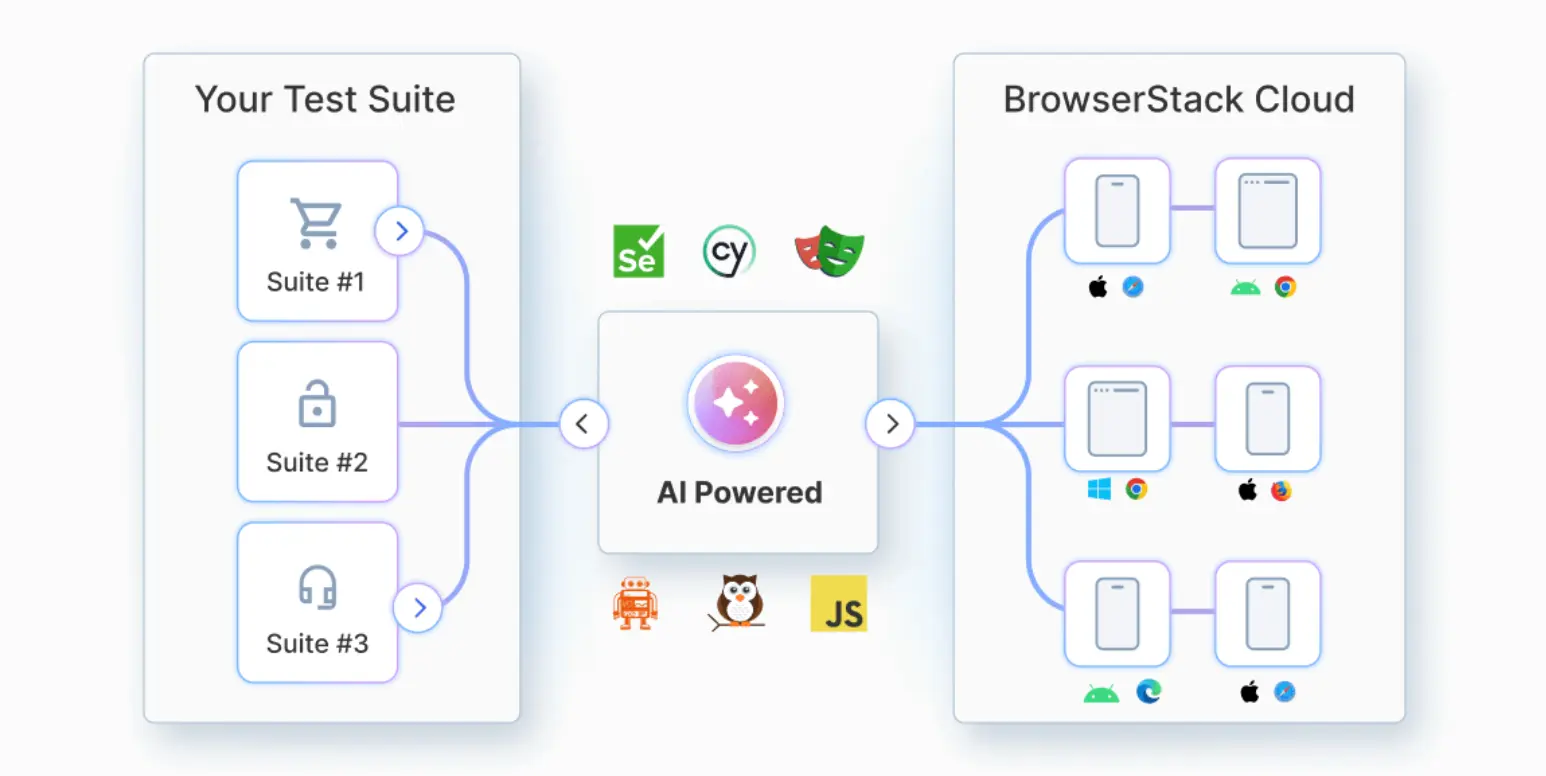
  • Enterprise-grade infrastructure for browser and mobile app testing—run tests in the BrowserStack cloud or self-host on your preferred cloud provider. This helps improve automation scale, speed, reliability, and efficiency.
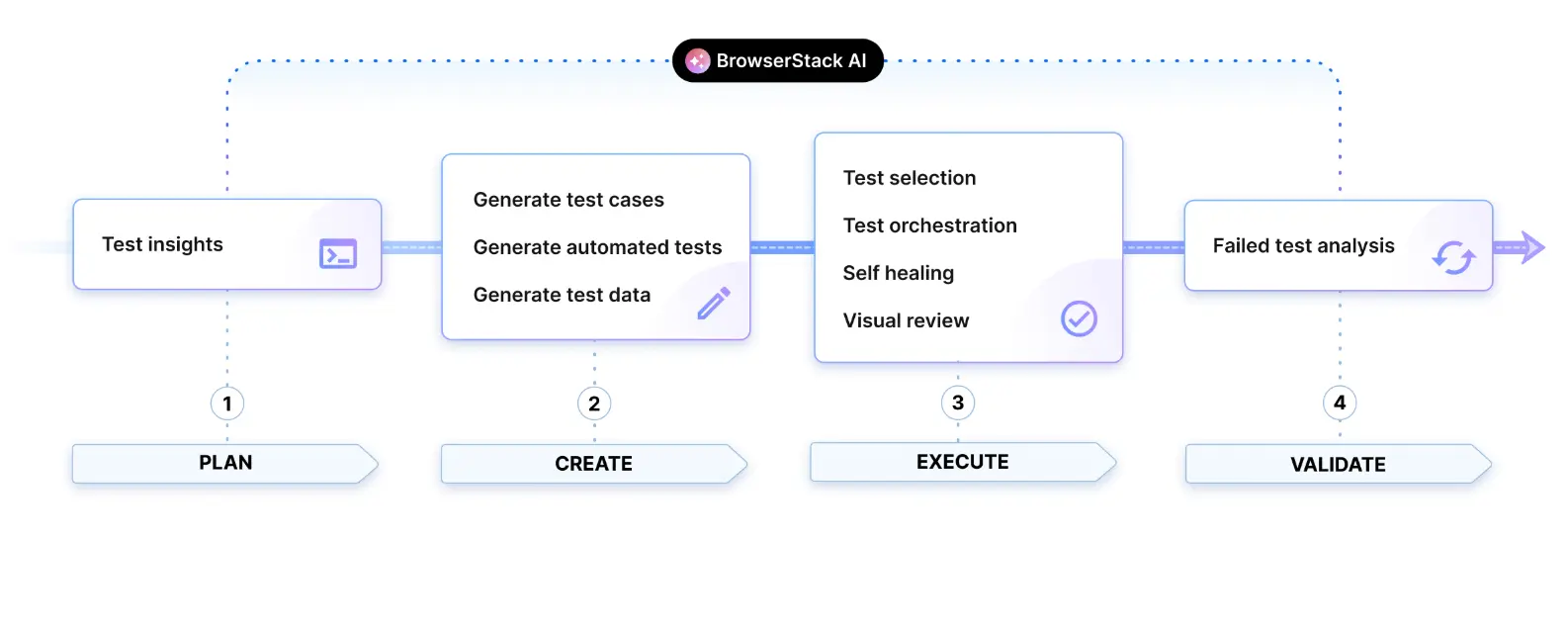
  • AI-driven test analysis, test orchestration, and self-healing to pinpoint and fix issues faster.
  • Designed to maximize the ROI of test automation, freeing you to focus on innovative work instead of manual maintenance.

2. BrowserStack AI Agents

  • The platform’s AI Agents transform every aspect of the testing lifecycle, from planning to validation.
  • With a unified data store, AI Agents gain rich context, helping teams achieve greater testing accuracy and efficiency.
  • Automate repetitive tasks, identify flaky tests, and optimize testing workflows seamlessly.

3. Comprehensive Test Coverage

  • 20,000+ real devices and 3,500+ browser-desktop combinations to replicate actual user conditions.
  • Advanced accessibility testing ensures compliance with ADA & WCAG standards.
  • Visual testing powered by the BrowserStack Visual AI Engine to spot even minor UI discrepancies.

4. Test & Quality Insights

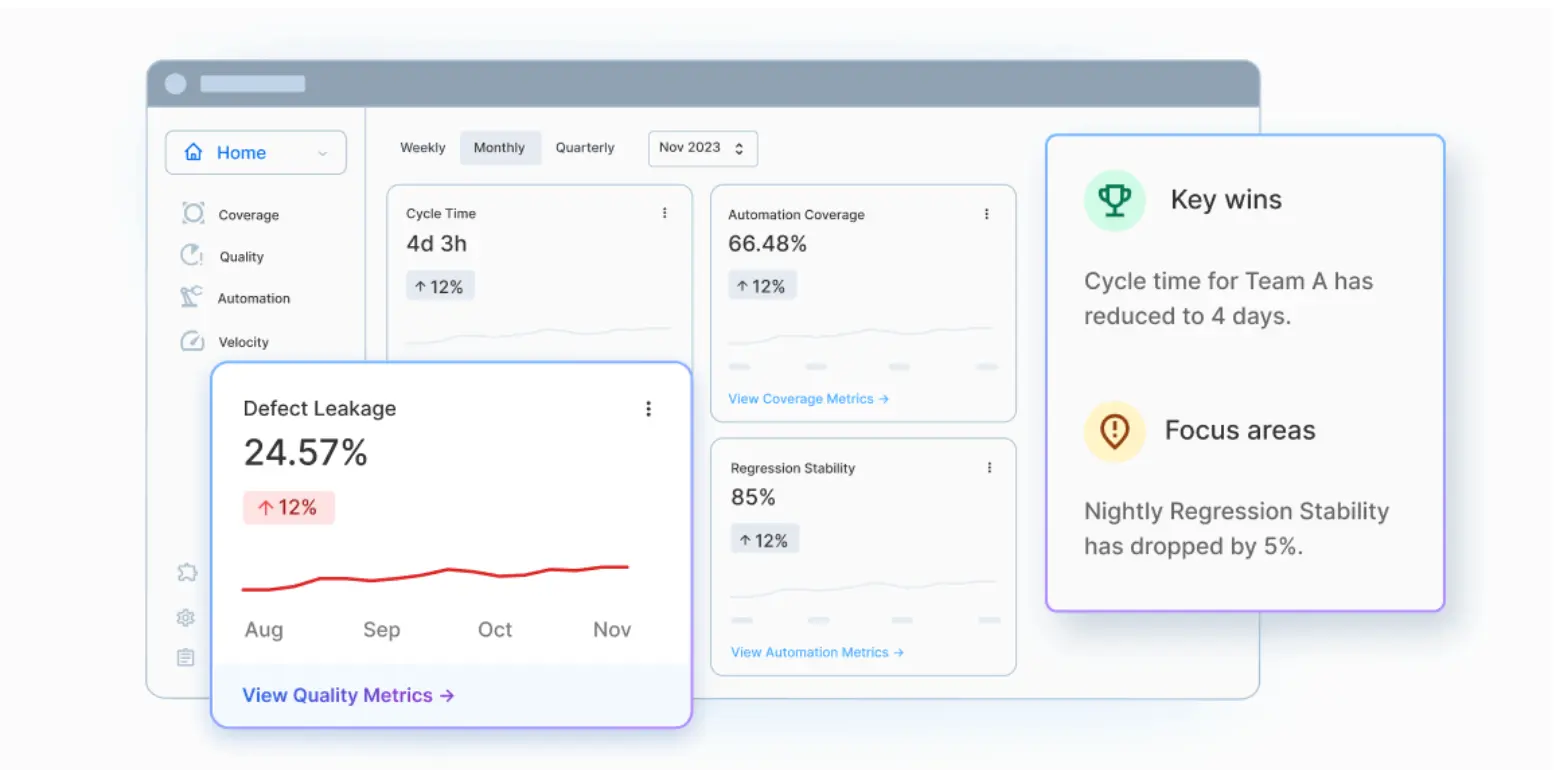
  • A single-pane executive view for all your QA metrics, integrated into the Test Platform.
  • Test Observability and AI-powered Test Management streamline debugging and analytics.
  • Data-driven insights to help teams make informed decisions and continuously refine their testing strategies.

5. Open & Flexible Ecosystem

  • Uniform workflows and a consistent user experience reduce context switching.
  • 100+ integrations for CI/CD, project management, and popular automation frameworks, letting you plug and play with your existing toolchain.
  • Built for any tech stack, any team size, and any testing objective—no matter how unique.

Built for Developers, by Developers

Our team of 500+ developers has poured their expertise into building a platform that eliminates friction from the testing process. From zero-code integration via our SDK to enterprise-grade security, private network testing, and unified test monitoring—every feature has been designed with one goal in mind: making testing seamless.

The Future of Testing Starts Here

The BrowserStack Test Platform is more than just a product launch—it’s a paradigm shift in how engineering teams think about software quality. Whether you’re a developer, tester, or QA leader, this platform is designed to help you build the test stack your team wants.

Ready to transform your testing workflows? Explore the BrowserStack Test Platform.

Author

Kriti Jain – Product Growth Leader

Kriti is a product growth leader at BrowserStack and focuses on central strategic initiatives, particularly AI. She has over ten years of experience leading strategy and growth functions across diverse industries and products.

BrowserStack were Gold Sponsors in EuroSTAR 2025. Join us at EuroSTAR Conference in Oslo 15-18 June 2026.

Filed Under: Gold, Sponsor Tagged With: EuroSTAR Conference

Principles Drive Trust in AI

May 14, 2025 by Aishling Warde

The pace that “artificial intelligence” (AI) is being incorporated into software testing products and services creates immense ethical and technological challenges for an IT industry that’s so far out in front of regulation, they don’t even seem to be playing the same sport.

It’s difficult to keep up with the shifting sands of AI in testing right now, as vendors search for a viable product to sell, and most testing clients I speak to these days haven’t begun incorporating an AI element to their test approach and frankly, the distorted signal coming from the testing business hasn’t helped. What I’m hearing from clients are big concerns around data privacy and security, transparency on models and good evidence, and the ethical issues of using AI in testing.

I’ve spent a good part of my public career in testing talking about risk, how to communicate it to leadership, and what good testing contributes to that process in helping identify threats to your business. So, I’m not here to tell you “No” to AI in testing but talk about how KPMG is trying to manage through the current mania and what we think are the big rocks we need to move to get there with care and at pace.

KPMG AI Trusted Framework

As AI continues to transform the world in which we live – impacting many aspects of everyday life, business and society KPMG has taken the position to help organizations utilise the transformative power of AI, including its ethical and responsible use.

We’ve recognized that adopting AI can introduce complexity and risks that should be addressed clearly and responsibly. We are also committed to upholding ethical standards for AI solutions that align with our values and professional standards, and that foster the trust of people, communities, and regulators.

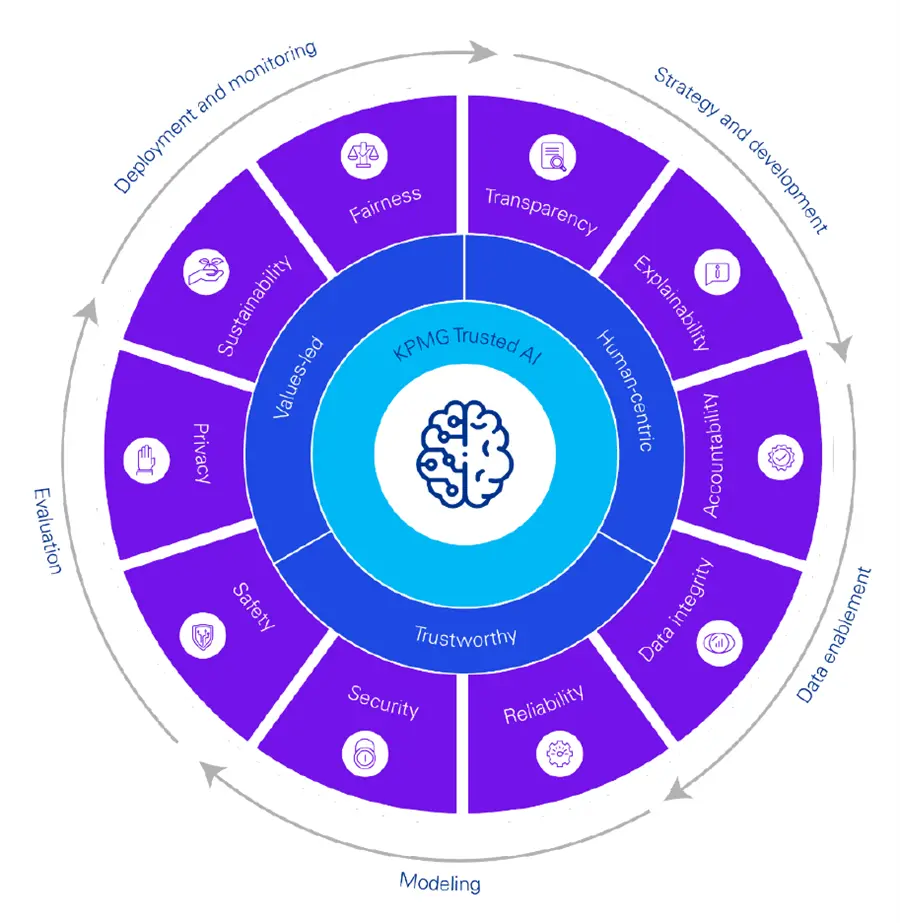
In order to achieve this, we’ve developed the KPMG Trusted AI model as our strategic approach and framework to designing, building, deploying and using AI strategies and solutions in a responsible and ethical manner so we can accelerate value with confidence.

As well, our approach to Trusted AI includes foundational principles that guide our aspirations in this space, demonstrating our commitment to using it responsibly and ethically:

Values-driven

We implement AI as guided by our Values. They are our differentiator and shape a culture that is open, inclusive and operates to the highest ethical standards. Our Values inform our day-to-day behaviours and help us navigate emerging opportunities and challenges.

Human-centric

We prioritize human impact as we deploy AI and recognize the needs of our clients and our people. We are embracing this technology to empower and augment human capabilities — to unleash creativity and improve productivity in a way that allows people to reimagine how they spend their days.

Trustworthy

We will adhere to our principles and the ethical pillars that guide how and why we use AI across its lifecycle. We will strive to ensure our data acquisition, governance and usage practices upholds ethical standards and complies with applicable privacy and data protection regulations, as well as any confidentiality requirements.

KPMG GenAI Testing Framework

The KPMG UK Quality Engineering and Testing practice has adopted the Trusted AI principles as an underpinning model for our work in AI and testing. We are focusing our initial GenAI Testing Framework on specific activities to extend the reach of testers while allowing risk management to be insight led and governance to be human centric. This is accomplished by through incorporating our principles into the architecture including:

Tester Centric Design

The web-hosted front-end is where testers can securely upload documents, manage prompts, and access AI generated test assets to use or modify. Testers can create and modify rules allowing consistent application and increased control of models and responses.

Transparent Orchestration

The orchestration layer sits at the heart of the system and manages the flow of data between different components to ensures seamless execution while providing transparency on the models being deployed.

Secure Services

The Knowledgebase contains the fundamental services powering the AI solution and storing input documents, test assets, and reporting data as well as domain and context specific information you design.

Software testing is essentially a function of risk management and integrating AI into your test approach presents multiple challenges for your test team as well as implications for programme governance. Model accuracy, intellectual property rights and IP leaks, data quality issues with accuracy, drift, or loss are all real internal risks to your operations to ensure you are testing the right things at the right time. Externally, your governance can run into copyright infringements or privacy violations, both which have implications for your brand let alone the potential harm done to vulnerable communities through model bias which makes using an ethical framework for designing and implementing AI in testing even more important.

There remains a great deal to be worked out regarding AI in software testing and we are just at the discovery phase of what it can – and should do for system quality. Whatever the future holds, your strategy has to be grounded in principles and values that reflect an ethical approach including putting the tester at the centre of process, transparency of models and data, and safety and security your primary objective.

Keith Klain

Keith Klain is a Director of Quality Engineering and Testing at KPMG UK and is frequent writer and speaker about the software testing industry.

He leads software quality, automation, process improvement, risk management, and digital transformation initiatives for retail banking and capital markets clients. With extensive international experience in software quality management and testing, he has built and managed teams for global financial services and consulting firms in the US, UK, and Asia Pacific.

He is passionate about increasing the value of technology by aligning test strategies to business objectives through process efficiency, effective reporting, and better software testing. He is also an advocate for workforce development and social impact, having designed and delivered technology training curriculum for non-profits to create technology delivery centres in disadvantaged communities. He has served as the Executive Vice President of the Association for Software Testing and has received multiple awards and recognition for his contributions to the software testing profession and diversity in tech.

KPMG were exhibitors in EuroSTAR 2025. Join us at EuroSTAR Conference in Oslo 15-18 June 2026.

Filed Under: Quality Assurance Tagged With: EuroSTAR Conference

How Your Team Can Achieve Sustainable Test Growth: Balancing Speed, Cost, and Quality in the AI Era

May 7, 2025 by Aishling Warde

The promise of AI-driven development is undeniable – faster code, quicker releases, and unprecedented innovation. But here’s the catch: AI isn’t perfect, and the code it generates could be riddled with hidden flaws. In fact, within three years, over a third of all code will be AI-generated, and much of it may introduce more bugs into production than ever before.

Digital transformation isn’t just a buzzword anymore – it’s a $3.9 trillion race to stay competitive, with 85% of organizations adopting cloud-first strategies. As release cycles accelerate and budgets tighten, how do you ensure quality doesn’t fall by the wayside?

For years, the rule of thumb has been “pick two – speed, cost, or quality.” Now, that luxury is gone. In this blog, we’ll dive into the growing pressure to balance all three, and why outdated testing processes could make or break your transformation efforts.

Testing Bottlenecks in the Era of Digital Transformation

Despite advancements in test automation, testing remains one of the biggest bottlenecks to digital transformation. Surprisingly, 80% of tests are still conducted manually across the industry. While automation promises greater efficiency, many test automation projects are started but never completed, and their ROI often falls short.

We recently surveyed SmartBear customers who do not use automation tools. The three most common barriers to automation adoption were:

  1. Lack of Time – Teams prioritize releasing the next version, leaving little time to develop automated tests. Automation efforts consistently lag, typically falling two sprints behind development.
  2. Lack of Expertise – Automation tools often require technical skills that teams may not possess. Record-and-playback solutions have failed to meet expectations, leading many teams to abandon automation altogether.
  3. Tool Overload – With hundreds of automation tools available, selecting the right one is overwhelming. Many teams revert to manual testing simply because it’s easier than navigating the complex tool landscape.

These challenges create friction and prevent teams from scaling their testing processes, slowing down release cycles and increasing the risk of bugs in production.

The High Cost of Delayed Bug Detection

The cost of bugs discovered in production far exceeds those caught earlier in development. A striking example is the recent CrowdStrike issue, which resulted in $5.4 billion in losses due to widespread system failures. The actual fix took only an hour and a half, but the repercussions were far-reaching.

On a broader scale, the numbers are staggering. Each year, 100 billion lines of code are added to software systems, with an estimated 25 bugs per thousand lines. This results in roughly 2.5 billion bugs leaking into production annually. The cost to fix these issues post-release is exponentially higher than addressing them during development.

Strategies for Sustainable Test Growth

To address these challenges, organizations must adopt a sustainable approach to testing – one that pushes defect detection earlier in the process (shift left) while improving monitoring and feedback in production environments (shift right).

Shift Left – Catching Bugs Early

The earlier a bug is found, the cheaper it is to fix. Shift left practices encourage testing earlier in the development lifecycle, reducing the risk of costly production issues. However, developers cannot be expected to take on all testing responsibilities. While developers are doing more testing than ever, end-to-end and UI testing require specialized skills. Overburdening developers with testing tasks detracts from their primary focus – writing application code.

Shift Right – Monitoring Production for Faster Feedback

By extending testing into production, teams can monitor for errors, track performance, and gather valuable insights to refine pre-production testing. Effective shift-right strategies rely on robust production monitoring systems that capture issues in real time and relay information back to development teams. This feedback loop ensures continuous improvement, reducing the cost and complexity of addressing bugs discovered in the field.

Tying It All Together

Combining these strategies creates a continuous quality loop that not only reduces the number of bugs slipping into production but also significantly lowers the cost of fixing them. By catching defects earlier and refining tests through production insights, businesses can avoid the ballooning costs associated with late-stage bug fixes. This holistic approach improves release velocity, enhances software reliability, and ultimately delivers a higher return on investment (ROI) by preventing revenue loss caused by critical failures.

Sustainable test growth isn’t just about preventing issues – it’s about driving long-term savings and maximizing the value of every development hour spent.

The SmartBear Approach to Testing

At SmartBear, we understand the delicate balance between speed, cost, and quality. Our holistic testing strategy focuses on continuous quality at every stage of development. By leveraging SmartBear API Hub, Test Hub, and Insight Hub, teams gain end-to-end visibility across the software development lifecycle, ensuring they can build, test, and release with confidence.

The Test Hub allows teams to manage, automate, and execute a variety of tests – from functional and UI tests to API and load tests – all within a single platform. This centralized approach streamlines workflows and reduces the overhead associated with managing multiple testing tools.

AI-Powered Enhancements for Modern Testing

SmartBear’s roadmap is filled with AI-driven features designed to accelerate test growth and simplify automation. Some of the latest innovations include:

  • Natural Language-Based UI Test Automation – Convert manual tests into automated scripts for web and mobile apps using simple natural language prompts, reducing the need for technical expertise.
  • Test Case Generation from Requirements – Instantly generate manual test cases directly from user stories and requirements, speeding up test creation and ensuring coverage aligns with business needs.
  • Test Data Generation – Create synthetic test data on demand through contextual prompts, eliminating the delays associated with test environment setup.
  • Visual Testing – Detect visual defects across web applications at scale, ensuring consistent performance across browsers and devices.
  • Contract Test Generation – Produce contract tests directly from OpenAPI specs, client code, or HTTP request/response pairs, ensuring robust API coverage.

By embedding AI throughout the testing process, SmartBear empowers teams to automate faster, identify defects earlier, and minimize production risks without overburdening development teams. These AI-driven capabilities are already delivering tangible results for organizations:

  • “Previously, locator-based plug-ins required painful updates as programs evolved. Zephyr Scale’s AI automation eliminates that issue, interpreting commands like ‘click on magnifying glass,’ cutting regression time from 90 to 20 minutes, improving consistency, increasing coverage, and saving time and money.” — Test Analyst at a Leading Automotive Services Provider
  • “Adopting no-code automation cut our manual regression time by about 60%, allowing QA to focus on complex scenarios. Non-technical team members now create tests aligned with business goals, increasing coverage, enhancing collaboration, reducing post-release defects, and fostering greater ownership.” — Quality Assurance Analyst at a Global Software Company

Future-Proofing Software Quality in the AI Era

As AI continues to reshape the software development landscape, organizations stand at a critical crossroads. The potential for faster development is undeniable, but without the right testing strategies in place, the influx of AI-generated code could unravel hard-won gains. Sustainable test growth isn’t just a technical goal – it’s a business necessity for navigating the complexities of digital transformation.

Shifting left to catch bugs early, embedding robust production monitoring, and integrating AI-driven automation can help businesses break free from the outdated “pick two” mentality. The organizations that succeed in balancing speed, cost, and quality will lead the next wave of innovation. Those that don’t risk falling behind grappling with costly production bugs, delayed releases, and customer dissatisfaction.

SmartBear Hubs provide the framework to streamline testing across the entire development lifecycle, enabling teams to release with confidence, minimize risk, and scale at the pace digital transformation demands. But the time to act is now.

If you’re ready to stop firefighting production issues and start building a proactive, AI-empowered testing strategy, SmartBear can help. Get in touch today and discover how our end-to-end solutions can future-proof your development pipeline and deliver sustainable test growth.

Author

Prashant Mohan

Prashant Mohan is a VP of Product Management at SmartBear. He is responsible for driving the vision and strategy of products that help developers and testers deliver quality applications at scale. Prashant is an engineer with a business degree, and has worked across several industries including B2B tech, Fintech and HealthIT.

SmartBear were Gold Sponsors in EuroSTAR 2025. Join us at EuroSTAR Conference in Oslo 15-18 June 2026.

Filed Under: Quality Assurance Tagged With: 2025, EuroSTAR Conference

Your biggest load testing challenge is adoption—this is where your ROI comes from

April 28, 2025 by Aishling Warde

Load testing is not a technical challenge. It’s not about having the right methodology. At least, not at first. The real challenge? Adoption.

Even if you have the best expertise, you won’t see a major ROI unless enough people in your organization are committed to performance testing.

Adoption beats everything else

Think of load testing like preparing for a marathon. Which training plan would you trust more?

  • Option 1: Intensive training on your own, two weeks before the race.
  • Option 2: Small, consistent team training runs, six months in advance.

Of course, the second option wins. Yet, many organizations fail to spread adoption of load testing because they get stuck on:

  • Lack of time
  • Lack of skills
  • Lack of awareness
  • Lack of prioritization
  • Lack of budget

And if you’ve ever tried to solve these one by one, you already know: it doesn’t work. Because adoption is not a tactical problem—it’s a cultural shift.

3 key moves to drive load testing adoption

To turn load testing into a company-wide practice, focus on three steps:

  1. Shift left: Make it possible to test at any time
  2. Scale vertically: Start small, but build reusable components
  3. Scale horizontally: Make load testing everyone’s job

Let’s dive in.

Step 1: Shift left—make it possible to test anytime

Here’s a hard truth: Load testing is no one’s full-time job.
That means it’s usually the first thing to get cut when deadlines are tight.
The best way to fight this? Make it possible to test at any time, not just at the end of a project. This is what’s called “shift left”—running tests early in development, not just before release.

When choosing a load testing tool, ask yourself:

  • Does it integrate well into our CI/CD pipeline? (Jenkins, GitLab, CircleCI, Travis CI, Azure DevOps, etc.)
  • Does it connect with our project management tools? (Jira, etc.)
  • Does it work inside our development tools? (IDEs, build tools, etc.)

Don’t worry about perfect testing environments yet. Your first goal is simply making testing easy and accessible—the rest will follow.

Step 2: Scale vertically—start small, but build reusable components

A common mistake in load testing is trying to do everything at once:

  • 100% coverage
  • Anonymized production data
  • A testing environment identical to production
  • Simulating massive traffic spikes from day 1;

These sound great on paper, but in reality: they are expensive, they take months to implement, and they may not even be necessary.

Instead, start small but smart:

  • Focus on key areas first: some parts of your app are more critical than others.
  • Accept partial coverage: sometimes limited tests give you 90% of the insights.

Prioritize real bottlenecks: fox example, recreating MFA login in a test suite can take weeks. Is that really where your performance bottleneck is?

Once you’ve secured an early ROI, focus on long-term success. The key? Reusability.

When teams can reuse components, load testing adoption skyrockets:

  • Developers onboard faster
  • Tests require less maintenance
  • Others will create reusable components as well and help you craft more and more complex tests

Load-test-as-code can help here. Storing tests in version control enables reusability, collaboration and scalability. At this stage, you’re close to full adoption—but not quite there yet. For that, you need the final step.

Step 3: Scale horizontally—make load testing everyone’s job

To spread adoption, you need a structured push to ensure all teams experience load testing at every level, for a limited time.

Here’s how you can kickstart company-wide adoption:

  • Tie your first load testing campaign to a business event to convince your top management to make it a priority: Black Friday, cloud migration, new product launch, etc.
  • Create internal SLAs for all your development teams: define clear ownership across teams.
  • Hold regular performance meetings: make people talk to each other throughout the whole process.
  • Share high-level reports → Help leadership understand the business impact of performance and think about long-term business requirements regarding performance.

Once you achieve this, you made it! Load testing is now everyone’s job. Years after years, your organization will fine-tune its performance strategy, with more and more stakeholders, more and more requirements, and more and more impacts!

How Gatling helps you scale horizontally

At Gatling, we’ve spent years refining strategies to help organizations expand adoption across all teams. Here are three key ways we tackle this challenge:

Speaking the developer’s language

If you want developers to adopt load testing, it has to feel natural.

That’s why Gatling evolved from Scala-only to a polyglot solution—supporting Java, Kotlin, JavaScript, and TypeScript.

Lowering the entry barrier with no-code

A no-code approach allows testers, product managers, and non-technical teams to create tests fast.

But no-code should never create silos—it should be a stepping stone to more advanced testing. This is why our no-code builder is also a code generator.

Bridging the gap between functional & load testing

Instead of reinventing the wheel, we asked: how can teams reuse functional tests for load testing?

That’s why we introduced Postman collections as load testing scenarios—allowing teams to repurpose existing functional API tests instantly.

Final thoughts: The key to load testing ROI is adoption

Load testing success isn’t about tools or methodology—it’s about adoption.

When you shift left, build reusable components, and make testing everyone’s job, you create a culture of performance—where load testing isn’t just a last-minute checkbox, but a strategic advantage.

Because once adoption happens, the ROI comes naturally.

Learn more about Gatling

Author

Paul-Henri Pillet

CEO & Co-founder of Gatling, the open-source load testing solution. Together with my business partner, StĂ©phane Landelle (creator of Gatling OSS), we built a business and tech duo to help organizations scale their applications—so they can scale their business. Today, Gatling supports 300,000 organizations running load tests daily across 100+ countries.


Gatling were Exhibitors in EuroSTAR 2025. Join us at EuroSTAR Conference in Oslo 15-18 June 2026.

Filed Under: Performance Testing Tagged With: EuroSTAR Conference, software testing conference

Taking Your First Steps with GenAI in Quality Engineering

April 21, 2025 by Aishling Warde

Generative AI (GenAI) is increasingly being recognized for its potential to enhance quality engineering by generating content from existing information to achieve known outcomes. However, determining where to begin can be challenging.

Key Activities for GenAI Implementation

  • Reviewing Requirements/User Stories – Use GenAI to analyze and refine requirements, ensuring clarity and completeness.
  • Generating Test Cases/Scenarios – GenAI can quickly generate diverse scenarios, reducing the manual effort involved.
  • Generating Test Scripts – Generate test scripts, or agile session sheets, that can be used for manual testing.
  • Generating Automation Code – Focus on small functions rather than entire frameworks to incrementally enhance your automation suite.
  • Generating Bug Reports – GenAI can help standardize bug reports, making them more useful for developers and save you time during the execution process.

Choosing the Right Starting Point

When choosing where to start, identify the activity that causes the most pain or time loss and poses the least risk if the outcome isn’t perfect. This strategic choice will free up time to invest in other areas of the lifecycle.

Start Small and Scale Gradually

Remember, the key to successful GenAI implementation is to start small. Master one activity before scaling to others. By doing so, you can gradually build confidence and expertise, ultimately enhancing your quality engineering processes with GenAI.

Which GenAI tool to use?

There are many free or low cost GenAI tools that are available today. Here are some tools you can consider:

  • ChatGPT
  • Gemini
  • Claude
  • Microsoft Copilot

In most cases you can use the free versions of these tools, but be aware that there may be limits on transaction rates, and your data may be used for training. Speaking of which


Security & Privacy

Data security & privacy is a critical concern for GenAI usage. Some vendors offer paid versions that provide greater data security and privacy features.

Evaluate the data privacy policies associated services to ensure they align with your organizational requirements.

NEVER Put Sensitive or PII Information Into GenAI Tools!

Quick Start guide to Prompt Engineering

So you’ve identified the activity you want to automate, you’ve selected the GenAI tool of preference
Now to write your first prompt!

Use a robust prompt engineering pattern like R.I.S.E. (Role, Input, Steps, Expected Output) to help guide GenAI to produce the desired results. The following is an example prompt for creating high-level test scenarios:

# Role: You are a software tester
 
# Input: I will provide a requirement
 
# Steps: I want you to generate high-level test scenarios. You should ensure that you generate positive and negative test cases, using equivalence partitioning and boundary analysis.
 
# Expected Output: The response should be in a table with the following headings: 
- TS-ID: A unique test scenario identifier starting with "TS-" 
- Description: A description of the test scenario 
- Type: A value of "Positive" or "Negative" that indicates if the test case is a positive or negative scenario. 
- Expected Outcome: The expected outcome from the test scenario

R.I.S.E is just one pattern, so try experimenting with different ones to see what works best for your input & output.

Experiment and Have Fun!

Author

Jarrod Plant

Jarrod Plant is a seasoned professional with 20 years of experience in software testing consulting, providing him with a diverse range of skills and knowledge in various industries, tools, and corporate cultures. He has a technical background, with experience in both Automation & Performance testing, that is balanced by his experience in customer solutions driving a value-focused delivery.

Driven by his passion for the potential of Artificial Intelligence, Jarrod currently serves as the product owner of Planit’s Quality Engineering-centric Generative AI platform. This role provided him with invaluable firsthand experience in building, managing, and testing a generative AI platform. He believes that we are at the precipice of an evolution in software delivery and testing, brought on by the power and accessibility of AI.

Planit were Exhibitors at EuroSTAR 2025. Join us at EuroSTAR Conference in Oslo 15-18 June 2026.

Filed Under: Test Automation Tagged With: 2025, EuroSTAR Conference

The Role of “Digital Tester” in Quality Engineering

April 16, 2025 by Aishling Warde

In today’s world, there is a profound transformation happening in how we compete, create and capture value. With the speed at which technologies like Generative AI and Agentic AI are adopted widely, the whole relationship between humans and machines is getting redefined.

Quality engineering is no exception to this. Adoption of AI into the testing tools, Development and Testing of AI applications and development is on the rise with so many new tools and strategies emerging daily.

Enterprises are competing in the way they are running their entire quality engineering operation. Your competitor is running their QE operations with a team of one-third the size of yours without compromising the scale and accuracy. In fact, they are growing twice as fast as yours. How?

While most enterprises are still deploying likes of ChatGPT for generating content and creating chatbots, very few are fundamentally reimagining the quality engineering with AI. They are deploying the “Digital Tester”. These digital testers are nothing, but the digital teammate or digital colleague implemented using Agentic AI.

While these digital colleagues can drive quality engineering at incredible speed and scale, they also have their own unique characteristics and limitations. Understanding these characteristics not only guides us in terms of what tasks to delegate to these agents but also build a strong relationship that maximize the potential of both human and machines.

While these digital testers are evolving themselves from simple automation tools to the complex autonomous agents, it is very important to select the right digital tester depending on the various factors e.g. your use cases, technical complexity, implementation costs etc. It is very similar to onboarding a new team member and integrating him into your existing team.

Although it looks like a very simple choice, i.e. selecting the complex autonomous digital tester to reduce manual dependency and improve speed, it is a wise decision to opt for a digital tester which supports the entire continuum from automation to autonomy. This will allow flexibility so that we can use the different digital tester skills below as per the testing needs.

  • Predictable and consistent behavior of digital testers with pre-defined rules; No learning and adaptation
  • Digital tester leveraging LLMs for constraint awareness, but behavior is validated against predefined rules
  • Digital tester with reasoning and action; Mult-step workflows are broken down into smaller actionable paths
  • Digital tester’s Reasoning and action combined with RAG for external knowledge sources
  • Integrate Digital tester with multiple tools for leveraging APIs and other software
  • Self-reflecting /analyzing Digital tester using feedback loops
  • Digital tester recalls relevant past experiences, preferences & uses this context for Reasoning
  • Digital testers actively manipulate and control digital/physical environments in real time
  • Digital testers improve themselves over time, learning from interactions, adapting to new environments, evolving

In its simplest terms, the testing needs of any enterprise can be broadly categorized into “What”, “How” and “When” of a software feature and Digital testers with the above skills can help us in all these aspects. AI assisted testing for “What” part of the testing e.g. AI pattern recognition helping the testers to know which parts of the application are likely problematic based on the analysis of the past test cases and historical data. AI powered testing for “How” part of the testing e.g. Self-Healing with AI ensuring the test cases remain valid when changes occur without manual intervention. And AI agents for testing for “When” part of the testing e.g. Self-learning AI with ability to spot unusual behaviour in the application by learning from each test cases they execute or independently exploring the application to discover unexpected issues.

Another most important consideration while selecting the Digital tester is deployment of the digital tester to test AI/ML systems. As AI and ML become more prevalent in our lives, it’s crucial to ensure these systems are thoroughly tested to work as intended.
While selecting your digital tester, make sure that the digital tester can overcome the challenges like being non-Deterministic, Lack of adequate and accurate training data, testing for bias, Interpretability and Sustained Testing and supports the critical aspects of AI systems testing like data curation & validation, algorithm testing, performance and security Testing and regulatory compliance e.g. compliance towards the country’s AI act.

Summing Up

The rise of AI and Generative AI marks one of the most transformative shifts in our lives. Over the past decade, advancements in machine learning, deep learning and neural networks have driven artificial intelligence theoretical concepts into real worlds applications. This evolution has revolutionized quality engineering, where AI became an integral part of the traditional testing platforms and tools. These platforms no longer remained only tools, but they have evolved into a complete Digital Tester which can be part of your Quality Engineering team and work in collaboration with the humans to deliver an exceptional result. As businesses increasingly use AI to construct systems and applications, these Digital Testers are now in turn made to test the AI applications.

The AI testing approaches, procedures and platforms will continue to evolve and improve over the next few years, eventually approaching the maturity and standardization of Digital Testers in the quality engineering landscape.

Authors

Keval Hutheesing, Chief Executive Officer, Cygnet.One

Keval Hutheesing, Chief Executive Officer of Cygnet.One, spearheads the organization’s strategic evolution toward scalable, high-performance technology solutions with quality engineering at its core. His visionary leadership integrates quality throughout the development lifecycle—driving automation, compliance, and operational excellence.
Keval positions quality engineering as the strategic foundation that accelerates business outcomes, ensuring consistent delivery, proactive risk mitigation, and exceptional customer experiences. Through his implementation of a comprehensive quality framework, he propels Cygnet.One’s transformation into a sophisticated platform-driven ecosystem where excellence is intrinsically woven into every aspect of operations.


Shivangi Dubey – AVP & Head of Quality Engineering, Cygnet One

With a rich background steeped in over 15 years of expertise in Quality Engineering and Product Management, Shivangi is a seasoned leader in driving transformative journeys and cost optimization through innovative approaches. She excels in securing new business, executing successful Testing Automation projects, and implementing comprehensive testing strategies.
Renowned for her problem-solving prowess and visionary leadership, she collaborates with customers to expand testing footprints and drive innovation. Experienced in strategic consulting, business development, and process standardization, achieving excellence is her way of life. As the Head of Quality Engineering at Cygnet.One, she brings a stellar track record and an unwavering commitment to excellence.

Cygnet One were Exhibitors in EuroSTAR 2025. Join us at EuroSTAR Conference in Oslo 15-18 June 2026.


Filed Under: Test Automation Tagged With: EuroSTAR Conference, Test Automation

Unlock the Fun with Passport Around the EXPO at EuroSTAR Conference!

April 15, 2025 by Aishling Warde

At the EuroSTAR Conference EXPO, we’re all about creating engaging, interactive experiences for our delegates, it’s a fun and rewarding challenge for attendees, and a fantastic way for exhibitors to connect with more visitors.

What is Passport Around the EXPO?

The Passport Around the EXPO is an exciting delegate challenge designed to get attendees actively exploring the EXPO floor. Every delegate will receive a ‘passport’ in their conference bag displaying each opted-in exhibitor logo. and must visit partner stands to have their ‘passport’ card stamped.

This initiative serves as a great icebreaker and provides an incentive for delegates to stop by and engage with your booth, while also offering a fun and memorable experience at the conference. It’s a simple, effective way to increase foot traffic to your stand and raise awareness about your company, product, or service.

Why Gamification Works at Booths

Gamification — using game-like elements in non-game contexts — has proven to be an effective strategy in boosting booth engagement. Here are some key statistics showing why this approach works:

  • 85% of attendees are more likely to remember a brand that incorporates a gamified experience at an event.
  • 78% of exhibitors report that gamification increases foot traffic to their booths.
  • 70% of booth visitors are more engaged when interactive activities, like games or challenges, are involved.

Gamified experiences can lead to increased booth engagement by 30% or more, compared to traditional static displays

By participating in the Passport Around the EXPO, your booth becomes part of an engaging experience, increasing the likelihood of attendees stopping by, interacting with your team, and learning about your offerings.

How Does It Work?

Step 1: Participants receive a passport card upon arrival in their EuroSTAR Conference Swag Bag.

Step 2: Delegates visit partner stands throughout the EXPO and get their passport stamped.

Step 3: The challenge is completed once delegates collect all stamps.

The more stamps delegates collect, the more they’ll immerse themselves in the excitement and fun of the conference—and increase their chances of winning the very first ticket to next year’s EuroSTAR Conference!

Why Should You Participate?

Passport Around the EXPO isn’t just a way to engage delegates; it’s also a fantastic opportunity for your booth to stand out. By participating, you’ll be:

  • Maximise Brand Exposure: Participating in the Passport Around the Expo puts your logo directly into the hands of every conference attendee. It’s a high-impact way to boost brand visibility and ensure your company is top-of-mind as delegates navigate the EXPO Hall
  • Building Connections: It offers a great reason for delegates to stop and chat with you, providing an opening for meaningful conversations and relationship-building.
  • Fun & Interactive: It makes your booth more interactive, turning a simple visit into an engaging experience that delegates will remember.

How Can You Get Involved?

The best part? Participation is completely free and optional. All you need to do is sign up, and we’ll take care of the rest — including providing the Passport cards and stamps. There’s no need for you to supply a prize; EuroSTAR has that covered. All you need to do is be ready to stamp passports and connect with attendees who stop by your stand!

This initiative is a fantastic way to bring a bit of excitement and fun to your EuroSTAR experience, while also boosting your visibility and creating new connections.

We Can’t Wait to See You!

So, if you’re exhibiting at the EuroSTAR Conference, don’t miss out on the Passport Around the EXPO initiative! It’s a fun and easy way to engage with delegates and make the most of your time at one of the largest and most prestigious testing conferences in Europe.

We look forward to seeing you at the conference!

Author

Clare Burke

EXPO Team, EuroSTAR Conferences


With years of experience and a passion for all things EuroSTAR, Clare has been a driving force behind the success of our EXPO. She’s the wizard behind the EXPO scenes, connecting with exhibitors, soaking up the latest trends, and forging relationships that make the EuroSTAR EXPO a vibrant hub of knowledge and innovation.


t: +353 91 416 001
e: clare@eurostarconferences.com
Filed Under: EuroSTAR Expo, Uncategorized Tagged With: 2025, EuroSTAR Conference

The Evolution of AI in Software Testing: From Machine Learning to Agentic AI

April 9, 2025 by Aishling Warde

Everywhere you turn, someone is talking about AI — AI this, AI that. No wonder some people roll their eyes at the mention of artificial intelligence. For some, it’s all smoke and mirrors, just a glorified spreadsheet rather than a technological breakthrough capable of real cognitive reasoning.

And just when you think you’ve caught up, something new appears. First, we had simple machine learning and AI, then came Generative AI, and now Agentic AI is all the rage. If you feel like you’re constantly playing catch-up, you’re not alone.

But whether you love it or loathe it, AI isn’t going anywhere. In fact, some tools are now designed to think, create, and learn—just like Keysight’s Eggplant Intelligence.

The Thinking, Creating, and Learning Framework

This framework simplifies AI by breaking it into three key functions:

  • Thinking involves decision-making and adaptability, much like Agentic AI, which enables AI to make choices based on real-time data.
  • Creating is tied to generative AI capabilities, allowing AI to generate test cases and user scenarios autonomously.
  • Learning follows the principles of traditional machine learning, pioneered by Alan Turing in 1950, and enables AI to improve over time based on historical data.

Figure 1: Eggplant Intelligence supports the entire Quality Engineering Lifecycle

So, what’s the real difference between these AI types? How do they impact software testing? And does anyone actually care? The short answer: there are plenty of differences, they have a huge impact, and yes, you should care.

Before we unravel these questions, let’s take a trip down memory lane to understand how we got here.

The Birth of AI in Software Testing – Keysight Eggplant’s Heritage

Back in 1947, Alan Turing gave a lecture that introduced the idea of a machine’s ability to exhibit intelligent behaviour and learn just like a human. Since then, ‘machine learning’ and artificial intelligence has evolved considerably, and in 2018, Keysight Eggplant integrated such tools into its Digital Automation Intelligence (DAI) platform, which is now known as Eggplant Test. This was groundbreaking then and remains so today, enabling automated software testing to:

  • Identify all user journeys – Machine learning algorithms analyze applications and uncover every possible user journey to generate test cases automatically, improving test coverage and reducing manual effort.
  • Prioritize test cases – By learning from historical test runs and code changes, the system can pinpoint high-risk areas and prioritize testing where it matters most, optimizing testing time and resources.
  • Detect anomalies – AI can track normal system behavior, spot deviations, and flag potential defects early in the development cycle.
  • Adapt test scripts – Automated scripts dynamically adjust to application changes, minimizing maintenance and improving long-term test stability.

This goes beyond simple test automation. Imagine changing your payment gateway on an eCommerce site—Eggplant can auto-generate new test cases to reflect the update without requiring hours of script rewrites. That’s the power of intelligent automation.

But AI in software testing isn’t just about running test cases. Keysight Eggplant Test has also led the way in image-based testing, optical character recognition (OCR), and computer vision—critical for automating graphical user interface (GUI) testing in complex, secure environments.

Generative AI – Automating Test Creation

Next up: Generative AI, the “Creating” part of the framework. This subset of AI revolves around understanding and generating human-like language through natural language processing (NLP), including large language models (LLMs).

Generative AI can be used to automate test cases, reducing manual effort while improving accuracy. But Keysight is taking it a step further—our Gen AI capabilities are in development to generate test case frameworks directly from software requirements documentation, allowing testers to refine them rather than start from scratch once launched.

Security is also a major priority, which is why when Eggplant Test with Gen AI is launched it will operate using secure, offline, technology-agnostic LLMs. Unlike cloud-based solutions, our models will be deployed on-premises, ensuring complete control over sensitive data and compliance with strict security regulations.

Cloud-based AI testing tools that use ChatGPT pose risks, such as “shadow prompting,” where unchecked user inputs generate unreliable outputs. While techniques like prompt engineering can mitigate this, on-premises AI solutions eliminate the risk altogether.

Agentic AI – The Next Evolution

Now, we arrive at Agentic AI, the “Thinking” part of our framework. This evolution introduces intelligent agents that can autonomously design, execute, and optimize test cases. Using chain of thought, a technique that stacks multiple commands to perform complex tasks, these agents perform intricate testing, ensuring all possible user interactions and edge cases are covered.

Another breakthrough is computer use agents (CUA) such as large action models (LAMs), which automate browser-based processes by interacting with web applications just like human testers. This is crucial for end-to-end web testing across various devices and browsers.

And then there’s large vision models (LLaVA), which enhance technologies like traditional computer vision to interpret and validate visual data, verifying UI elements and graphical components in applications.

Sound familiar? It should. Eggplant Intelligence already integrates elements of AI, Gen AI, and Agentic AI into a single platform. Our system optimizes test coverage, automates interactions across digital environments, and executes tests just as a human would, all while remaining offline and compliant with AI governance laws in the UK, EU, and US.

AI Testing Compliance – The Keysight Advantage

Many testing tools rely on cloud-based AI architectures, making them non-compliant with the EU AI Act and other regulatory frameworks. Cloud-based solutions often fail to meet the strict security demands of regulated industries, leaving organizations exposed to potential privacy violations.

For industries like aerospace, defense, and healthcare—where data security is non-negotiable—cloud-based AI testing tools are simply not an option. Storing customer or intellectual property data outside a secure firewall can lead to legal consequences and hefty fines.

This is why Keysight Eggplant is the only AI-powered testing solution that prioritizes security, transparency, and governance. Our on-premises approach ensures that all sensitive data remains secure, meeting even the most stringent compliance requirements.

And let’s be clear—using cloud-based AI for test script generation or test reports is not only risky but illegal in many jurisdictions. GDPR and other data protection laws prohibit storing customer data outside of an organization’s firewall, making cloud AI tools a liability for compliance-conscious businesses.

The Future of AI in Software Testing

AI in testing isn’t just about keeping up with the latest buzzwords. It’s about making smart, future-proof choices that balance innovation with security, scalability, and compliance.

Keysight Eggplant has been pioneering AI-driven testing since 2017, long before many of today’s players entered the field. As AI evolves, we continue to push boundaries, ensuring our platform remains at the cutting edge of secure, offline AI testing.

So, if you’re serious about automated software testing and need a future-proof, AI-driven platform that doesn’t compromise security, compliance, or flexibility—it’s time to take a closer look at Keysight Eggplant.

Contact us today for a 14-day free trial or have a read of the Ultimate AI Testing Playbook.

Header image is a photo by Mauro Sbicego on Unsplash.

Author

Mike Wager

Product Marketing Manager at Keysight Technologies


Keysight were Gold Partners in EuroSTAR 2025. Join us at EuroSTAR Conference in Oslo 15-18 June 2026.

Filed Under: Gold, Sponsor Tagged With: 2025, EuroSTAR Conference

  • « Previous Page
  • Page 1
  • Page 2
  • Page 3
  • Page 4
  • Page 5
  • Page 6
  • …
  • Page 19
  • Next Page »
  • Code of Conduct
  • Privacy Policy
  • T&C
  • Media Partners
  • Contact Us

part of the