• Skip to main content
EuroSTAR 2027 - Sign up for early access

EuroSTAR Conference

Europe's Largest Software Testing Conference.

  • Programme
    • Call for Speakers
    • 2026 Programme
    • Community Hub
    • Awards
  • Attend
    • Why Attend
    • Bring your Team
    • Testimonials
  • Sponsor
    • Sponsor Opportunities
    • Sponsor Testimonials
  • About
    • About Us
    • Our Timeline
    • FAQ
    • Blog
    • Organisations
    • Contact Us
  • Book Now

Fiona Nic Dhonnacha

Why Invest in Quality?

August 11, 2021 by Fiona Nic Dhonnacha

When everyone talks about digital acceleration and how the pandemic came to boost digital transformation in organizations, we all realize that part of the “secret” to respond to this context is the speed with which companies are/were able to reinvent themselves and to adapt business models to the digital world.

The pressure on IT departments has increased, application development and the introduction of new solutions and technologies as well. And it is in this scenario that talking about Quality – Quality Assurance and Quality Management – makes even more sense. These are issues that business decision-makers and managers should be aware of. Talking about Quality, Quality Assurance, software testing, it cannot be just an IT theme, it is a theme that impacts the entire organization, different stakeholders, customers, in short, the business.

Some facts that demonstrate it

– According to Forrester, 25% of users abandon a web or mobile application after a delay of just 3 seconds. 3 seconds is an eternity in customer perspective, who quickly leaves the Site or application … and looks for alternatives.

– According to the IBM System Science Institute, the correction of a critical incident in Production has a cost 10x higher than it would be in the final testing phase, and 100x higher than the design phase. These costs are only incurred in IT processes, that is, without adding the possible impacts on the business, which often result in tangible and intangible losses on unaffordable scales.

– And the most “impressive” data… 50% of most organizations’ IT effort and budget are spent on maintenance tasks, due to problems related to poor performance, errors, or problems with their applications (internal or external), according to us says techrepublic.com.

Have you calculated the direct costs, the intangible impact, and the reputational and commercial damage that this type of incident can cause in your business?

Implementing an efficient Quality Management strategy is essential to minimize this impact, with proven data that guarantees, from the start, significant increases in customer satisfaction, for example, when they have an excellent online experience with your brand and applications or your company’s website; reduction of releases and versions of the developed application; significant reduction in critical incidents, increasing levels of user confidence (internal or external) in the reliability of the systems and even the information they generate or the significant reduction in time-to-market, not to mention the effective cost reduction, related to maintenance, carrying out redundant tests or other types of inefficiencies related to their systems and applications.

Test Automation

Automation is one of the top companies’ priorities nowadays and is one of the biggest trends in the technology industry. Some even speak of Hyper Automation to describe the central role that automation will play in the organizations of the future. Also, in Quality, the automation of software tests is already a reality. All, or almost all, the large companies that have applications and systems critical to their business, are looking to automation as a way of reducing effort, reducing the performance of manual tests, optimizing resources, and, above all, reducing application development times and associated costs.

Despite the obvious gains that Test automation represents, it should not, however, be a “miraculous” solution in the context of quality and should be implemented gradually and always considering an important KPI – ROI (Return on investment). Automation costs must be taken into account, and it is very important to estimate the balance between effort-investment benefits of implementing an automation solution. It is necessary to consider the effort and frequency of development of the application in question, its criticality to the business, the support/maintenance it will require, and the test tasks that are carried out manually.

In short, it is increasingly important for organizations to adopt a Quality Strategy, to guarantee a faster arrival to their target audience, with reliable technological solutions – ensuring its functionality and a good customer experience. Failure to achieve this goal is nowadays penalizing for most organizations, and the short/medium term will simply be decisive in their ability to survive in a market increasingly eager for adequate solutions and made available at the right times.

Noesis is exhibiting at EuroSTAR 2021 Online. Looking to learn more on test automation? Check out the EuroSTAR 2021 programme, and join us September 28-30th.

Author

Eduardo Amaral, Quality Management Director at Noesis

Quality Management Director at Noesis – Portuguese QM Services Market Leader, Eduardo worked as analyst/developer, project manager, program manager and service delivery manager. He has a background and certifications in several areas, including quality assurance, project/program management, process management and product management. Over the last 21+ years, Eduardo has been involved in a variety of software project development lifecycles and solutions integration, at high levels of complexity and customer experience exposure, performed in some of the major national and international companies, from different business areas – Industry, Banking, Insurance, Telco, Retail, etc.


Filed Under: EuroSTAR Conference, Test Automation

Engage with the EuroSTAR 2021 Programme

July 27, 2021 by Fiona Nic Dhonnacha

2021 EuroSTAR Programme Chair, Fran O’Hara, and his committee; Janet Gregory, Derk-Jan de Grood, Sowmya Ramesh and Szilárd Széll have crafted an incredible programme of talks around the theme of “Engage”.  You’ll see sessions on Engagement with new approaches and technologies – for all you ‘trekkies’ out there, think exploring new worlds of testing. Engagement with teams and colleagues – collaborative approaches and techniques, mental health, coaching and personal development, and more. Engaging people so they become interested in testing. A binding commitment to deliver quality and value to your customers and stakeholders and how testing can help you achieve that within your team and organisation – and many more.

Tutorials for Actionable Tactics

Get ready for a blast of knowledge from 14 tutorials with expert trainers ready to teach and ensure you leave with a testing toolkit armed with new skills, tactics, tips, and tricks.

A selection of EuroSTAR 2021 Tutorials

Gáspár Nagy

Join Gáspár Nagy, coach, trainer and test automation expert, for his half-day tutorial on Living Documentation with BDD: Structure, Consistency, Traceability. Behaviour Driven Development (BDD) is becoming more and more commonly used at bigger enterprises and in larger projects. BDD encourages collaboration on the requirements which is definitely useful for larger projects as well. Bigger projects require a bigger specification set (more scenarios), so finding the right structure is crucial for keeping your living documentation (BDD scenarios & automation) usable. In Gáspár’s tutorial you will discuss and practice ideas that will help to improve the structure, consistency, and traceability of BDD living documentations. This tutorial is suitable for all roles and there are no special technical or coding skills required.

Get to grips with overcoming resistance within your team with Anne Colder & Jantien van de Meer in their tutorial Engage Resistance with the Power of ‘Verwondering’.  Testers frequently deal with resistance, reluctance and annoyance from peers. Anne and Jantien are going to help you deal with these behaviours, and give you tips to coax people to get to a point they might initially not want to go. You’ll learn about psychological models related to primal fears to identify why people resist or refuse. You’ll learn to analyse people’s behaviour so can you effectively overcome it.

Anne Colder and Jantien van der Meer EuroSTAR speakers
Jana Gierloff & Zoran Gjorgiev EuroSTAR speakers

Who better to get tips on learning through gamification than gamers … or more accurately, testers that test the games! Enter Jana Gierloff & Zoran Gjorgiev from the €1 billion+ InnoGames, makers of Forge of Empires, Elvenar, Tribal Wars and more. In their morning tutorial Teaching QA Through Gamification Jana and Zoran will help you understanding how a QA mindset can be coached through gamification to engage participants. They’ll give you usable learning approaches and ideas of how existing games can be transformed to reflect a development environment along with tips and tricks to make the most out of your efforts and avoid pitfalls along the way.

Agile Transformation Leader & Coach, Mette Bruhn-Pedersen is also hosting a tutorial at EuroSTAR 2021. The last 18 months has particularly shown how important it is to adapt to new conditions and respond to changes in customer demands. Companies are scaling agile approaches from team level to organisational level. How you approach quality and testing need to align with and support this change. During her tutorial on Test Leadership for Business Agility, Mette will look at typical quality and testing challenges when scaling agile, focusing on an organisational level as opposed to individual teams. You will learn how to leverage existing agile practices to scale quality. You will also gain new ideas for partnerships in your organisation in order to grow a quality culture.

Mette Bruhn Pedersen EuroSTAR speaker
Tariq King EuroSTAR Speaker

Are you looking to improve your knowledge of AI and how it can improve your testing? Tariq King, Chief Scientist at test.ai and AI-driven testing expert, is the person to learn from! Tariq will be presenting a tutorial on Exploring the Intersection of AI for Testing on Tuesday afternoon (Day 1 of EuroSTAR 2021). He’ll explore the intersection of AI for software testing. You’ll learn the fundamentals of AI-driven test automation and then dive into some of the challenges, approaches, and practical issues around testing AI systems. With Tariq, and your fellow attendees, you’ll demystify AI for testing and use collective human intelligence to tackle open problems in this rapidly growing field. You’ll be able to identify some of the key challenges and methods associated with testing AI and ML-based systems as well as assess the need for designing AI/ML based systems with embedded self-testing capabilities.

We are delighted to welcome Michael Bolton back to EuroSTAR 2021 for his tutorial on Testing the Test Tools. Testing tools can lighten a software tester’s load and help see the invisible, but when used indiscriminately, they can also become a burden and a distraction. In Michael’s tutorial, you’ll examine the ways tools can focus testers on specific tasks and on particular perspectives of the product. You’ll consider potential value from tool use and both the subtle costs and hidden risks in strategies that centre on tools. You’ll look at how tools, while powerful and useful, can disengage from primary tasks: experiencing, exploring, and experimenting with the product to find problems that matter to your organizations and your clients. After attending this tutorial, you’ll have strategies for talking about tools with managers, developers, and other testers; connecting the insider view of testing with perspectives and pressures from the outside.

Michael Bolton speaker

Be part of EuroSTAR 2021

In addition to the half day tutorials on day one, there is an action packed further two days of EuroSTAR, 28-30 Sept 2021 including engaging track talks and inspiring keynote presentations as well as bonus community sessions and non-stop networking. So, what are you waiting for? Get your ticket today and secure the best possible price whether you book an individual ticket (save €100) or bring your team (5-for-4 or 10-for-7 tickets).

Last Chance for Tickets

Don’t miss out – book tickets now.

Teams save up to 25%.

Individual

From €895

*1 Day Ticket

BOOK TICKET

Groups

From €1,268

Based on 10 Tickets

Book Group

Filed Under: EuroSTAR Conference, Virtual Conference

COVID-19: Automation as a Solution

July 21, 2021 by Fiona Nic Dhonnacha

The pandemic we lived in the past year has not only accelerated the transition to automated processes but is also leveraging investments that drive change and protect organizations in scenarios like the current one.

All sectors are feeling the effects of the pandemic today. In recent weeks, the discussion on the economic and productive impact of companies has deepened, which will naturally be felt in the present and future. One thing we can be sure of, the pandemic will bring profound changes in the corporate fabric, not only negative but opportunities to improve methodologies and processes. Some have already given COVID-19 responsibility for speeding up the digital transformation process, at least in organizations with the process under development or at an early stage. With employees at home, many companies have drastically reduced their productivity, this being a moment of reflection. It is in this reflection that the opportunities and the vision to succeed in the future arise.

Automation is one of the first areas to take a step forward in companies’ evolution. The economic and productivity challenges we face today can be partly solved by automating routines, processes, and actions.

Today, and even more in the future, organizations need cost-effective and robust processes on the path to sustainable digital transformation. Human resources are often assigned to tasks and routine activities. The diversity of interfaces and different degrees of complexities leads to an increased probability of error in key organizational processes. Using robotic software to perform these routine tasks, rather than humans, makes it possible to execute the processes remotely, in turn ensuring business continuity.

Automation should not be seen as a threat. It should be seen by decision-makers as a tool that ensures productivity, not only by automatism itself and by decreasing the probability of errors, but because it allows allocating human resources to other tasks that may be more priority for the organization.

At Noesis, as a result of our industry and the automation of our processes, today we are 100% operational, ensuring a quick and efficient response to our customers. We believe that at least up to 30% of organizations’ tasks can be automated through Robotic Process Automation (RPA). We are talking about multiple activities, from generating an automatic response to an email to implementing thousands of bots, each programmed to complete a specific task, based on the state of the art technologies based on Machine Learning and Artificial Intelligence.

As a basis for the automation of RPA processes, Noesis uses its background with more than 10 years of experience in the field of test automation, being at this moment of Lockdown an excellent weapon to combat the errors of the applications that support, not only our day-to-day work but the applications that support the economy, allowing the uninterrupted provision of online services.

For this reason, and because we need the services and applications on the web to remain available, Noesis also actively participates in detecting bottlenecks of availability through the execution of load tests and safety tests, in a preventive way. In this way, we have received more and more orders in these areas, with the primary objective of reducing our customers’ costs, by detecting errors much earlier in the software development cycle, be they functional, availability, or security errors.

The future is a little more uncertain today, but the challenges are the same and we will continue to be ready to find solutions.

Noesis is exhibiting at EuroSTAR 2021 Online. Check out the EuroSTAR 2021 programme, and join us September 28-30th.

Author

Tiago Honorato, DevOps & Automation Senior Manager at Noesis

Tiago has 10+ years of experience in SW Development and Frameworks creation and design. He is currently Senior Manager at Noesis in the automation area, and is responsible for managing test automation projects for Noesis clients. He is creator, and responsible for, an innovative solution that became a Noesis product.

Filed Under: Test Automation Tagged With: Test Automation

EuroSTAR Pay it Forward Initiative

July 13, 2021 by Fiona Nic Dhonnacha

At EuroSTAR, we believe in learning, and we know that our incredible community gets even better with different perspectives.

We love to welcome attendees from many different organisations and have been working on new ideas for collaboration. Enter the EuroSTAR Pay it Forward Initiative: to support those in education, whether studying or teaching, and give them an opportunity to connect with the global testing community at this year’s EuroSTAR conference.

How does it work?

It’s simple. From now until 31st July, for every booking made – we’ll sponsor an additional free ticket for a student of software testing to attend EuroSTAR & learn with our amazing community.

This means, thanks to YOU, a tester in the making will join us in September, to nurture their career, deepen their learning, make connections, and enrich our community. You can feel good knowing you are paying it forward! 

We’ll distribute these Pay It Forward tickets via universities and local software testing special interest groups. Let us know if you would like to recommend a university or individual student.

So get involved – Get your ticket today, and help our future testers grow and learn.

BOOK TICKETS

Filed Under: EuroSTAR Conference, Virtual Conference Tagged With: EuroSTAR Conference, Learning

3 Obstacles to Continuous Testing & How to Remove Them

July 6, 2021 by Fiona Nic Dhonnacha

Continuous testing is a process that empowers teams to build quality into software development and accelerate the delivery of high-quality customer experiences. With continuous testing, teams get instant feedback on code health using automated testing.

Continuous testing allows organizations to assess business risk. Recent industry surveys show the top metrics used to track project progress and success:

  • High test coverage
  • Increased defect remediation
  • Decreased defects in production

Building Quality Into the Development Process

Quality is an important topic for senior levels of management. Here are some insightful findings of business leaders polled:

  • 48% said quality improvement was in their top three initiatives.
  • 68% were seeking ways to improve delivery speed and quality.

The new goal? Build quality into the development process to accelerate the delivery of high-quality customer experiences.

How is this combination of speed and quality achieved? Continuous testing. But it does come with its challenges.

Overcoming Continuous Testing Obstacles

With quality at speed as the goal, there are typically three primary obstacles to overcome when implementing continuous testing.

  • Lack of expertise. The team may lack in availability to take on new approaches and skills needed to learn and adopt new tools and techniques.
  • Unstable execution. Test automation as it currently stands in the organization may be unstable and unreliable. As code grows, so does execution time.
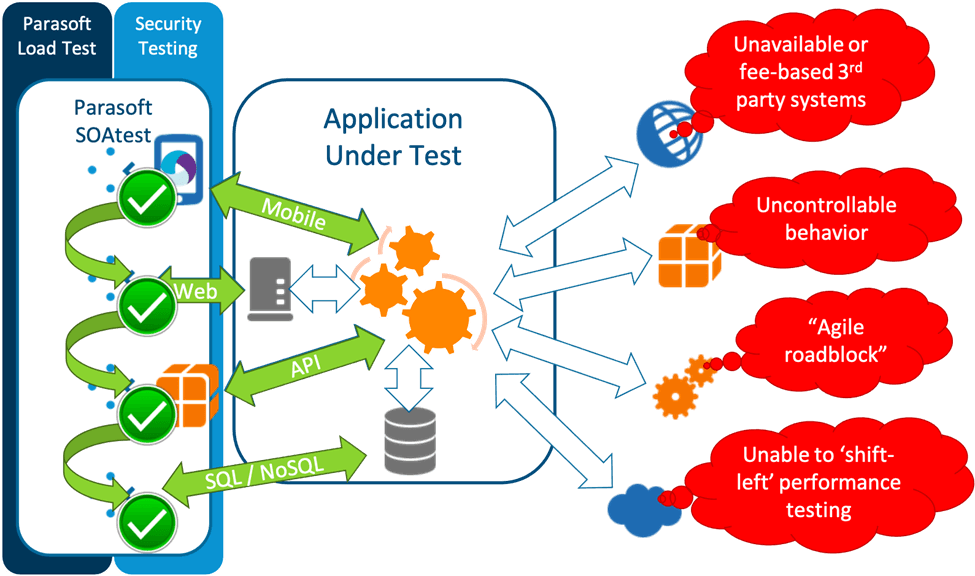
  • Unavailable environment. The test environment is often unavailable, uncontrollable, and constrained by system dependencies.

Teams must remove these obstacles for continuous testing to become ingrained in the development culture of a software organization.

Obstacle 1: Lack of Expertise on the Team

Initially, the lack of expertise isn’t only the team’s lack of knowledge and skills. It’s also limitations of tools being used.

Consider user interface (UI) test automation. It’s a common practice and reliable, but reusable automation is difficult. Selenium is the de facto standard. While open source and free, it has its own adoption curve, and it takes experience and time to master.

Selenium tests can be unreliable and what’s recorded one day, can’t be played back the next. Test maintenance becomes a growing issue as more UI tests are automated. Selenium requires further tools support to become easier to use and maintain.

Service level or API testing is a relatively new, but valuable practice. However, it sits in a no man’s land between developers and testers. Developers understand the APIs the best but aren’t motivated nor compelled to test them and testers lack the knowledge needed to do API testing.

The number one challenge when organizations are trying to adopt API testing, is understanding how the APIs are actually used. This isn’t to say APIs aren’t documented or designed well. Rather, there isn’t much information about how the services are being used together in a use case, workflow, or scenario.
lack
In addition, it’s important that API test automation goes beyond record (during operation) and playback (for testing). Modeling the behavior and the interactions between APIs are needed, as is using these interactions to steer test creation and management processes.

Performance testing is often seen as something that’s done by another team in the organization, perhaps performed as a check box item. But when performance issues arise, product development may have moved forward, and a disruptive rollback may be required.

Ideally, performance testing needs to be done earlier in the software development process and leverage the work already being done with automated functional testing. At the same time, the team is adopting API testing, they can leverage that work to enable performance testing to shift left, making it a joint responsibility of developers and testers.

How to Remove: Simplify Test Automation

The lack of expertise and training in the development and test team should not reflect on the team itself, but rather on the complexity when adopting test automation and associated tools. There are solutions available that strive to simplify test automation. These solutions make adoption less disruptive and integrate better into existing processes.

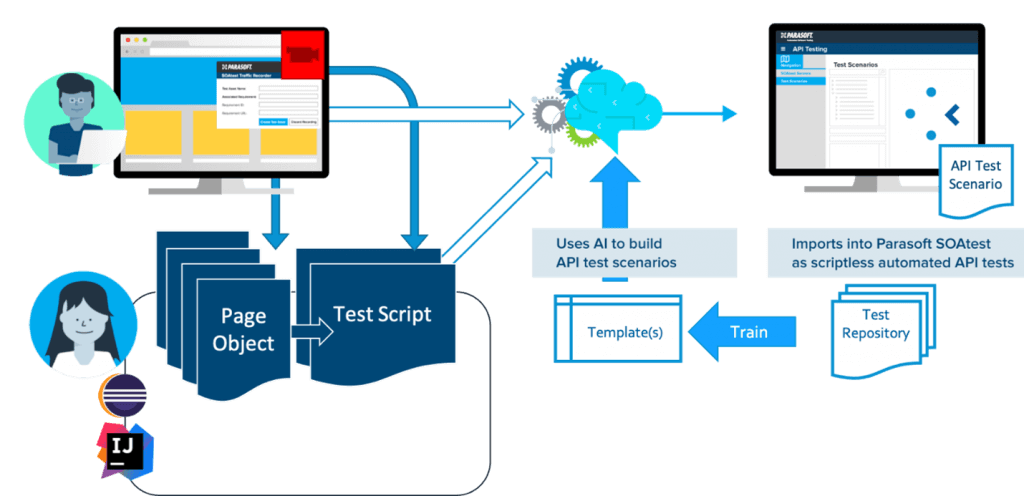
Create reusable, maintainable, and understandable test scripts. Parasoft Selenic solves the main issues with Selenium adoption: test creation and maintenance. By recording UI interactions via the Chrome browser, Selenium test cases are automatically created based on these interactions. In addition, locators are recorded using the page object model to be more resilient to changes in the UI. Selenic uses AI-driven self-healing of tests so that when UI changes break existing tests, the tool makes intelligent assumptions to prevent the test cases from failing.

Model real-world API test scenarios by recording manual and automated UI interactions. API test adoption is hindered by the ability to create tests. Parasoft SOAtest uses existing UI tests (including Selenic-created tests) to record API interaction happening during execution of the application. AI within SOAtest organizes these recorded interactions into recognizable scenarios which then form the basis of an API test repository. These API scenarios can be played back, edited, cloned, and reused to form a comprehensive API test suite. The automation and AI-powered decision making SOAtest does to make API testing easier to adopt, use, and maintain. Plus, it helps bridge the API testing knowledge gap in the development team.

Reuse existing test artifacts to efficiently scale load, performance, and security testing as part of DevOps pipeline. As the development team becomes more proficient at test automation for the UI and API levels, the test repository becomes an important reusable resource. Tests can be reused for load and performance testing and to increase use case and code coverage.

The process flow shows automation for Selenium UI tests, recording and creation of API tests, and reuse of assets for future functional, performance, and security tests.

Obstacle 2: Execution of Tests Is Unstable, Unreliable, & Takes Too Long to Run

Understandably, software organizations expect automated tests to be efficient and not impede development progress. However, as test suites grow, so do the problems with maintaining and executing them. Tests, like code, are impacted by change. New functionality added during a sprint can significantly impact the user interface or the workflows of the application. These changes break existing tests, making them unstable. It’s important to address those as quickly as possible.

When tests fail, you need to understand the context of the failure. Not every test failure is equal. Some use cases are more important than others or, perhaps, some tests are unstable by nature. What is lacking is an understanding of the impact of test failures or test instabilities on the business priorities of the application. Investigating these constant test failures becomes a distraction from the overall test automation strategy. Correlation between business requirements and tests is critical to ensure that the value of automation is realized.

Another obstacle is the actual execution time for test suites. As the test portfolio grows, so does the execution time beyond a reasonable waiting period for feedback. Quick feedback to change is essential for a successful CI/CD pipeline so test efficiency and focus are required.

How to Remove: AI-powered Test Execution

The solution to the test execution obstacle is to test smarter with AI. This means leveraging test automation AI to make tests more resilient to change and to target execution on key tests only.

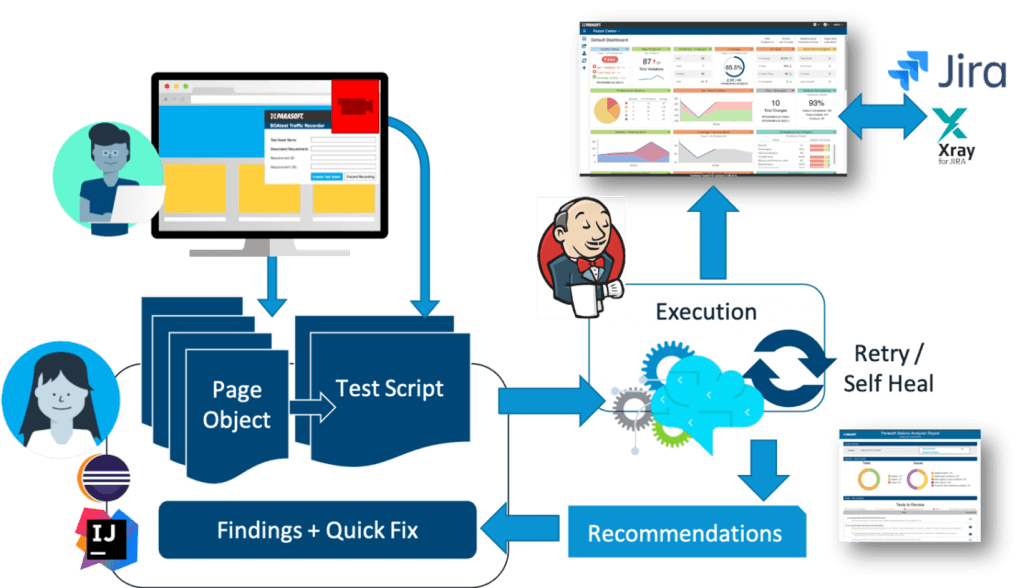
Smart UI testing with Selenium and Selenic. Using AI, Parasoft Selenic self-heals tests when UI changes are detected. These are automatically used but recommendations are sent to the developer to help fix the tests. These fixes can be automatically applied to the Selenium tests, removing manual debug and code changes.

Using AI to self-heal tests reduces test instability but also provides recommendations and quick fixes.

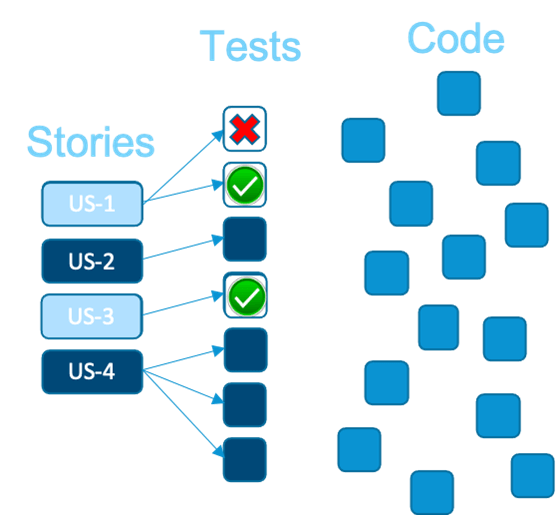
Plan work item tests based on impacted requirements. To prioritize test activities, correlation from tests to business requirements is required. Keeping track of user stories and requirements provides real-time visibility into the quality of the value stream. User stories and requirements should be reviewed for priority. The traceability capabilities in Parasoft SOAtest are used to plan execution for tests that validate items being worked on in-sprint. However, more is required since it’s unclear how recent changes have impacted code.

Prioritizing tests based on impacted user stories is the first step to optimizing test execution.

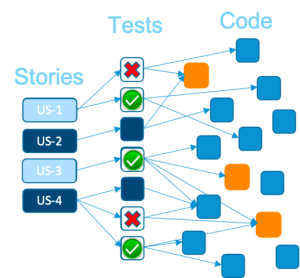
Use test impact analysis to validate only what has changed. To fully optimize test execution, it’s necessary to understand the code that each test covers, then determine the code that has changed. Parasoft tools provide this capability through a central repository for test results and analysis. Test impact analysis allows testers to focus only on the tests that validate the changes.

Test impact analysis determines which tests correlate to the code that changed to focus testing only on what should be tested.

Obstacle 3: Test Environment Is Unavailable, Uncontrollable, & Constrained by System Dependencies

The testing environment is the linchpin of the obstacles stopping organizations from turning automated into continuous testing. There are three types of challenges that organizations face when trying to make tests run anytime, anywhere, and dealing with the external dependencies of the application. This is especially true for a microservices architecture. The number of dependencies explodes due to the very nature of the design.

Test Environment Challenges

Waiting for access to a shared system, like a mainframe or an external dependency provided by a third party. Availability might be time limited and costly. It’s also a challenge if the external dependency is heavily loaded with multiple people working on it at the same time, resulting in test instability from data collisions.

Bottlenecks caused by delayed access. This is due to the nature of parallel development and typical of modern processes. For example, multiple teams are collaborating to deliver new features to the value stream such as interdependent microservices. Testing can’t proceed on one microservice because another isn’t available yet.

Uncontrollable test data. Although microservices are relatively easy to deploy and test in isolation, their dependencies on data or performance characteristics limit the ability of them to be tested thoroughly. For example, reliance on data in a shared production database can limit the ability to test services.

How to Remove: Control the Test Environment

Start simulating these dependencies to give the team full control using a service virtualization solution. Parasoft Virtualize simulates services that are out of your control or unavailable. It provides workflows that:

  • Enable users to access complete and realistic test environments.
  • Stabilize their test environment.
  • Get access to otherwise inaccessible dependencies.
  • Manage the complex business logic, test data, and performance characteristics required for virtual services to behave just like real services in the real environment they represent.

Service virtualization removes the bottlenecks. Here’s how.

Record and simulate: Capture, model, and provision simulations of live systems.

Using the recording capability of Parasoft SOAtest, it’s possible to capture the behavior of the application in its environment. Parasoft Virtualize models the behavior of external dependencies making it possible to remove and simulate the behavior of dependencies, dynamically on the fly, switching out real versus virtual. Making these services and dependencies available and stable, virtually, accelerates the testing process and enables continuous testing.

Dependencies in the test environment are obstacles to testing. Virtualizing these dependencies removes their impact on testing and enables continuous testing.

Deliver a prototype first: Model behavior based on contract descriptions or payload examples.

Service virtualization enables prototype development based on the contract descriptions derived from the API interaction recordings and analysis in SOAtest.

Dependent services can be simulated with good fidelity to create prototype versions that satisfy their roles in the system when testing another adjacent service. This removes the schedule limitation inherent in parallel development—even when services aren’t complete, they can be virtualized for testing other services.

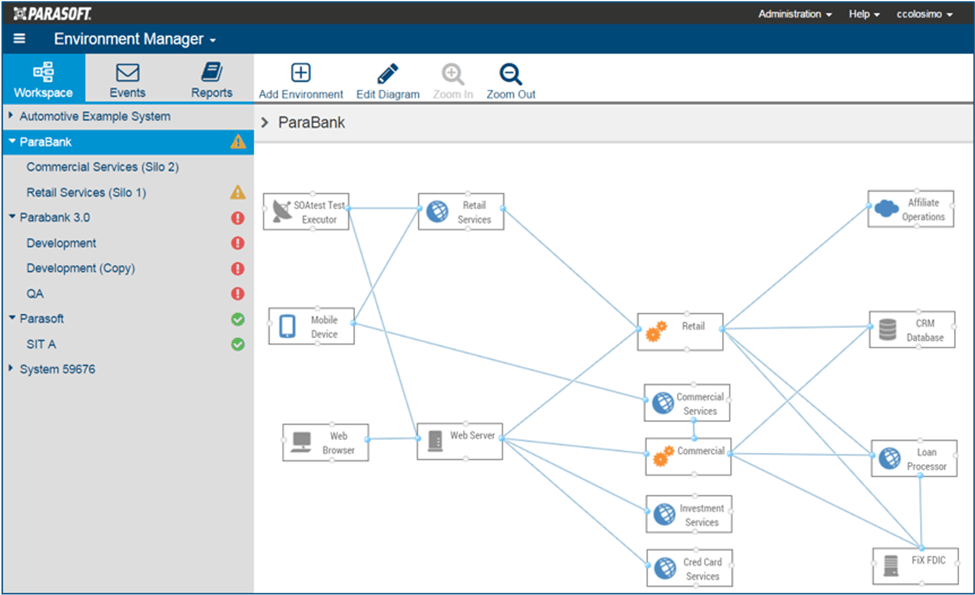
Environment Manager provides graphical modeling and control of the test environment. Services are controlled and virtualization parameters are configured using this diagram.

Synthesize private test data.

Another obstacle in testing enterprise applications is test data. Many organizations use real data, but this is fraught with privacy concerns. Purely synthetic data is often not realistic enough to test with so a compromise is needed. Synthesizing real data by removing personally identifiable information (PII) provides realistic and safe-to-use data. Test data management is required in conjunction with service virtualization to provide a realistic, highly available test environment that won’t result in any privacy compromises.

The Benefits of Continuous Testing

Removing the key obstacles to continuous testing enables testing to occur on a regular, predictable schedule. It transforms application testing empowering teams to:

  • Test earlier. Shift left to in-sprint testing where it’s quicker, cheaper, and easier to remediate the problem.
  • Test faster. Automate and execute continuously to get immediate feedback when defects are introduced.
  • Test less. Focus and spend less time creating, maintaining, and executing test scenarios. Reduce the cost of test infrastructure.

Want to learn some more about continuous testing? Join us at EuroSTAR in September, for 3 days of talks, tutorials, and lots more from leading test experts. Check out the full programme.

Parasoft is exhibiting at EuroSTAR Conference this year – take a look at their work here.

Author

Mark Lambert, VP of Strategic Initiatives at Parasoft

Mark focuses on identifying and developing testing solutions and strategic partnerships for targeted industry verticals to enable clients to accelerate the successful delivery of high quality, secure, and compliant software. Since joining Parasoft in 2004, Lambert has held several positions, including VP of Professional Services and VP of Products. Lambert is a public speaker and author. He’s been invited to speak at industry events such as JavaOne, Embedded World, AgileDevDays, and StarEast/StarWest. He has published thought-leadership articles in SDTimes, DZone, QAFinancial, and Software Test & Performance. Lambert earned both his Bachelor’s and Master’s degrees in Computer Science at Manchester University, UK.

Filed Under: DevOps, EuroSTAR Conference Tagged With: DevOps

EuroSTAR Keynote Spotlight: 5 Unmissable Talks

July 1, 2021 by Fiona Nic Dhonnacha

You know that feeling of clarity when something clicks into place? …aha! 💡 Well, our keynote speakers are serving up plenty of lightbulb moments – inspiration, game-changing ideas, and new ways for you to work.

This is your opportunity to get real insights on stories from AI, rapid testing, communication, exploratory testing, & lots more.

Moving to Frequent Releases – the 10 Communication Principles that Support Rapid Change

Rob Lambert

Shifting your delivery approaches to add more value to your customers requires epic amounts of good communication. Rob’s keynote details how his team moved from 14-month releases to weekly releases in just over a year – and almost all of it was to do with effective communication.

How? Politics, curbing dysfunctional behaviours, creating a strategy, dealing with failures, working well with other departments, setting goals and moving people into action.

Rob will share his 10 scientific principles of communication, and how each one lends itself to bringing about change.

Rapid delivery is not about new tech and shiny agile ways of working, nor is it about command and control; it’s about the subtle art of painting a bright future, creating a strategy, aligning people around that future, focusing on behaviours and routines, and finally, learning your way through it. All of this requires exceptional leadership and compelling communication. Rob will show you how to move people into motion by using emotion.

Key takeaways

  1. 10 useful, science based, communication techniques to use whenever you are trying to bring about change or sell a new idea
  2. How to move from long releases to short releases by putting testing at the heart and shifting the risks into production
  3. How to create a strategy and bring it to life.

The Journey of Testing Software for DNA Analysis

Aprajita Mathur

DNA contains our genetic code and it’s unique for everyone. The DNA of any 2 humans is on average, 0.1% different. This may seem insignificant, but it isn’t. To be specific, one letter change in just the right place in a 6.4 billion letter code of your DNA can cause a genetic disease.

DNA analysis is performed across the globe, and used to understand how to build better crops, how coronavirus impacts us, and how can we treat cancer. Given the wide range of applications, the task of identifying significant pieces of information in this BIG DATA set is performed using data analysis techniques, ranging from statistical methods to machine learning.

Aprajita shares her journey of testing bioinformatics applications, and how core quality and testing principles are applied to test complex data analysis software. Learn about common challenges like environments, continuous integration and data integrity, and new testing challenges like building novel datasets and testing statistical models that this industry faces and approaches to solve them.

Key Takeaways

  1. What is personalized medicine and how to engage with this technology, especially as a tester
  2. Challenges and mechanisms of testing data heavy applications. Why DATA is so critical !
  3. Testing is a diverse skillset and we are using it for testing ML , lets not be scared of this. Lets embrace, learn and engage


Digital Happiness in the Age of Customer Obsession

Michiel Boreel

Every general purpose technology impact on society follows a distinct pattern in long waves, that can last for 60 to 70 years. The internet will follow the same pattern. Just like the first industrial revolution with its machines and factories, the age of heavy engineering, and the age of the automobile, oil and plastics – we can learn a lot.

In the case of the internet, we are only halfway, and the most fundamental impact on society is still ahead of us. We’re right in the middle of a transformation from technological to societal innovation, where it becomes crucially important to focus on the social sustainability of all the magical applications we are creating.

How can the digital assurance and quality engineering community become the guardian of positive computing and digital happiness? With the rise of artificial intelligence and the emergence of surveillance capitalism, this becomes more important then ever.

Only when we all benefit from information technology, a new technology driven Golden Age can occur.

Key Takeaways

How is digital different from previous transformational technology waves

What is the impact of Artificial Intelligence, especially now that machines become creative?

How can the testing and quality engineering community assure beneficial application of technology and digital happiness for all?

The Automationist’s Gambit

Maaret Pyhäjärvi

In this talk, we extend agency from a person making decisions about design and execution of tests to making these decisions about use of automation. When we enter exploratory testing with programming skills, test automation becomes a way of documenting our testing and extending our reach. We can’t explore well without automating; we can’t automate well without exploring. And we need to learn between the tests in a way that changes the next test we perform.

what does sharing the exploratory testing work in teams with continuous delivery, continuous integration and DevOps look like? What new skills do we need to make good choices on where we apply automation?

Opening the game with an automationist’s gambit is a good option for solid foundation of testing. We need to talk about the impact of opening to the middle and end game of testing a product as well as building a career with testing emphasis.

The skills the future of the testing craft requires have already shifted. Good testing includes exploring with automation as well as without, intertwined.

Key Takeaways:

  1. Importance of agency and how to foster that in an organization
  2. Test automation as documentation, and its other uses
  3. Adding power to exploring one idea at a time

Engagement is a State of Mind

Janet Gregory

Engagement at the team level – what does that look like for testing activities? There is human engagement of empathy, collaboration, as well as understanding the impact to individuals, teams, organizations, stakeholders and our domain partners. Also, technical engagement with tools, infrastructure, deployment pipelines, versioning, and domain complexity as part of our daily work.

The only constant in life is change, so if a person is not learning new things, they are falling behind. A positive attitude to embrace change is needed to keep pace with our strategic roles. Can we, as testers, maintain that state of engagement? Join Janet to discuss how to keep engaged in all aspects of development and as part of our accelerated learning.

Key Takeaways

  1. Different ways to engage with your testing activities
  2. Thinking about engagement as something you have control over
  3. How active engagement can accelerate your learning

Check out the full EuroSTAR programme here to see all of our 2021 speakers, and start planning your schedule. Book your EuroSTAR ticket now and join us in September for 3 days of testing, learning and connecting.

Filed Under: EuroSTAR Conference

Acing an interview in the new normal

June 25, 2021 by Fiona Nic Dhonnacha

The ‘new normal’ means many things to many people. In all walks of life, we have to re-learn how to do simple things, and that’s no different in business.

One of the major changes many people have to contend with is the traditional interview process. How do we navigate interview etiquette when such an important part of an interview is about physical contact, facial cues and getting a “feeling” for the person we’re interviewing (or is interviewing us)?

Here are the 5 most important things you need to know about acing an interview in the new normal.

Replacing the handshake

Prior to the ‘new normal’, we would walk into a room and shake the hand of the interviewer, or the panel of interviewers, to establish rapport and introduce ourselves. But unfortunately, nowadays, we can’t do that. Instead, we now have to do this virtually. The good news is that we can still make that great first impression, and it’s all about making sure the first image of you, when you appear on the video screen, is what you want it to be. This will set the scene for the rest of your interaction.

For example, you can show ‘openness’ with a gentle and friendly raising of your hand, along with a gentle smile, while greeting the people on the other side of the screen. I’m not talking about a wave, just a gentle raising of either your left or right hand, followed by a polite greeting. This shows you are happy to be there, that you’ve got a warmness about you, and that you’re comfortable talking to the rest of the panel.

Technology can be your friend (or your enemy)

It is absolutely imperative to understand, and know how to use, the virtual platform. Some organisations use Teams, some use Skype, some use Zoom. One of the biggest challenges that I find is candidates only acquaint to the platform at the time of the interview, which can be a problem, especially in making that all-important first impression.

I’ve had instances where candidates couldn’t find the video toggle button, or something as simple as the unmute button. Which means they have to essentially try navigate their way through a ‘new’ piece of software for the first time, when it’s actually supposed to be interview time.

My suggestion: do a dry run and test the link a day or two before. It’s all about knowing what the process is to going to be like, so you’re fully prepared.

Secondly, and more importantly, is the hardware that you use. I strongly suggest you don’t use a cellphone for a video interview. Rather use a fixed device, either a laptop or a desktop. Remember, an interview is not the same as having a Whatsapp call; the image of you needs to be professional, which means stabilised and properly framed. There have been times where I’ve had interviews with candidates who use their cellphones, and all I could see was an image up their nose. This is not a good look.

Know your own CV

This point for me is probably one of the most important and in fact doesn’t only apply to the new normal but to any interview situation. This is where most candidates fail interviews, because they’ve actually lost familiarity with their own CVs and struggle to answer questions around tasks and duties that they themselves have put on the CVs.

Your CV is your textbook; learn it, study it and know it well. It is about you, after all. Being unable to respond quickly and effectively about your own capabilities will create doubt in the mind of any interview panel.

Maintaining focus during your interview

One of the most important techniques to learn for physical interviews is how to look at people, to maintain eye contact, and to be able to respond and look at different people in an interview panel inside the room. This is difficult, if not impossible to do in a virtual interview, but you can do the next best thing: maintain your focus on the screen at all times.

To simulate eye contact, keep your eyes focused just below the eye of the camera on your device, and it will appear to the viewer that you’re looking directly at them. When listening to the interviewer or anyone that’s posing questions, you are welcome to look at his or her face on your screen, but when you respond, always focus your eye just below your camera. Even though there may be multiple attendees on the chat, it will give every single person the impression that you are looking at and talking directly to them.

Integrate your surroundings

In a virtual call, each participant will be seated at various settings and locations. Some are at home, some at the office, some in their cars. However, it is up to you to invite the panel into your setting.

I have no problem with fixed backgrounds on Teams and other platforms for most video calls, but this is a problem when it comes to interviews. I once interviewed a candidate who used the standard office background on Microsoft Teams, which at first glance, looked absolutely fine. However, when he moved around, I could actually see that he was sitting up in bed, not a good look for a professional interview.

You can actually use your background to your advantage. Create a natural setting that reflects who you are as a person, not just a professional. For example, you can display your highest qualification behind you, or maybe a professional interest that you may have. Perhaps you’re a tennis lover, or a cricket player, a music listener, an animal activist; include some visual elements to represent that without you having to openly discuss it in the interview. Be careful not to be too controversial, by including visuals of specific sports teams for example. Rather keep it neutral and conversational.

Remember, interviews in the new normal can be just as exciting (or scary) as they were in the ‘old days’. By learning to adapt, using the guidelines above, and working with – rather than against – the technology, you can make an even better impression than before.

Good luck! 

Inspired Testing is exhibiting at EuroSTAR 2021 Online. Check out the EuroSTAR 2021 programme, and join us September 28-30th.

Author

Greg Naidoo, Head of Talent Acquisition at Inspired Testing

Greg has been leading Talent Acquisition efforts in Technology for more than 15 years. He has enabled organisations across South Africa to effectively attract and acquire top talent in Quality Engineering and Testing. He is passionate about growing the existing compliment of brand ambassadors at Inspired Testing to showcase their world class software quality engineering solutions..

Filed Under: EuroSTAR Conference, People Tagged With: EuroSTAR Conference

First Steps to Approach Test Automation

June 11, 2021 by Fiona Nic Dhonnacha

Test automation is a top priority for today’s companies. All, or almost, are betting on this aspect to reduce the effort of carrying out manual tests, avoiding the turnover of people in the projects, motivating employees, and saving time in the commercialization of products and services. But before jumping into the automation topic, several key aspects must be considered to fulfill the goal we establish.

The first thing to do is to analyze those three important areas need to be included in any test automation process: tools, test environment, and scope; although it is not necessary to do it in this order, because they are related.

Tools

The first step is to consider which tool meets our needs. The important thing is to analyze our needs and observe the types of validation, architecture, and tools that allow us to build, manage and report the automation project. The process of selecting an automation tool for web or mobile is not the same if we are thinking of an SAP system. Therefore, in this case, it is necessary to take a more specific approach concerning technical support and tools that suit the type of system chosen.

Test Environments

We need software, licenses, and infrastructure, in addition to a log of executions and parameterization. Therefore, it is necessary to define the test data management strategy and the requirements for continuous testing. In many cases, it is important to keep in mind that to get these sandboxes up and running, we need a lot of data. This is an aspect that cannot be ignored.

Scope

In terms of reach, what we must evaluate is what we want to automate. The initial assessment should aim to define which business processes we are going to automate. To do this, we must identify what kind of applications we have, the repetitive tasks and what we want to automate. Likewise, we have to define at what level we will implement test automation.

With these three fundamentals well established, we can observe some additional steps, such as the identification of the pilot application, the definition of small validation steps, which must be carried out step by step to manage expectations properly, and the automation criteria, which are used to identify the stability of the application in a test state. In this sense, we have to be sure of what will be used and evaluate the application’s life cycles; if it will be used for a long time, if it is obsolete or if the test time is acceptable.

Return On Investment

Last but not least, we must look at ROI (Return On Investment), taking into account both automation costs, with the remaining costs that we will have. The important thing here is to estimate the break-even point for the development, support/maintenance effort, and the tasks that must be performed manually. We will find the balance when we reach approximately 80% profit (considering the use of automation) and 20% effort (that would be the total amount to automate 100% of the reach).

In this sense, each organization must define the levels of automation that it will implement, and its level of scales, starting from 0 that corresponds to having no automation, and gradually going through levels 1 to 4. The first level corresponds to a basic level; the second at a more productive level, where we already have a roadmap, defined objectives, and KPIs; the third with a more consolidated automation framework, in which we already work on processes and not just on applications; and a fourth, and last, more advanced, in which we have already introduced artificial intelligence. These levels give a priority reference to guide us and the ideal is to have a detailed scale of priorities. Thus, as we increase coverage by 60-80%, investment starts to decrease. This is an important aspect to consider before starting.

Ultimately, it is important to focus on the future uses of test automation, based on good market practices, as well as how to get the ROI we want to achieve and good ways to measure it.

Noesis are exhibiting at EuroSTAR 2021 Online. Looking to learn more on test automation? Check out the EuroSTAR 2021 programme, and join us September 28-30th.

Author

Eduardo Amaral, Quality Management Director at Noesis

Quality Management Director at Noesis – Portuguese QM Services Market Leader, Eduardo worked as analyst/developer, project manager, program manager and service delivery manager. He has a background and certifications in several areas, including quality assurance, project/program management, process management and product management. Over the last 21+ years, Eduardo has been involved in a variety of software project development lifecycles and solutions integration, at high levels of complexity and customer experience exposure, performed in some of the major national and international companies, from different business areas – Industry, Banking, Insurance, Telco, Retail, etc.

Filed Under: EuroSTAR Conference, Test Automation Tagged With: software testing tools, Test Automation

  • « Previous Page
  • Page 1
  • …
  • Page 6
  • Page 7
  • Page 8
  • Page 9
  • Page 10
  • …
  • Page 15
  • Next Page »
  • Code of Conduct
  • Privacy Policy
  • T&C
  • Media Partners
  • Contact Us

part of the