• Skip to main content
EuroSTAR 2027 - Sign up for early access

EuroSTAR Conference

Europe's Largest Software Testing Conference.

  • Programme
    • EuroSTAR Global Series
    • Call for Speakers
    • 2026 Programme
    • Community Hub
    • Awards
  • Attend
    • Why Attend
    • 2026 Photos
    • Bring your Team
    • Testimonials
  • Sponsor
    • Sponsor Opportunities
    • Sponsor Testimonials
  • About
    • About Us
    • Our Timeline
    • FAQ
    • Blog
    • Organisations
    • Contact Us
  • Book Now

EuroSTAR Conference

Reminiscing EuroSTAR 2021: My Top 10

October 20, 2021 by Ronan Healy

A EuroSTAR Committee member looks back at the 2021 software testing conference.

It has been two weeks since the action packed conference has ended but I am still full of thoughts from the amazingly memorable event it has been this year. I have been associated with EuroSTAR for many years now as a reporter and a volunteer but this year was all the more special, with an opportunity to be a part of the programme committee. It was a huge honour and I enjoyed every moment of playing the role, working alongside some of the biggest names in the testing world Fran O’Hara, Janet Gregory, Derk-Jan De Grood and Szilard Szell. This has been a exhilarating experience to say the least! Right from going through the significant number of submissions, to making decisions on sessions for the three days it was incredibly fulfilling and enlightening to witness the programme come together. The collaboration with fellow committee members was brilliant as we went through an incredibly difficult decision of choosing sessions from submissions of very high quality! The programme always feels incredibly impressive but this year, there was a personal connection.  To witness the final form of it get unraveled to hundreds of participants is one of the most unforgettable experiences! This being a second online edition of the conference, there were a number of aspects to be considered but I must say none of that felt like an unsurmountable challenge, thanks to the unwavering support provided by the fantastic conference team. As the event got underway, there was so much energy and knowledge in the virtual environment that I felt transported into a world of unlimited inspiration! So much to learn and rejoice! As always, I want to list the top 10 things from this year’s conference for me. In no particularly order these aspects stood out for me this year: 

  1. Engage theme: I felt this year’s theme was a winner in attracting a huge variety of submissions. It was awe inspiring experience to see the various interpretations of it! I found it to have created a welcoming spirit amongst the conference participants as the theme could have multiple interpretations which helped spur creativity and imagination. Many congratulations to conference chair Fran to have come up with this motivational theme – it was a joy to work as a programme committee member on this theme 

  2. Tutorials – I always enjoy this format of the programme as you get to focus and absorb information on one specific topic. This year, once again I have to say the tutorial experience was an absolute delight, being a part of the award winning team of Anne Colder- Jantien van de Meer, who effortlessly delivered  a highly coordinated, superbly crafted session. A stellar line up of speakers including maestros Michael Bolton, Rik Marselis delivered these phenomenal sessions, giving the participants an opportunity to deep dive into topics of interest – a great feature of the conference! 

  3. New terminologies – I learnt a few excellent terms from this year as part of many conversations ‘Critical incident’ is the top one from this year which was shared by Testing Guru Dawn Hayes. As Dawn puts it, critical incident is an experience after which you never return to operating like before. To me, all of this year’s experience has been one such critical experience! Another term is ‘happiness engineer’ – I derived it from an amazing key note delivered by Michiel Boreel who  referred to testers as the guardians of digital happiness and in fact went on to suggest we should consider the above new title for testing professionals! These interesting terms have been duly added to my everyday vocabulary! 

  4. Implementable knowledge: All through the three days the sessions I attended delivered not just the theory behind an idea but gave an excellent focus on practical implementation of those approaches. Be it the concept of Building relationships by Lukasz Pietrucha, Automation pitfalls and possibilities by Sune Engsig, Quality and human factors by Andrew Brown, Dealing with conflict by Marielle Roozemond – I can list possibly every single session I attended which gave me new insight on how differently testers can approach real life challenges. As I am catching up on recordings from the event, my learning is continuing! 

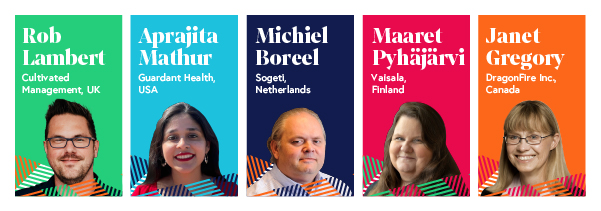
  5. Riveting Keynotes: Each and every keynote session in this year’s conference was a gem, I went on being amazed at how fantastically these topics were presented by the skillful speakers. As one of the participants said “how many times can mind be blown in three days!”. I found all keynotes to be outstanding and to have delivered key messages that are highly relevant to our area of work. Rob Lambert, Aprajitha Mathur, Micheil Boreel,  Maaret Pyhäjärvi and Janet Gregory – a huge round of applause to have made incredibly impactful deliveries.

  6. Lightening talks: This has been my favourite format of talk, ever since I witnessed it back in 2018 with none other than Fran O’Hara on the stage! I was delighted to not only see this format again on EuroSTAR platform but also get the privilege of being a part of it! I was one of the eight speakers who delivered a brief 5 minute talk on a topic of their choice, which delivered great nuggets of thoughts for audience to consider. It was a high energy, fast and interesting session. I personally enjoyed preparing and delivering my short piece, felt honoured to have shared the virtual stage with amazing speakers like Dawn Hayes, Tariq King, Elise Carmichael, Rob Meaney, Sanne Visser,  Chris Armstrong and Raj Subrameyer. Thrilled to have been a part of this fantastic ensemble!


  7. Huddle sessions: This is an aspect of  the conference I hold close, as my predominant involvement as a reporter / volunteer has been in this space. As always, this was action packed this year with a variety of conversations and activities. Inspirational AMA sessions with Michael Bolton, Rob Lambert, Jyothi Bhatt and Sune Engsig, career advise from Raj Subrameyer, Ensemble testing by Maaret Pyhajaravi,  exploratory bug hunt with Marek Lof and so much more! The breaks from sessions had many engaging activities to relax and to network with fellow participants. The feedback sessions were great in hearing from the members of community. Always a hugely uplifting huddle of people! 

  8. Award winners: It was an absolute delight to learn of the most deserving winners of the award which was actually a top secret and not known till announced at the ceremony! Hearty congratulations Kari Kakkonen on the Software Testing Excellent award! I had the privilege of attending Kari’s session last year’s conference and I have since been in awe of his dedication, enthusiasm for testing, particularly about educating younger generation. The winner of best paper Adonis Celeste is again someone I have seen on EuroSTAR platform back in 2018. His white paper has deep insight and excellent pointers for tester role, a highly recommended read. We are fortunate as a community to have such brilliant thought leaders! 

  9. Conference team:  I have known this team for a few years now and I guess I have run out of superlatives to express how much I admire them! It was yet another extraordinary experience to see the event being brought together skillfully and coordinated to perfection. What was an additional aspect was how experienced the team has in running the conference and how deftly they apply it in real time. The process was smooth flowing in spite of how complex the three day long event can be in terms of logistics and planning. Their tireless efforts, commitment and professionalism is simply top notch. Truly a wow team! 

  10. Testing community spirit: This entry has stayed in my top 10 list ever since I started attending EuroSTAR conference. This is an aspect I am so proud of and so very much enjoy during this event. The enthusiasm and community spirit just shines through on every occasion. This year too the participants proved that the format is secondary and the spirit of being in company of fellow testing professionals is much more! The conversations during the talks and the engagement with Q&A sessions from this year’s talks was outstanding! It was really nice to get to meet many participants from near and far, covering a big spectrum of career experience. The celebration of diversity in this community is exemplary and I feel really lucky to be a part of it!

As this year’s conference comes to an end, the new one is already looking hugely exciting! To be held in the beautiful city of Copenhagen, the conference is going to be first in-person event after 2 years of being virtual. It will be headed by none other than testing Guru Graham Freeburn,  accompanied by the team of experts Sue Atkins, Morten Hougaard, Bart Knaack, and Tone Molyneux. I am sure this fabulous team will come up with a brilliant programme that we all look forward to! 

In conclusion, I must mention, this year has been particularly emotional for me as EuroSTAR has been on my mind for the last 8 months. I am immensely happy for the conference Chair Fran, fellow committee members and the conference team on the success of this year’s event. My hearty congratulations to everyone involved  – the speakers, the audience, the sponsors – what a festive experience that was from start to finish! I also feel a bit philosophical about the year that has been to us in the larger sense. We have all been through strange times and this event made reflect on how we have managed to stay connected as a community in spite of multiple challenges. Human resilience and adaptability will hopefully see us through as society as we transition back to the ‘original normal’. Here’s to the new sprouts of hope that have started to appear and here’s to good health, well being for everyone! 

About the Author

Sowmya Ramesh EuroSTAR Committee
Sowmya Ramesh

Sowmya Ramesh is a testing professional with over 18 years of IT industry experience currently working as a consultant with 2i Testing. She has a deep interest in the area of non-functional testing, in particular, accessibility testing which she has promoted for a number of years in the testing community. Sowmya writes blogs on topics of professional interest and has been a speaker at events for MOT Edinburgh, DevTest Summit. Sowmya was awarded a reporter role on Eurostar Conferences in 2017 and 2018 and in 2021 was part of the EuroSTAR Conference Committee.

Filed Under: EuroSTAR Conference Tagged With: EuroSTAR Conference

Call for Submissions 2022 is open

October 11, 2021 by Fiona Nic Dhonnacha

The 2022 Call for Speakers is officially open, and we want YOU to get involved, and share your story on Europe’s biggest testing stage.

If you haven’t already heard, we are back live and in-person for 2022. Next June 7-10, we’re celebrating 30 years of the EuroSTAR community with a live celebration in Copenhagen. This will be no ordinary EuroSTAR – it’s going to be a massive in-person party. Join us!

submit to speak

Do you have a testing story you’d like to share? A new strategy or approach? Perhaps a lived experience that you want the testing community to benefit from? Your contribution is so valuable to our community, and our EuroSTAR audience is active and ready to learn. 
The theme of 2022 is ‘Shaping Testing’. There are so many ways to interpret this theme, but here are some pointers to get you thinking. 

  • How you shaped your testing in a project to best fit the context
  • Building and developing your testing skills – what “shape” of tester do you want to become?
  • How best to learn from things that go wrong or are difficult1.  
  • What should the shape of testing be in the future?
  • What shapes / variations of techniques have you used and what benefits did they deliver?
  • The floor is open…
submit to speak

We invite speakers from a diverse range of topics including approaches to testing, testing techniques, tools and automation, security, quality, skills and knowledge, teams and organisations as well as ethics, professionalism, how we work and so much more to speak at EuroSTAR.

Whether you’ve never spoken at a conference before, or you’re a professional speaker, we welcome everyone to submit to speak at EuroSTAR. There are so many reasons why speaking at an international testing is beneficial. Learn more here.

It could be you this year on the EuroSTAR stage! Start preparing your submission now – the closing date for submissions is November 15 2021.

Filed Under: EuroSTAR Conference

EuroSTAR 2021 Day 3 – Sketchnotes

October 1, 2021 by Ronan Healy

Wow, the last day of the 2021 edition of the EuroSTAR Conference was over in a blink. There were also offered several side events that took place in between the conference talks like tool demos, AMAs and a feedback round at the end of the day.

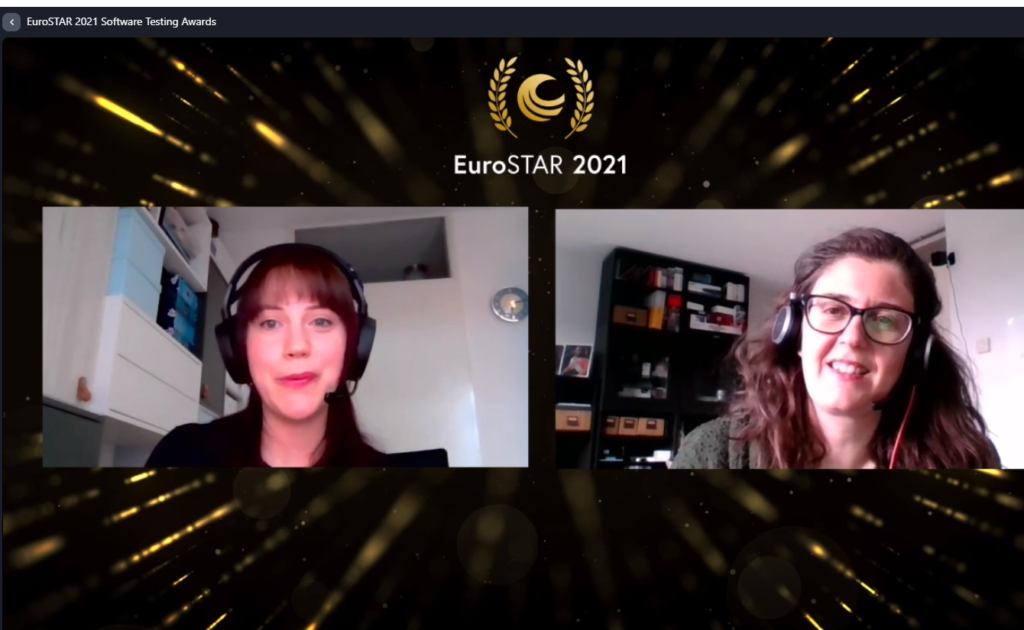
A special program point was the EuroSTAR 2021 Software Testing Awards ceremony. Here the winners of the awards for Best Tutorial, Best Conference Paper and the 2021 EuroSTAR Testing Excellence Award have been announced.

And last, but not least, the programme committee and location for the 2022 edition of the EuroSTAR Conference have been presented. Copenhagen in summer – how cool is that?

But now, let me show you my sketchnotes of the day and do a quick summary of the talks.

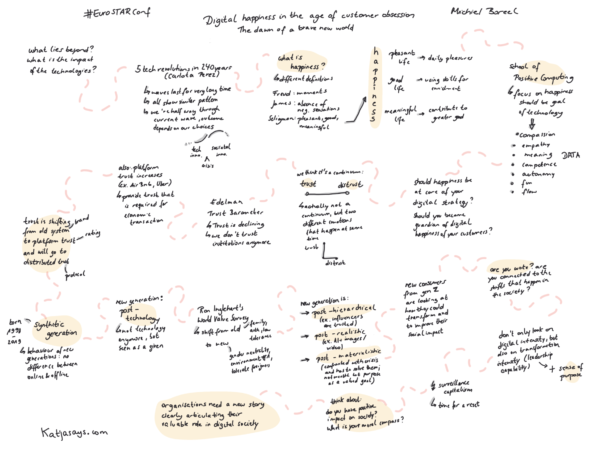
Digital happiness in the age of customer obsession

Michiel Boreel
As the world is constantly changing and with it the people and their needs, opinions an mentality, Michiel wanted us to think more about Positive Computing. Focusing on happiness as a goal of technology.

We tend to think that from trust to distrust it’s a continuum, but actually they are two different emotions that happen at the same time. Overall, trust is declining. We don’t trust organisations anymore. Also, platform trust increases (ex. Airbnb, Uber) as these platforms provide the trust that is required for the economic transaction.

People born from 1998 to 2019 build the new synthetic generation. These people don’t see a difference between online and offline. They are:

  • Post-technological: it’s not an innovation anymore, but seen as given
  • Post-hierarchical: they trust influencers more than companies
  • Post-realistic: with AI working on images and videos, reality can be altered
  • Post-materialistic: they are confronted with crisis and want to solve the issues. Now not wealth but purpose is a valued goal

Companies have to ask themselves if they are woke – are they connected to the changes that happen in society? How can you transform and get a sense of purpose? Organisations need a new story clearly articulating their valuable role in digital society.
Digital happiness in the age of customer obsession

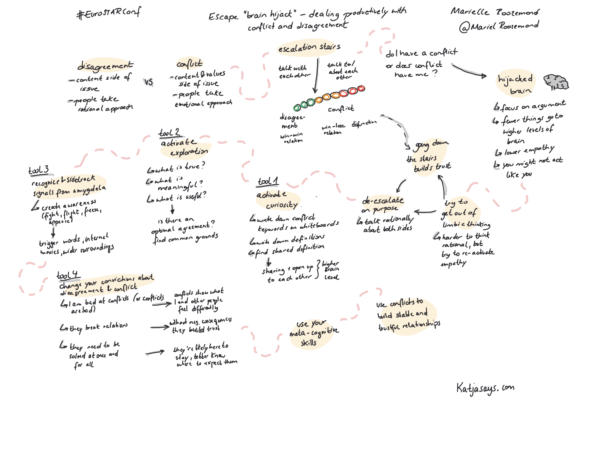
Escape “brain hijack” – dealing productively with conflict and disagreement

Marielle Roozemond
First, let’s define disagreement and conflict. Disagreements are about the content side of issues and people take a rational approach to them. Conflicts are about the content and the values side of issues and people take an emotional approach to them. Going up the escalation stairs, it’s not a very long way from win-win situations over win-lose situations to disfunction.

A highjacked brain focuses on the argument while fewer things get to the higher levels of your brain. You have a lower empathy and you might act not like you. If so, you need to try to de-escalate on purpose and to re-activate thinking with the higher levels of your brain.

Marielle proposed 4 tools to do so:

  • Activate curiosity
  • Activate exploration
  • Recognize and sidetrack signals from amygdala
  • Change your convictions about disagreement and conflict
Escape brain hijacking - dealing proactively with disagreement and conflict

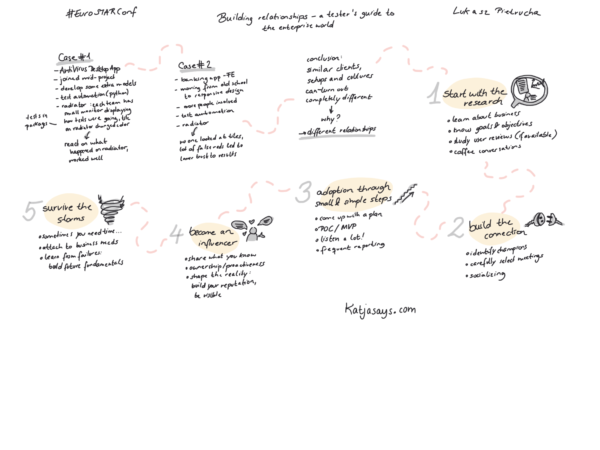
Building relationships. A Tester’s Guide to the enterprise world

Lukasz Pietrucha
Building relationships is crucial, not only, but especially when working as a tester. Lukasz has a 5 pillar concept that he presented to us:

  1. Start with the research: learn about business, know goals & objectives, study user reviews
  2. Build the connection: identify champions, carefully select meetings, socializing
  3. Adoption through small and simple steps: come up with a plan, POC/MVP, listen a lot, frequent reporting
  4. Become an influencer: share what you know, ownership/proactiveness, shape the reality – build your reputation, be visible
  5. Survive the storms: sometimes you need time, attach to business needs, learn from failures – build future fundamentals
Building relationships - a testers guide to the enterprise world

Using requirements as call to … conversations

Irja Straus
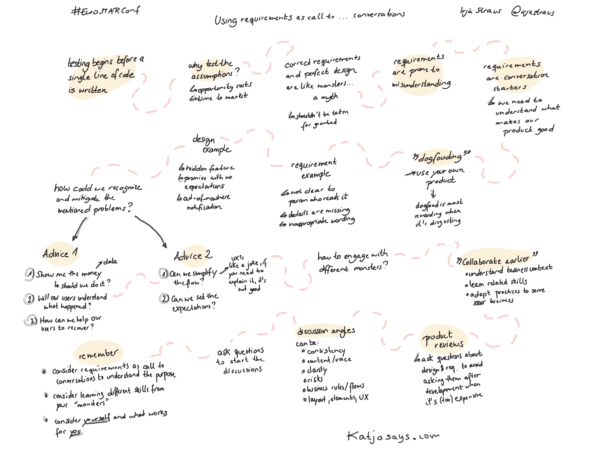
Testing begins before a single line of code is written. Testing assumptions can be helpful to determine opportunity costs and time to market. Keep in mind that correct and perfect requirements are a myth, they are prone to misunderstanding. BUT: They are a great conversation starter.

Irja likes to use “dogfooding” to get the to ground of the requirements – this basically means using your own product. The more disgusting it is, the more rewarding it gets, as you can discover more problems along the way.

Ask yourself if you have enough data that shows, that you need to build a certain feature. Will users understand what is happening and if not, how can we help them recover in case of failure? Try to simplify the workflow and think about if you could set the expectations.

A good approach is to collaborate earlier. Understand the business context, learn related skills and adapt practices that serve YOUR business. A good way of doing this is by doing product reviews. Ask the questions about design and requirements to avoid asking them after development when it’s too late/expensive to change anything.

Irja wants us to remember the following 3 things:

  • Consider requirements as call to conversations to understand the purpose
  • Consider learning different skills from your “monsters”
  • Consider YOURSELF and what works for YOU
Using requirements as call to conversations

The Automationist’s Gambit

Maaret Pyhäjärvi
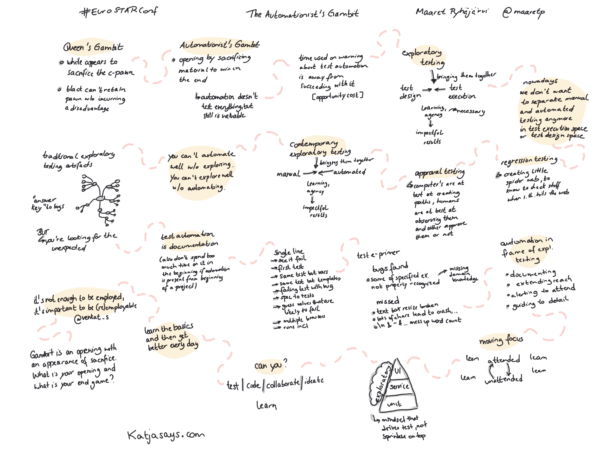
Some time ago Maaret learned about the Queen’ Gambit – a chess move in which white appears to sacrifice the c-pawn but then black not being able to retain pawn without incurring disadvantage in the end. She then thought about the Automationist’s Gambit – opening by sacrificing material to win in the end. Automation might not test everything, but still be very valuable. Even if at first your automation tests aren’t perfect, start small, learn the basics and then get better every day.

Traditionally test design and test execution as well as manual and automated tests were seen as separate things. With (contemporary) exploratory testing this has changed. In test execution a good example is regression testing: automation serves as a little spider web and if something hits the web, you can manually check that part. For test design approval testing is a good example: the computer, the automation, creats the paths, and the human, manually, observes them and either approves or diapproves these paths. So you can’t automate well without exploring. You can’t explore well without automating.

Test automation in the frame of exploratory testing can serve for:

  • documenting
  • extending reach
  • alerting to attend
  • guiding to detail
The Automationists Gambit

Frustrated? It might be your fault!

Jeffrey Fredrick & Douglas Squirrel
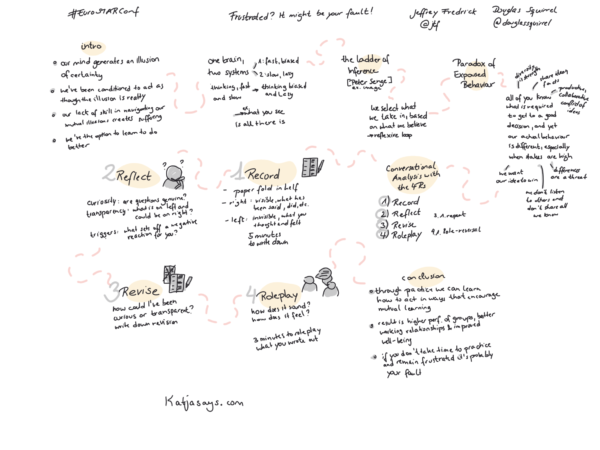
Our mind generates an illusion of certainty. We’ve been conditioned to act as though the illusion is reality. Our lack of skill in navigating our mutual illusions creates suffering. We have the option to learn to do better. All of us know what is required to get to a good decision, and yet our actual behaviour is different, especially when stakes are high. We want our idea to win, we see difference as threat and we don’t listen to others and don’t share all we know.

Jeffrey and Douglas presented the 4R Model for Conversational Analysis:

  1. Record: fold a paper in half – on the right side write down the visible part of the conversation, on the left side write down the unvisible part, meaning your thoughts and feelings
  2. Reflect: Be curious and ask if your questions are genuine, be transparent and think about what things from the left side could be on the right and think about the triggers that set of a negative reaction for you
  3. Revise: How could you’ve been curious and transparent – write down a revision
  4. Roleplay: Roleplay your revision and see how it sounds and feels

Through practice we can learn how to act in ways that encourage mutual learning. The result is higher performance of groups, better working relationships and improved well-being. If you don’t take time to practice and remain frustrated, it might be your fault.
Frustrated - it might be your fault

Continuous quality: The secret of the Pharaos

Adonis Celestine
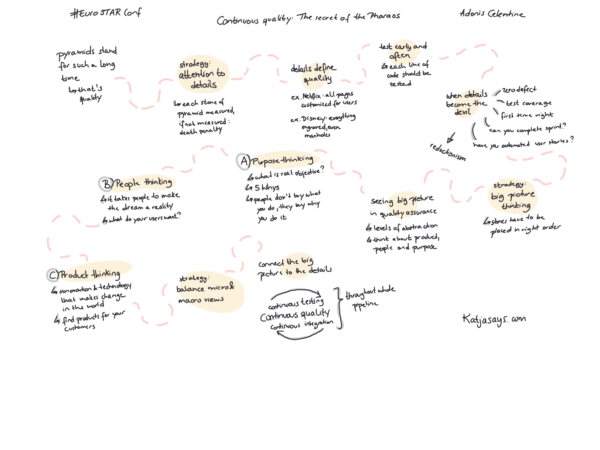
When thinking about pyramids, it is astonishing that they are still standing, even after such a long time. This is because of their great quality. Adonis talked about the strategies of the pharaos and what we can learn from them for building continuous quality into our products.

The first strategy is the attention to details. The pharaos measured all stones, each and every one. Details define the quality, like Netflix customizing their pages for their users or Disney even engraving manholes in their parks with their logo. But details can also become the devil. Think about things like zero defect strategy, doing it right the first time, test coverage, questions about if the sprint can be completed or if the user stories have been automated.

The second strategy is thinking about the big pictures. The stones of a pyramid have to be placed in the right order. In quality assurance you have to use the following types of thinking:

  • Purpose thinking: what is the real objective, ask the 5 whys – people don’t buy WHAT you do, they buy WHY you do it
  • People thinking: it takes people to make the dream a reality, so think about what your users want
  • Product thinking: what is the innovation and technology that makes a change in the world, you have to find products for your customers, not customers for your product

And the last strategy is to balance micro and macro views, meaning connecting the big picture to the details throughout your whole pipeline.
Continuous quality - the secret of the pharaos

Engagement is a state of mind

Janet Gregory
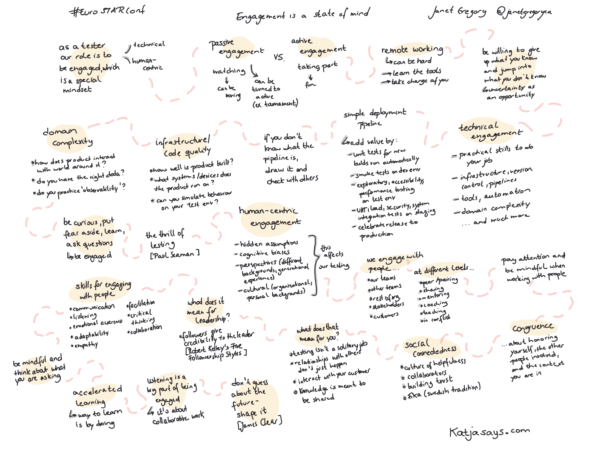
The final keynote of the EuroSTAR Conference 2021 was held by Janet Gregory. She thinks that as a tester our role is to be engaged, which requires a special mindset. There is passive and active engagement, watching vs. taking part. Use uncertainty as an opportunity to grow.

Technical engagement is about practical skills to do your job, infrastructure, pipelines, tools, automation and domain complexity. Ask how well your product is built, what system/devices it runs on, if behaviour can be simulated, how the product interacts with the world around it. Ask if you have the right data and if you practice observability.

In human-centric engagement there are hidden assumptions, cognitive biases, different perspectives and cultures and all this also affects our testing. We engage with people like our teams, other teams, stakeholders or customers at different levels like sharing, mentoring, teaching or in conflict. Therefore we need to pay attention and be mindful when we work with people. Honour yourself, the people involved and the context you are in.

To be socially connected, you need a culture of helpfulness, collaborators and to build trust. As a tester you have to remember that testing isn’t a solitary job, relationships with others don’t just happen, you need to interact with your customer and that knowledge is meant to be shared.

So the skills for engaging with people are:

  • communication
  • listening
  • emotional awareness
  • adaptability
  • empathy
  • facilitation
  • critical thinking
  • collaboration
Engagement is a state of mind

I can’t believe the EuroSTAR Conference 2021 is already over. Hopefully I’ll get the chance to attend the next edition and once again share my sketchnotes with all of you.

About The Author

Profile Photo

Katja Budnikov is a software tester and sketch noter from Northern Germany. Katja is passionate about software testing and sketch noting! She loves attending events like EuroSTAR and sharing her experience and learnings with others on her blog Katjasays.com. Katja first started sketchnoting in 2016. First analogue with pen and paper and now digitally with an iPad and Apple Pencil.

In her work life Katja started out in online marketing, then specialized in search engine optimisation and is now a quality assurance specialist in both manual and automated software testing. Away from work Katja loves photography, especially taking photos of nature, including many of her dog Auri, a young Australian Shepherd, who is super cute and fun to take photos of. She loves to spend time with her dog and partner, going out for walks, traveling and eating cake at a nearby coffee shop with a beautiful garden.

Filed Under: EuroSTAR Conference Tagged With: EuroSTAR Conference

EuroSTAR 2021 Day 2 – Sketchnotes

September 30, 2021 by Ronan Healy

Woohoo, finally it’s that time of the year again – the EuroSTAR Conference is on. This year it took place as an online edition which gave people from all around the world the opportunity to take part in this amazing conference without needing to travel during the pandemic times.

Although it is an online edition, there was plenty of space to meet other attendees. You could do a speed meet sessions and talk to someone randomly for 3 minutes. You could join a lean coffee session and discuss interesting topics. You could get solutions to your problems from the Test Clinic. Or you could check out the demos of the sponsors and stroll through the Expo area.

The Programme Committee around the Programme Chair Fran O’Hara made an amazing job when choosing the speakers for this year’s edition and you could listen to talks from different areas of testing, speakers with different backgrounds and from different cultures. Let me summarize my first day at the EuroSTAR Conference 2021 by using my sketchnotes.

Moving to frequent releases. The 10 Communication Principles that support rapid change.

Rob Lambert
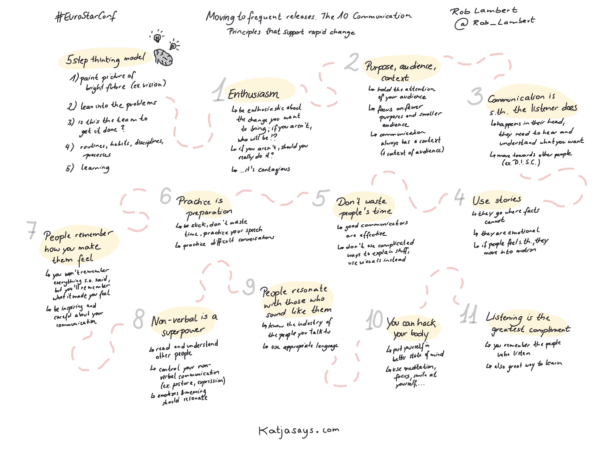
The first keynote of the day was held by Rob Lambert. Rob started by explaining the 5 step thinking model. First, you paint a picture of the bright future (like a vision). Then you lean into the problem and ask if the team is the right one to get it done. Afterwards it’s all about routines, habits, disciplines and processes, and finally there is a lot of learning.

He then talked about the 10 (+1) Communication Principles to support rapid change. These are:

  1. Enthusiasm
  2. Purpose, audience, context
  3. Communication is something the listener does
  4. Use stories
  5. Don’t waste people’s time
  6. Practice is preparation
  7. People remember how you make them feel
  8. Non-verbal is a superpower
  9. People resonate with those who sound like them
  10. You can hack your body
  11. Listening is the greatest compliment
Moving to frequent releases - the 10 Communication Principles that support rapid change

Quality is not about testing … it’s about value!

Gitte Ottosen
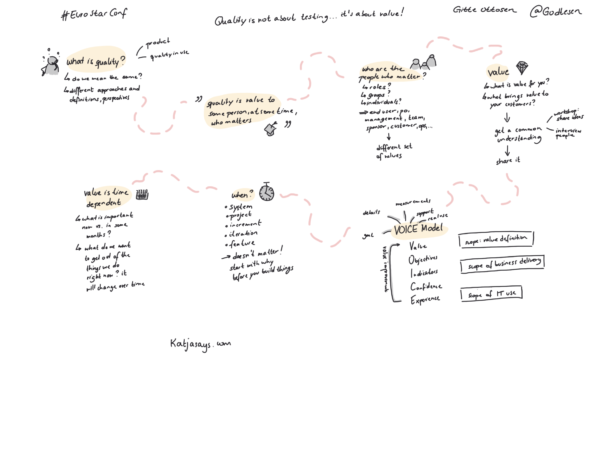
Gitte thinks that is not that easy to define what quality is, as it doesn’t mean the same to everybody. It is the value to some person, at some time, who matters. So you have to find out who the people that matter are.

More important, you have to think about what value means to you and get a common understanding throughout the whole team. You can do so by using the VOICE Model: Value, Objectives, Indicators, Confidence, Experience. As value is time dependent, you have to think about what you want to get out of the things you do right now – this will change over time.
Quality is not about testing - its about value

5 myths and anti-patterns to refactor out with continuous performance

Paul Bruce
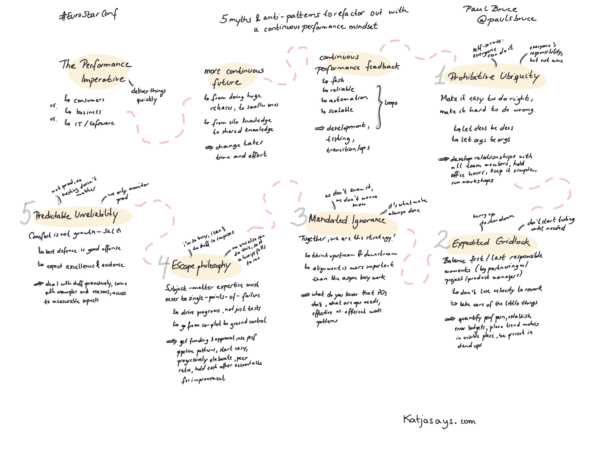
Nowadays, organizations want to deliver things quickly. They run into a more continuous future where they do smaller releases more often and share knowledge along the way. This only works if continuous performance feedback is given.

Paul used 5 myths/anti-patterns to explain how to get to having a continuous performance mindset:

  1. Prohibite Ubiquity
  2. Expedited Gridlock
  3. Mandated Ignorance
  4. Escape Philosophy
  5. Predictable Unreliability

Have a look at my sketchnote to learn more about the mantra and possible actions for each anti-pattern.
5 myths and anti-patterns to refactor out with continuous performance

CSI testing – investigate like a pro

Adam Matlacz & Elzbieta Sikora
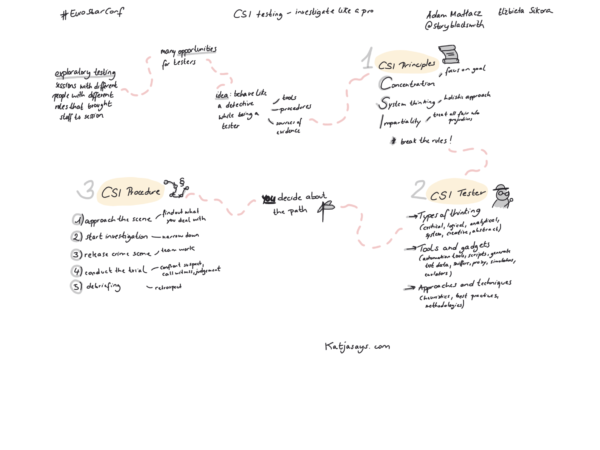
Adam and Elzbieta think that exploratory testing brings many opportunities for testers, especially when the sessions are held with people with different roles. While being a tester, you can behave like a detective when you are on a bug hunt. That’s how they came up with CSI Testing.

The CSI Principles are: Concentration, System thinking and Impartiality (+ break the rules). Focus on a goal, use a holistic approach and treat all fair without prejudices. A CSI Tester should build skills around different types of thinking, tools and gadgets and approaches and techniques.

The CSI Procedure would look like that:

  1. Approach the scene: Find out what you deal with
  2. Start investigation: Narrow down
  3. Release crime scene: Team work
  4. Conduct the trial: Confront suspects, call witnesses, judgement
  5. Debriefing: Retrospect
CSI testing - investigate like a pro

Lightning Strikes

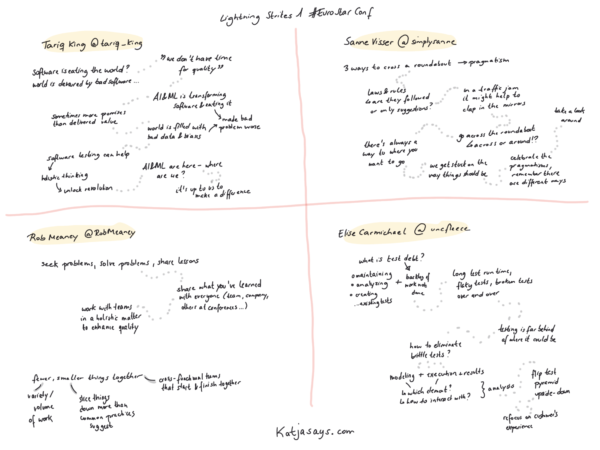
Lightning Strikes are short talks of 5 minutes in which 2 slides are allowed. This year there were 8 speakers who were giving a lightning talk.

Lightning Strikes 1

Tariq King, Sanne Visser, Rob Meaney & Elise Carmichael
Tariq thinks that the world is full of bad software and by filling AI & ML systems with bad data and biases, the problem is being made even worse. By testing your software and using a holisitic approach, you can unlock a revolution and make a difference.

The essence of Sanne’s talk is, that you should always remember that there are different ways to get to where you want to get and that you should take a look around and think outside the box to not get stuck on the way things should be.

Rob shared two philosophies with us: Seek problems, solve problems share lessons, which is basically about sharing what you’ve learned with everyone and working in a holistic matter to enhance quality. The other one is: Fewer, smaller things together – which means fewer as in the variety/volume of work, smaller as in slicing things down more and together as in cross-functional teams that start and finish together.

Elise thinks that next to maintaining, analyzing and creating tests there is a huge portion of test debt, a backlog of work not done. She thinks that flipping the test pyramid upside-down helps you to refocus on the customer’s experience and therefore also reducing some of this debt.
Lightning Strikes 1 EuroStarConf

Lightning Strikes 2

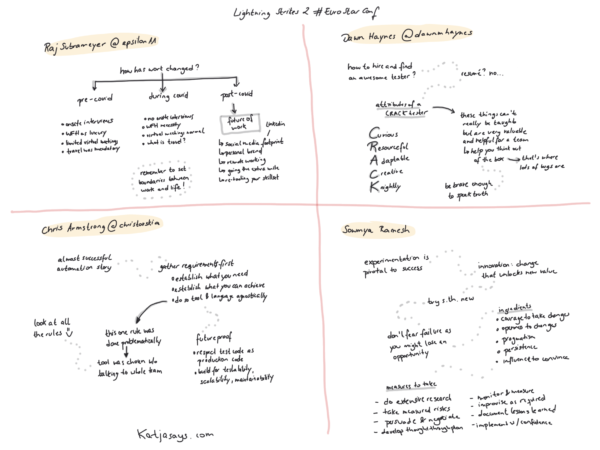
Raj Subrameyer, Dawn Haynes, Chris Armstrong & Sowmya Ramesh
Raj compared pre- and during covid work to each other and found that from having onsite interviews, working from home as a luxury, limited virtual meetings and mandatory travel it all transfered to no onsite interviews, work from home as a necessity, virtual meetings as a normality and travel not existing any more. This leads to a huge change in the future of work in which a social media footprint, personal branding, remote working, going the extra mile and re-tooling your skillset become crucial.

Dawn’s approach to finding and hiring awesome testers is usins these attributes of a CRACK tester:

  • Curious
  • Resourceful
  • Adaptable
  • Creative
  • Knightly

In short, Chris’ talk is about not overlooking any rules when doing test automation. A small mistake as letting someone and not the whole team decide on which tool to use might turn into a huge problem.

Experimentation is pivotal to success. Sowmya encourages us to be open to changes, so that we don’t lose any opportunities. But while experimenting, you should not forget to do extensive research, monitor and measure, improvise as required, document the lessons learned and implement with confidence.
Lightning Strikes 2 EuroStarConf

The seeds of toxicity we’ve been trained to overlook at work

Raj Subrameyer
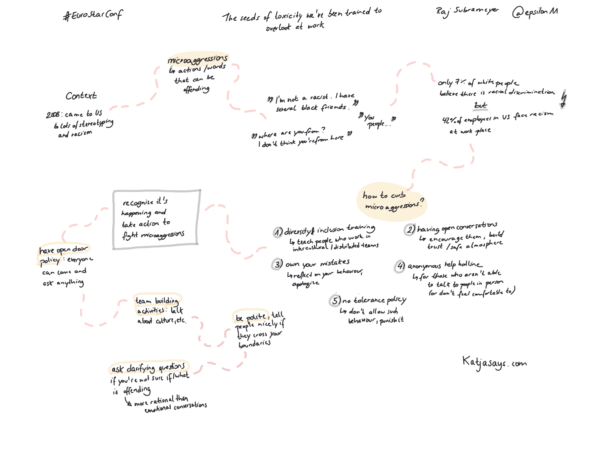
Raj has been dealing a lot with stereotyping and racism himself – mostly microagressions (actions/words that can be offending). He discovered that those often appear at work places and should definitely be fought. He has 5 proposals on how to curb microagressions:

  • Diversity & inclusion training
  • Having open conversations
  • Own your mistakes
  • Anonymous help hotline
  • No tolerance policy
The seeds of toxicity we ve been trained to overlook at work

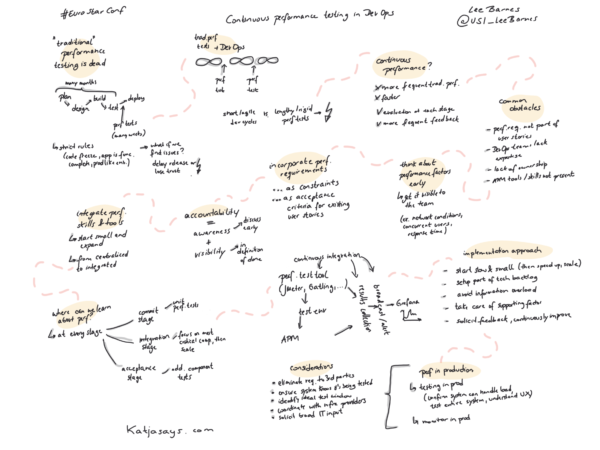
Continuous performance testing in DevOps

Lee Barnes
Traditional performance testing, which often comes too late and takes too long, is dead. Continuous performance, which means evaluation at each stage and more frequent feedback, is uprising. But you have to think about performance factors early on in your development process. Incorporate the requirements as contraints or/and as acceptance criteria for existing user stories.

Lee advises us to start small and expand to move from a centralized to an integrated performance team. Gather feedback and continuously improve.

Testing and monitoring in production is important, but don’t forget to consider to:

  • eliminate requests to 3rd parties
  • ensure system “knows” that it’s being tested
  • identify an ideal test window
  • coordinate with infrastructure providers
  • solicit broad IT input
Continuous performance testing in DevOps

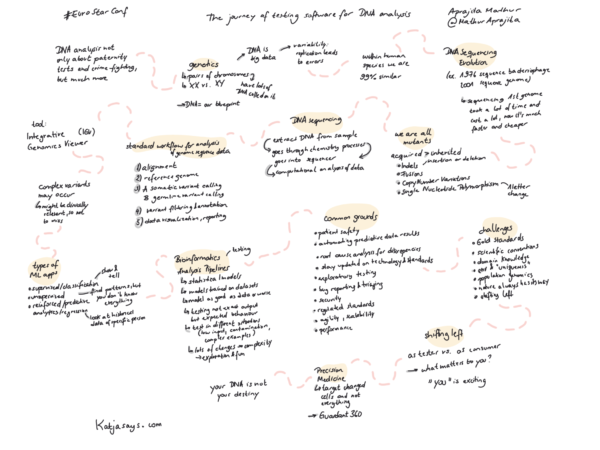
The journey of testing software for DNA analysis

Aprajita Mathur
The last keynote of the day was held by Aprajita Mathur. She was talking about testing software for DNY analysis. The standard workflow for analysis of genome sequence data is:

  1. Alignment
  2. Reference Genome
  3. A) Somatic or B) Germline variant calling
  4. Variant filtering & annotation
  5. Data visualization & reporting

Machine learning applications help testing and can be supervised, unsupervised or predictive. While testing – also called Bioinformatics Analysis Pipelines – keep in mind:

  • Statistical models are used
  • The models are trained on data sets
  • The model is as good as the data or worse
  • You aren’t testing the exact output, but expected behaviour
  • You have to test in different situations
  • There are lot of changes, which lead to complexity, but also exploration and fun

Between testing software for DNA analysis and “normal” software testing there are a lot of common grounds. But to DNA analysis, there are also some challenges as Gold Standards, domain knowledge, population genomics and that nature always has its way.
The journey of testing software for DNA analysis

As you can see, on the first day of EuroSTAR 2021 there were a lot of different topics already. From communication principles over performance testing and racism at work to testing software for DNA analysis – that’s what I call a huge variety. And there are so many talks that I haven’t attended and might re-watch after the conference.

About The Author

Profile Photo

Katja Budnikov is a software tester and sketch noter from Northern Germany. Katja is passionate about software testing and sketch noting! She loves attending events like EuroSTAR and sharing her experience and learnings with others on her blog Katjasays.com. Katja first started sketchnoting in 2016. First analogue with pen and paper and now digitally with an iPad and Apple Pencil.

In her work life Katja started out in online marketing, then specialized in search engine optimisation and is now a quality assurance specialist in both manual and automated software testing. Away from work Katja loves photography, especially taking photos of nature, including many of her dog Auri, a young Australian Shepherd, who is super cute and fun to take photos of. She loves to spend time with her dog and partner, going out for walks, traveling and eating cake at a nearby coffee shop with a beautiful garden.

Filed Under: EuroSTAR Conference Tagged With: EuroSTAR Conference

10 things you can’t miss at EuroSTAR 2021

September 22, 2021 by Fiona Nic Dhonnacha

Since 1993, we’ve been bringing testers together at Europe’s largest software testing conference. That’s 29 years of expert talks and sessions, sharing new ideas, and forming thousands of friendships. This year, we’re amping up the experience with a truly global online programme: 50+ diverse, educational sessions; 53 superstar speakers from 14 different countries, and a global community of testers. It’s all here, and there’s SO much of it happening. So, we’ve narrowed it down to 10 things you can’t miss at EuroSTAR 2021. Get your ticket now and join us next week – Sep 28-30th.

Meet the people who have the deep technical knowledge you’re seeking. Discuss the topics that matter the most to you. Leap into action with real learnings you can apply both professionally and personally. Make lifelong friends with people who share the same passions.

get tickets

1. Aha! moments at inspiring keynotes

The EuroSTAR Conference always draws the biggest names in testing, ready to share their experiences with you – successes, failures, & breakthroughs, and you don’t want to miss the amazing lightbulb moments our keynotes are sparking this year. Michiel Boreel shares his insights on digital happiness and the impact of AI on machines. Janet Gregory dives into ways you can engage with your testing activities and accelerate your learning. Maaret Pyhäjärvi highlights the importance of agency and how to foster that in an organization. Rob Lambert talks about 10  useful techniques you can use to move people into motion and enact change, and Aprajita Mathur shares her journey of testing bioinformatics applications.

2. The actionable tutorials

EuroSTAR tutorials are in-depth training sessions with our expert trainers, and it’s where you learn those practical new skills that you just can’t wait to put into practice in your work.  We have a whopping 14 half-day interactive tutorials this year, hosted by a star line-up of speakers including Rik Marselis, Dawn Haynes, Michael Bolton, Jana Gierloff, Tariq King, Mette Bruhn-Pederson, and lots more. Topics include (deep breath) agile, BDD, automation, collaboration, QA, continuous delivery, security, AI, testing teams, gamification, risk… whatever you’re working with, we’ve got you covered. Bring your questions, problems, curiosity & a fresh notebook. Check out our full line up of tutorials here.

3. Fresh insights at track talks

Track talks are 30 mins long – bite-sized learning opportunities that pack a punch. We have 30 track talks at EuroSTAR this year, brought to you by Isabel Evans, Tina Christin Syversen, Erik Fogg, Veerle Verhagen, Peter Collewijn, and lots more incredible speakers. Whatever your topic of interest or expertise, there’s plenty of knowledge and insights for you to build on. Here’s just a few examples of what you will take away from track talks.

  • why testing must be done as a whole team approach
  • how to build sustainable continuous performance pipelines in large-scale enterprises
  • use the VOICE model to understand your objectives and why you are testing
  • understand why testing AI systems is different to testing traditional rule based systems
  • how to authorise API requests correctly – and test it
  • learn a complete ‘CSI’ algorithm to deal with the most difficult test cases

4. Community spirit in Huddle

EuroSTAR is a global gathering rooted in community. And of course, the heart of that community lies in Huddle – we invite you to take part in all the conversations and fun that happens in our amazing community sessions throughout the conference.

It’s also an ideal place to go if you’re a first time attendee. Here are just some of the great things happening this year: we’ve got Lean coffee every morning as a great way to kickstart your day, bonus sessions with speakers on topics such as collaboration, mob testing, building your personal brand, and lots more; plus the Huddle Hangout Games Party on Monday, and lots of chances to win prizes and giveaways.

get tickets

5. The thrill of lightning strikes

The concept of Lightning Strikes is to challenge speakers to give an engaging talk in just 5 minutes… 8 speakers each have 5 minutes and just two slides to give a complete presentation on their chosen topic. If they don’t finish on time, lightning will strike and they have to (virtually) leave the stage immediately! This year’s topic is experimentation. Who will convey their points clearly and quickly? Who will be unceremoniously struck down? Join us to find out.

6. The impromptu conversations

We all know that conversations spill outside of the speaker sessions, and that’s usually where new ideas are born, discussions and opinions are shared and debated. At EuroSTAR 2021, you can meet and jump into conversations with the world’s largest testing community This is is an opportunity to connect and meet people from very different backgrounds and experiences. There are always groups of people gathering to discuss different methodologies and their merits: agile, devops, and anything else you want to talk about. What conversations will you join?

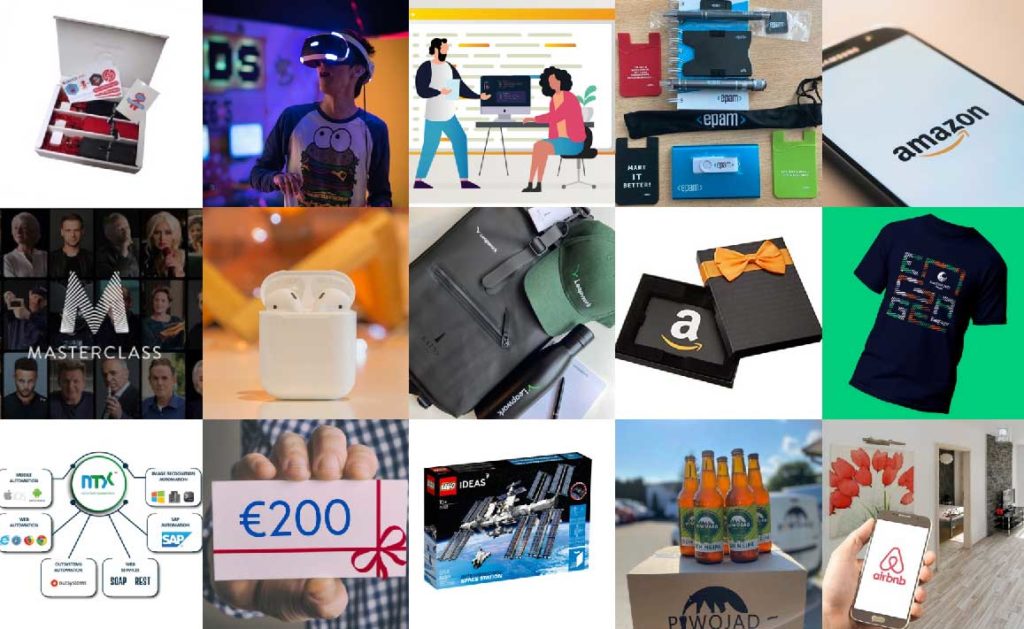
Rectangle shaped collage of 12 different prizes and giveaways from the EuroSTAR expo, taken from the 10 things you can't miss at EuroSTAR blog

7. The cool prizes and swag

Trying cool new tools and demos from vendors is all part of the conference experience, and our online expo will be buzzing. It draws some of the biggest companies in the world armed with solutions for you, and it’s a great place to visit between sessions. Stay on top of what’s new in testing tools, check out tons of cool demos, get 1:1 help on video chat … and of course, win prizes and bring home some cool swag. Visit the Expo booths throughout the conference to find out how you can get your hands on some of these incredible prizes.

get tickets

8 Solving problems at the Test Clinic

The Test Clinic helps you solve your software testing problems, with the help of Our ‘Test Doctors’ – industry experts with years of testing experience and knowledge. They’re on hand to offer coaching and guidance on ideas and solutions. Every year the Test Doctors strive to solve 100% of problems, and won’t send you home until you have a solution to implement on your return! Is there something slowing your team down? Do you have an  idea that could help others improve? Bring it to the Test Clinic. You can take part in open clinics or avail of 1:1 appointments.

9. Asking your burning questions

If you’ve ever been dying to ask a speaker a question, but didn’t get around to it during their talk or Q&A, the Ask me Anything sessions are just what you’re looking for. It’s pretty simple – it’s a dedicated session to give you a chance to ask a speaker your burning questions. We have Ask Me Anything sessions with some of the best minds in testing. This is your chance to chat to some of our speakers including Gaspar Nagy on BDD, Irja Straus on collaborating with stakeholders, Sune Engsig on automation, Ken Munro on security, and more.

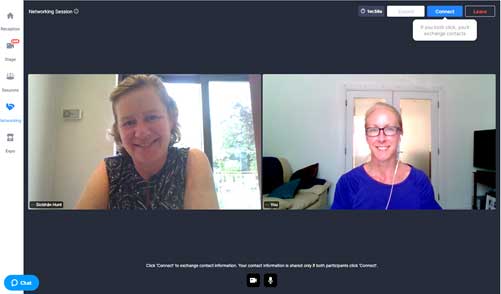
screenshot of two EuroSTAR attendees video chatting, from the 10 things you can't miss at EuroSTAR blog

10. Making new friends at SpeedMeet

With online networking opportunities, it’s easier than ever to make connections at EuroSTAR. A SpeedMeet is a great way  to strike up a conversation with someone new, or a very familiar face! Our speed meet event lets you meet people for a 3 minute chat. Simply enter the speed meeting room and click to start chatting. Exchange details so that you can continue talking in 1:1 video chats on the platform if you run out of time and want to keep chatting – something that happens regularly to our attendees!

Now you know of 10 things you can’t miss at EuroSTAR 2021 – what next? There’s so much more going on, and the only thing left to do is get your ticket right now, and make sure you don’t miss out ! Join us next week, Sep 28-30th.

get tickets

Filed Under: EuroSTAR Conference, Virtual Conference

What you can expect at the EuroSTAR 2021 Expo

September 16, 2021 by Fiona Nic Dhonnacha

The 29th annual EuroSTAR Conference is almost here, and we can’t wait to bring you 3 awesome days of testing, learning, and connecting with the global testing community.

A very important part of the conference is the Expo area: it’s a great place to visit between sessions, and draws some of the biggest companies in the world armed with solutions for you. Stay on top of what’s new in testing tools, check out tons of cool demos, get 1:1 help on video chat, add new processes to your testing toolkit… and of course, win prizes and bring home some cool swag.

Visit the Expo booths throughout the conference to find out how you can get your hands on the incredible prizes below – we’ll see you there!

A big thank you to our Platinum Partners Inspired Testing, Tricentis and Xray; Gold Sponsors Digitate, mabl, Saucelabs and Test Rail; and all our brilliant exhibitors. Check out all of our 2021 exhibitors.

Remember – you can save 20% on your EuroSTAR 2021 Ticket with one of our Expo Partner Codes – see their individual partner pages for more!
GET YOUR TICKET TO EUROSTAR

Inspired Testing

Platinum Partners at EuroSTAR 2021, Inspired Testing are a pure play testing company that can help you deliver exceptional software. Join Clinton, Lloyd and Steve at the Inspired Testing booth and enter their draw to win a Star Wars: Millennium Falcon Lego Set*.

Tricentis

The Tricentis team will be on hand to discuss and demonstrate how their AI-based, automation platform dramatically increases software release speed. They also have have a fantastic prize of Air-pods Pro* for attendees who enter their draw.

Xray

Helder, Ines and Tonislava are delighted to be back at EuroSTAR and they have a €100 Amazon gift card for one lucky visitor to their booth. Visit them during EuroSTAR and discover why Xray are the #1 Manual & Automated Test Management App for Quality Assurance in Jira.

GET YOUR TICKET TO EUROSTAR

Digitate

Call to the Digitate booth at EuroSTAR 2021 and enter their draw to win a subscription to Masterclass. Digitate is a leading software provider bringing agility, assurance, and resiliency to IT and business operations and their team are looking forward to meeting you.

Mabl

Mabl enables software teams to increase test coverage, speed up development and improve application quality. This is their third EuroSTAR and you’ll get to meet Eddie, Jordan, Reed and Leah. If you fancy a getaway, they have a €200 Airbnb gift card up for grabs.

Sauce Labs

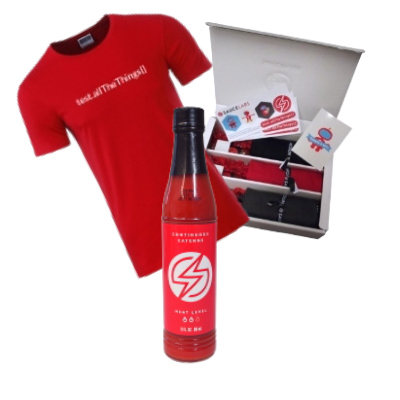
Having run more than one billion tests on the Sauce Labs cloud, the team; Madeline, Frederico and Hector are looking forward to meeting everyone. They have some saucy swag* available for our EuroSTAR attendees so don’t forget to stop by and say hi!

Test Rail

The TestRail Team is excited to be part of EuroSTAR! Stop by TestRail’s booth to learn how to build a better testing process, increase coverage, and ship releases with more confidence (and enter to win your very own International Space Station Lego Set!).

GET YOUR TICKET TO EUROSTAR

Applause

If you like to shop online, you should chat with Tom and Niki from Applause as they have not one but four €50 Amazon Gift Cards to giveaway. Visit their booth and find out why Applause is a worldwide leader in enabling digital quality.

Eficode

The leading DevOps company in Europe, the Eficode team, Timo and Kalle, are excited to be exhibiting at EuroSTAR for the first time. They love learning as much as we do and have free seats for lucky attendees to access the Eficode Academy training!

EPAM

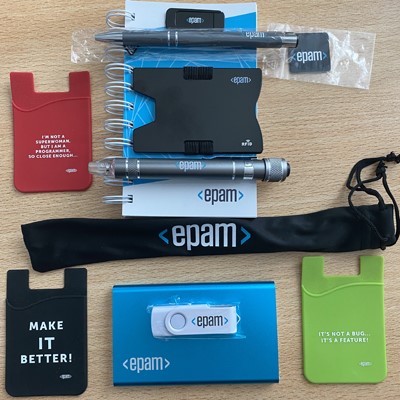
Win some cool EPAM merch including a mini screwdriver set & light, notebook camera cover, 8gb pendrive, pen, self-adhesive screen cleaner, 4000 mAh powerbank, variety of card holders, metal straw. Jozsef, Pavel and Elizaveta are looking forward to meeting you.

Global App Testing

Global App Testing is a trusted partner for Facebook, Google, Microsoft, Instagram and many more. Swing by to meet Daniel, Fahim and Michael during EuroSTAR 2021 and you could win a pair of VR Goggles*.

Inflectra

Join the Inflectra team at their booth and enter their draw for a pair of Apple Air-pods*. In addition to the cool prize you’ll hear what makes them a market leader in test management, test automation, application lifecycle management, and enterprise portfolio management space.

GET YOUR TICKET TO EUROSTAR

Leapwork

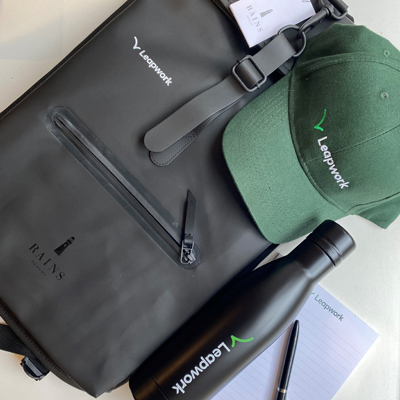
The Leapwork team will demonstrate how Leapwork breaks down the barriers between humans and computers with an entirely visual no-code system. Plus they have a RAINS backpack* & some swanky swag for the EuroSTAR attendees who enter their booth draw.

Noesis

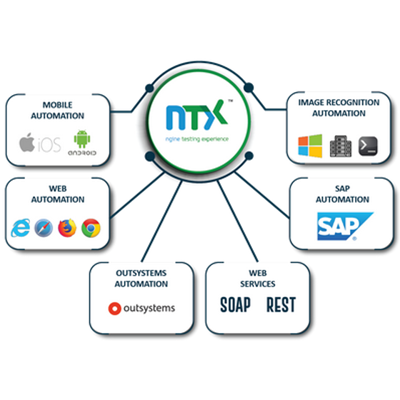
The Noesis team will be on hand at EuroSTAR to discuss how their services and solutions support clients in digital transformation. This year they are offering a free trial of their NTX tool (Ngine Testing Experience) which you can claim on their booth.

Parasoft

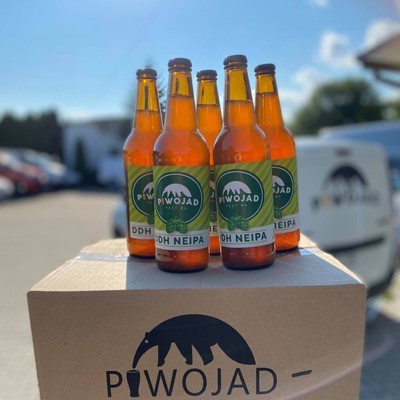
Stop by the Parasoft booth at EuroSTAR and enter their draw to win an IPA tasting session* with a private virtual brewery tour for your team (up to 10 people).  Learn how Parasoft supports the embedded, enterprise, and IoT markets.

SmartBear

Cliodhna, Edwin and Colin are excited to chat with you about SmartBear tools; Swagger, Cucumber, ReadyAPI, Zephyr, TestComplete – used by 7 million developers, testers, and operations engineers. They have a €200 gift card for one lucky EuroSTAR attendee!

*Please note that photos are representations only. All prize details will be provided by each partner and these photos do not indicate the exact make or model of what is being provided.

The EuroSTAR Conference hosts the largest software testing expo of testing tools and service providers. You’ll get to meet and speak with a host of solutions providers who can help your team deliver on projects and achieve company targets. Chat with them in their virtual booth and stop by their demo sessions which offer learning opportunities to all attendees.

This is all part of three jam packed days at EuroSTAR 2021. Kicking off on Tuesday 28th September with 14 half day tutorials, followed by Wednesday and Thursday’s line up of inspiring keynote speakers, energetic lightning talks, engaging track talks from across the globe and a wide variety of bonus community sessions.

EuroSTAR Limited Edited T-Shirts

On top of all of the fantastic partner giveaways at EuroSTAR this year, we also have a number of limited edition EuroSTAR 2021 ‘Engage’ t-shirts. If you want to get your hands on one of these, watch out for pop up opportunities during all 3 days of the conference. Hint… the more you engage the more chance you’ll have 🙂

If you haven’t yet bought your ticket, check out our Expo partner pages linked about for a 20% discount code.

See you there!

Filed Under: EuroSTAR Conference, EuroSTAR Expo, Virtual Conference Tagged With: Expo

Service delivery in the ‘new normal’ Part 2

September 10, 2021 by Fiona Nic Dhonnacha

Part 2: making the change

In the first part of this article series I introduced the five principles we use to guide our service delivery philosophy. I spoke about overcoming the initial challenges to changes in the workplace, and how the principles became even more important in light of the social and business upheaval brought about by the Covid pandemic.

But understanding the principles is one thing. Making them work is a whole different ballgame. 

Leon gives a sneak preview of Mihai Grigorescu’s EuroSTAR 2021 talk on adapting delivery models and structures in the ‘new normal’

Making the change

It takes more than changing how we work to make the change to the ‘new normal’ a seamless and successful one. Within the company – and within myself – we needed to make a mental change to what this all entailed.

For example, we needed to shift from expecting people to be online from 8AM to 5PM, and from judging productivity based on time spent online as opposed to actual outcomes delivered. It also meant a change in understanding deliverables, and discovering if people were actually able to deliver what was expected of them.

A good first step in this approach is to make it clear, from a leadership perspective, what’s expected of each individual and team. This flows on to the responsibility, visibility and collaboration from a team and a management perspective. Once this was agreed, we no longer had to look at whether someone was online at specific hours and focusing on the ‘’green bots’ of availability, and instead focused on the outcomes, and correlated that with productivity.

The key to making the change, as I personally discovered, is empathy. Not in the usual sense, but rather empathy for how people like to work in their own space (and at their own pace), how they can be fatigued by staring at faces on a screen all day, and how they have their own schedules and rhythms for running errands and running their households. Working from home is not working at work, and the more we try to force that square peg into round holes, the less successful we’ll be in transitioning our workplaces in the new normal.

Outcomes-based delivery

From a management perspective, we took on the notion of outcomes-based delivery as opposed to hours-based productivity. It became less important for our staff to be online, and more important that they were still delivering to expectations.

Obviously, there are times when someone has to be online – like a team meeting or a client call. But outside of those times, people were freed up to work as they needed, when they needed. This necessarily meant making a change to how we measured productivity. Fortunately most of our clients use Agile, and are Agile in their workflows, which means we can use constructs like velocity tracking to measure whether a team’s velocity is dropping or improving. If it’s dropping we can start asking questions or take a closer look at any issues affecting productivity in those teams. Moreover, team stand-ups become more important, so that people are aware of the goals and collaborate and create visibility accordingly, which then ropes in the principles of responsibility and prioritisation.

Finding balance

While maintaining productivity is key to service delivery, we also needed to make sure that our people were supported through the changes it required to balance productivity with wellbeing. We were very careful to look for signs of mental fatigue brought about by the trauma of the pandemic on the one hand, and the sudden drop in sick days taken, and increase in availability on the other, because this generally came at the cost of work life balance.

Every individual is different. From personal experience, it’s easy for me to walk into my study at seven in the morning and then have to pull myself away from the screen at seven in the evening. When there’s no commute and few distractions, work can take on an all-encompassing persona.

For many people it takes just as much discipline to prioritise taking time away from work – going for walk or to the gym – as it does to keep working. From a management perspective it’s equally important not to expect the sudden jump in productivity to be the ‘new normal’, mainly because it’s realistically unsustainable. Trust me when I tell you there’s no harder stop to productivity than burnout.

Closing thoughts 

From a business perspective, service delivery has always been about ensuring our clients are always getting the value they expect and deserve from us. We’ve done it by applying our core principles in a way that allowed us to make the change to a new way of working without taking our eye off our delivery goals.

Once you have the metrics in place and can measure performance based on KPIs – for example, mixing in service delivery scorecards and net promoter scores with a focus on internal KPIs – then you can adjust to whatever the ‘new normal’ means for your business in terms of service delivery.

Want to learn more about delivery models? Join Inspired Testing’s Mihai Grigorescu at EuroSTAR Conference on 11:15 CEST Thursday, 30 September for an in-depth exploration of the lessons learned in the journey towards a ‘Quality engineering without frontiers’ delivery model, tearing down the typical limitations imposed by the unprecedented  pressures of a post 2020, modern, interconnected world.

We’ve got a packed programme of 50+ talks at EuroSTAR 2021, brought to you by world renowned speakers, to inspire your testing and generate new ideas for your work. Book your ticket now.

Author

Leon Lodewyks, Chief Delivery Officer at Inspired Testing.

Leon heads up the delivery function at Inspired Testing as the Chief Delivery Officer, after spending 16 years working in the UK and Europe, at various high profile companies, gaining best of breed experience at some of Europe’s most leading companies. He has 20 years’ experience in the software testing industry and is passionate about software testing and in particular shaping custom solutions for clients, based on the clients exact needs.

Filed Under: EuroSTAR Conference, Virtual Conference

How to speak like a pro

September 7, 2021 by Fiona Nic Dhonnacha

Want to become a better speaker? Create that perfect presentation to blow your audience away? We’ve got you covered. Learn to speak like a pro from the people who do it best – our own EuroSTAR 2021 expert speakers, who are ready to wow our attendees this September. They’ve got lots of tips you can use to make your next presentation sing, and have you speaking like a true pro in no time – and who knows, we might see you on the EuroSTAR stage in the near future…

Check out the best ways to present your information, how to achieve the ideal set-up, how and when to be ruthless when cutting out information, making the most of online presentations, and lots more.

Headshot of EuroSTAR 2021 track talk speaker Andrew Brown - from the blog tips on how to speak like a pro

Andrew Brown, Expleo.

EuroSTAR track talk: Software Quality and Human Factors – our next challenge

Keep it short, keep it focused. I know that all your ideas are totally brilliant, but you really do only have 20 minutes to get one idea across and embedded into your audience’s minds. With a typically tight schedule and an abundance of interesting information, you will need to be tactical about this.

Try this: Put each point you have onto a separate, rough slide, then practise talking through each slide. You will run over the 20 minutes. Now, think about your one central message, that one idea you need inside people’s minds at the end. Ask yourself – is the point on this slide absolutely necessary to that message? If not, ruthlessly cut that slide out. Also, cut it out, don’t trim it down, hoping that you can briefly cover this plus a myriad of other points. You most likely can’t.

If you think it’s tough to get your idea across in only 20 minutes, have a look at a few of the totally brilliant TED talks for inspiration; none of which are longer than this time.

Headshot of EuroSTAR 2021 track talk speaker Isabel Evans - from the blog tips on how to speak like a pro

Isabel Evans – Independent Consultant

EuroSTAR track talk: Who are we? What are we doing? How are we doing it?

Presenting in general: Your presentation is a distillation of what you know. Remember you have a story to tell, which needs to be gripping. But to tell that story – to make the distillation – you need to know the back-story. In other words, you have more material in your mind and your notes than you will present, because you won’t have time. Having that background will help you tell your story. Writing a paper can give you the chance to expand on your ideas. Think how J. K. Rowling built up a whole world: her notebooks have details that didn’t make it into the books, and the books have details that didn’t get to the films.

For speaking on Zoom: Take a few minutes to do your set up, as people are going to have to look at you and your backdrop for the duration of the talk. Check your camera angle, background, and appearance before you start – for example for a Zoom meeting, you can check your set-up before the meeting by having a Zoom meeting by yourself to see what you look and sound like. Use a plain background, and ensure there’s nothing that shouldn’t be visible in the broadcast. Raise your laptop/device up so it’s level with your face (I put my laptop on a shoebox) – then you won’t be filming the inside of your nose. Lighting from the side and front, not from the back, gives a good light to your face.

Headshot of EuroSTAR 2021 tutorial speaker Gáspár Nagy.

Gáspár Nagy – Spec Solutions

EuroSTAR tutorial: Living Documentation with BDD: Structure, Consistency, Traceability

Many speakers are much better in Q&A than presenting the topic from prepared slides, so turn this to your benefit: imagine your talk is a Q&A and think about what questions your audience would ask. Structure your talk in a way you would answer these assumed questions. You can even show or say out loud the question you are going to address as a kind of section intro. This way you can ensure that your talk will be more relevant. When you record/present the talk, imagine a person behind the camera as one who was asking the questions – it will appear more natural both for you, and your audience.

Headshot of EuroSTAR 2021 track talk speaker Gitte Ottosen

Gitte Ottosen – Key2Quality

EuroSTAR track talk: Quality is not about testing… It’s about value!

Keep it simple: Don’t try to squeeze too much in! I was really challenged with the shorter 20-minute time that works best for online talks, compared with the usual longer 40 minute in-person track session. I created a shorter presentation focused on fewer key points, took some notes, and did a dry-run or two on my own to ensure that I did not run over.

Practice: Do a couple of dry runs so that you’re certain about what you want to say, and how you’re going to get your message through. The better prepared you are, the less focused you’ll be on your notes during the presentation.

Stand up! If at all possible, stand up during your presentation 🙂 I found that I got more energy when I was standing up, and using my gestures as I would normally do in a physical presentation.

We hope that’s helped spark some ideas for your next presentation. If you want to see our speakers in action and learn some incredible new ideas for your testing, get your ticket to EuroSTAR here.

Filed Under: EuroSTAR Conference, Virtual Conference

  • « Previous Page
  • Page 1
  • …
  • Page 4
  • Page 5
  • Page 6
  • Page 7
  • Page 8
  • …
  • Page 16
  • Next Page »
  • Code of Conduct
  • Privacy Policy
  • T&C
  • Media Partners
  • Contact Us

part of the