• Skip to main content
EuroSTAR 2027 - Sign up for early access

EuroSTAR Conference

Europe's Largest Software Testing Conference.

  • Programme
    • Call for Speakers
    • 2026 Programme
    • Community Hub
    • Awards
  • Attend
    • Why Attend
    • Bring your Team
    • Testimonials
  • Sponsor
    • Sponsor Opportunities
    • Sponsor Testimonials
  • About
    • About Us
    • Our Timeline
    • FAQ
    • Blog
    • Organisations
    • Contact Us
  • Book Now

Uncategorized

10 things to do in Copenhagen

April 26, 2022 by Fiona Nic Dhonnacha

Join us for this year’s EuroSTAR Conference in stunning Copenhagen; a surprisingly compact, easy to navigate city, oozing Scandi cool from all corners. Bridges bustle with cyclists, colourful houses hug the harbours, and the city is abundant with cultural riches. Let’s dive in to 10 things to do while you’re here ☀️

Book ticket to EuroSTAR

1. Stroll through Tivoli Gardens

The iconic Tivoli Gardens is Copenhagen’s central theme park – and the second-oldest amusement park in the world. Visitors have been flocking here since the 19th century, and it’s inspired the likes of Hans Christian Andersen and Walt Disney, who both visited many times (Walt Disney found his inspiration for Disney World here). And it’s no wonder: Tivoli features exotic architecture, lush gardens and picnic lawns, a scenic lake; and the iconic Star Flyer to send you soaring through the skies. At night, thousands of twinkling lights illuminate that fairytale feeling.

2. Explore history at the Museum of Copenhagen

The Museum of Copenhagen sits right behind City Hall, and tells the story of the city through its artefacts, buildings, people, and culture. Explore your way around 800 years of the city’s history, from Viking tales, to plagues, bikes, fires, and the building boom – everything which has shaped Copenhagen into what it is today. You’ll get to grips with some incredible archaeological finds – including the skeleton of a warrior from the Middle Ages, and an early edition of a bicycle made of wood! Exhibits feature installations that bring history to life, including an interactive model that gives you an overview of the entire city.

3. Take in a show at Wallmans

The historic circus building, Cirkusbygningen, is home to Wallmans Dinnerparty, a magical show packed with sumptuous music, artistry and impressive acrobatics. Artists serve at the tables and perform, not only on the stage, but also in every corner of the circus arena. After the show’s grand finale, the venue turns into a nightclub – one of the biggest in Copenhagen! We’re so excited to host our EuroSTAR 2022 Gala Awards dinner here, with a massive celebration encompassing a show, dinner, and the EuroSTAR Software Testing Awards. This is a night you don’t want to miss.

10 things to do in Copenhagen - go swimming in the harbour baths

4. Plunge into pristine waterways

You’re never far from a swimming opportunity in Copenhagen, and summer is the ideal time to embrace its waterways and go for a dip. Try the centrally located ‘harbour baths’, which are free public swimming pools located along the harbours and fjords of the city – and there are plenty of them. As part of wellness at EuroSTAR, we are hosting daily morning swims during the conference, so make sure you join us for an invigorating wake up.

5. Hang out at Nyhavn

This 17th century harbour is easily one of the most iconic landmarks in Copenhagen, and it’s hard to find a more beautiful spot to hang out on a sunny day. Nyhavn has a history as colourful as its buildings – originally this was a commercial port where ships from all over the world would dock, and it was packed with sailors visiting its pubs and alehouses. It was also a favorite haunt of Hans Christian Anderson, and where he was inspired to write. Today, the multicolored houses have been renovated and its bustling quay is lined with wooden ships, modern boat, and restaurants.

book tickets

6. See historic trees at Frederiksberg Gardens

Frederiksberg Gardens has been a favorite spot for locals for centuries. It’s arguably Copenhagen’s most romantic park, with lakes, canals, woodlands and goergous trees and shrubs. Don’t miss one of its most unusual attractions, the suttetræet (sucky tree), located north of the Chinese Pavilion. The 250-year-old tree is hard to miss, its branches hung with hundreds of colourful ribbons tied to baby pacifiers. According to Danish tradition, when a toddler turns three it is time to give up their pacifier. They entrust the pacifier to their local suttetræet, along with a note on behalf of the toddler asking the tree to take good care of it.

7. Enjoy the epic sights at Kastellet

Kastellet is one of the best preserved star fortresses in Northern Europe. It was originally commissioned by Frederik III in 1662. You can walk or jog the grassy ramparts, and take in the moat surrounding some beautiful 18th-century barracks, as well as a chapel occasionally used for concerts. The high walls of the fortress offer a lovely view of the harbor, and don’t miss the charming windmill.

10 things to do in Copenhagen - cycle the bridges

8. Bike across Copenhagen’s bridges

Copenhagen is made for bikes, and that includes its bridges. Hop on two wheels and go for a ride across the harbour. Start south along the Cykelslangen (bike snake), a stunning, curved bridge which takes you on a criss-cross seven meters above one of the harbour baths. Once you get across the harbour, you can bike on to Olafur Eliasson’s Circle Bridge, then ride back over the harbor on the new Lille Langebro bridge. You’ll also come across the Inderhavnsbroen, AKA the Kissing Bridge, in Christianshavn.

9. Visit the Little Mermaid

This may be Copenhagen’s smallest attraction, but it’s packed with history. Based on the 1837 fairy tale The Little Mermaid by Hans Christian Andersen, this small and unimposing statue is a Copenhagen icon, and has been a major tourist attraction since its unveiling in 1913. It was a gift to the city from Danish brewer Carl Jacobsen, after he attended the ballet based on the story. He was so impressed that he asked Danish sculptor Edvard Eriksen to create the statue. The sculpture is made of bronze and granite, and sits in the water at Langelinie Pier.

10. Experience hygge

Of course, we couldn’t talk about Copenhagen without mentioning hygge. Pronounced hoo-gah, it’s a unique term that defines cosy social gatherings and intimate get-togethers, expressing the feeling of wellbeing and warm atmospheres. You can get your hygge on right here at EuroSTAR – the whole software testing community is coming together to chat, connect, learn from each other, and create lots of memorable moments.

What are you waiting for? It’s your last chance for EuroSTAR tickets as we count down to June 7th. Book your ticket now – and if you book a team, you save up to 30%. See you in sunny Copenhagen.

get tickets

Filed Under: Uncategorized

Book your Early Bird ticket now and save

April 13, 2022 by Fiona Nic Dhonnacha

We can’t believe that EuroSTAR 2022 is just a few weeks away. We’re busy adding all the finishing touches to a massive celebration as we bring the whole software testing community together again – in-person for the first time in 2 years. It’s an extra special conference this year as we celebrate EuroSTAR’s 30th birthday! We want to thank everyone for being part of a really special community over the past 30 years. Superstar speakers on this year’s programme include James Lyndsay, Smita Mishra, Michaël Pilaeten, Alex Schladebeck, Rikard Edgren, Anne Kramar, and more.

Now is the BEST time to book your Early Bird ticket – prices are rising on April 22nd, and it’s our final offer of the year. You save 10% on individual tickets, and up to 35% if you bring the whole team.

Here’s what you can expect at this year’s conference.

4 days of learning from the world’s leading test experts

The 2022 committee has carefully curated a programme bringing together the brightest minds in the software testing community. Our testing experts are bringing new ideas, fresh perspectives, and a vast wealth of experience to all of the talks. They are here to help YOU achieve your testing goals, so take your place next to some series brainpower and bring all your questions, thoughts, ideas, and a let’s put our heads together.

There are 70 sessions this year – with 5 inspiring keynotes, 10 tutorials, & 55 track talks to get creativity flowing. Of course, there will be lots of actionable ideas and new processes for you to take home and apply to your work right away.

Book now

In-depth tutorial training

Our 10 tutorial trainers are here to deep dive into all the topics you care about the most – agile, DevOps, automation, strategy, management, and more. Learn new ways to solve the typical problems that impact on test and quality in Scrum. Develop your critical thinking and testing skills. Discover a visual ATDD approach you can start applying to your projects. Understand how to implement exploratory testing concepts through all phases of testing. And So. Much. More.

The EuroSTAR tutorials are focused on being interactive, and give you the opportunity to ask questions, discuss problems with your peers, and find solutions together. Choose between half and full day tutorials.

Book your Early Bird ticket now and save

Networking and community events

It’s always nonstop networking at EuroSTAR, and this year is no different. The Huddle Community Area is the heart of the conference – this is where you can hang out in between talks, chat to speakers at couch sessions, enjoy Lean Coffee, games, prizes, and lots more. It’s also where you’ll find the Test Lab and Test Clinic, where our dedicated testing experts are on hand to help you.

Once the day is finished, it’s on to EuroSTAR at Night! The EXPO Community Networking party is your opportunity to connect with leaders in software testing tools and services. There’s also plenty of opportunity to chat in between talks, and have impromptu discussions with other attendees.

book tickets

1:1 problem solving

This is your chance to solve your software testing problems with the help of onsite test experts. Whether you’re a QA manager, team lead, test architect, software developer in test… the Test Doctors are here to help. Have a problem that’s slowing you or your team down?

Tell us what you need help on, and our Test Doctors will offer coaching and guidance on ideas and solutions. They bring years of testing experience and knowledge – and have yet to meet a problem they can’t solve. You can either join an open session or book a private consultation.

Book your Early Bird ticket now and save

New tools and services

The EXPO area is a huge part of the conference. It’s where attendees go to visit in between sessions, and it draws some of the biggest companies in the world – all armed with solutions for you. Discover new testing tools, check out all the latest trends in software testing, and get lots of cool demos.

Did we mention the prizes? Every year, the EXPO booths offer incredible prizes and cool swag for you to bring home. Visit the Expo booths throughout the conference to find out how you can get your hands on some super cool stuff!

You know what to do next – go check out our offers and book your Early Bird ticket to Europe’s best software testing conference, at the best price.

Filed Under: Uncategorized

Native quality management: how to adapt to a quality-centric culture

April 11, 2022 by Fiona Nic Dhonnacha

This article was provided by José Domingues, Head of Marketing at Xray.

“A company with a highly developed culture of quality spends, on average, $350 million less annually fixing mistakes than a company with a poorly developed one.”

Harvard Business Review

Historically, software development and quality assurance were one and the same. If you built it, you also tested it. But then software grew up, and as it got more and more complex, dev and QA needed to split up in order to do their job right.

But instead of these two teams remaining close friends, they grew far apart. Each in their own world, operating in different environments, using their own workflows, speaking different languages.

Who paid the price? The software. Now, complex, disconnected workflows weigh us down, slowing down our releases. Critical tests are missed, compromising our coverage. And more than anything else, we’re just not on the same page – even simple tasks are frustrating when each team needs to translate into their own language just to get stuff done.

How can we expect our software to be at the highest quality, when quality and development are so disconnected?

Adopt a “native quality management” approach to testing and development that prioritizes quality every step of the way.

Let’s see how to do just that.

Measure your “quality maturity” and the time and cost it takes to fix bugs

In August 2013, Amazon experienced a software glitch that shut down the website for 40 minutes. Amazon lost $4.8M or $120,000 per minute due to this glitch. As a result, Amazon executives prioritized quality management to prevent any similar catastrophes in the future.

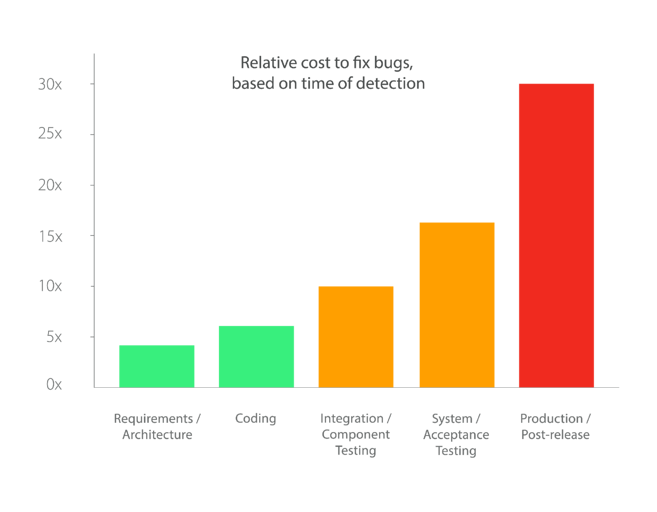
In the report “The Economic Impacts of Inadequate Infrastructure for Software Testing by NIST (National Institute of Standards and Technology), the relative cost to fix bugs based on the time of detection significantly increases as you progress through the software development lifecycle.

By the time a bug slips through all the way to production and post-release, it can be up to 30x more expensive to fix than if it was caught during the requirements/architecture phase.

native quality management by Xray graph illustrating the cost of failure

Now more than ever, you need to understand how much quality impacts your organization. A method you can use to assess your “quality maturity” is to measure the time and cost it takes to fix bugs.

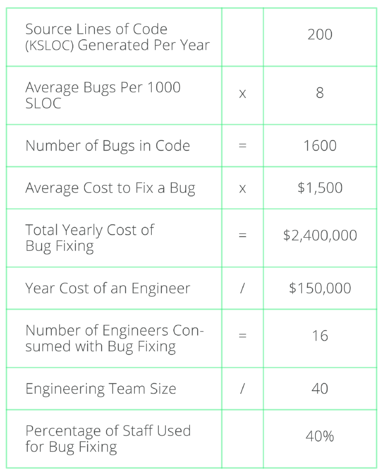
In the book, How Google Tests Software – Help me test like Google, authors James Whittaker and Jason Arbon show how Google quantified the cost of poor software quality and how long it took engineers to fix bugs.

They used the following model to calculate the cost of bug fixes:

native quality management by Xray graphic calculating the cost of failure

Plugin your own numbers and try this technique to gain a clear indication of how much time you waste fixing bugs, so you focus on preventing them in the first place

By now you understand that you can’t ignore software quality. Testing needs to evolve to fit the growing demands of rapidly released software.

So, how do you adapt to avoid costly errors?

Evolve into a “Quality-Centric Culture” that prioritizes quality every step of the software development lifecycle.

Transform to a culture of quality vs testing

Your team needs to collaborate and adapt to deliver quality. Shift the focus from a specific role or team that does testing, to a unified organization focused on creating quality.

First, let’s understand the meaning of Quality. In the book Leading Quality: How great Leaders Deliver High-Quality Software and Accelerate Growth by Ronald Cummings-John, he describes “Quality (as) subjective; it’s determined by whoever is using the product at the time…Quality is relative; it changes over time.”

To begin, understand what is the “Quality Narrative” in your organization. Leading Quality: How Great Leaders Deliver High-Quality Software and Accelerate Growth by Ronald Cummings-John, tells us how we can adapt the quality-first narrative in our organization.

Ask your team the following questions:

  • Who owns quality in the team?
  • What is the perceived role of quality and testing?
  • What does quality mean to us and to our customers? Are we aligned?
  • How important is quality when it comes to releasing a product?
  • How do we define risk and what is our threshold for risk?

By answering some of these questions, you gain a better handle of how quality is perceived in your organization, and how you can improve it.

The shift from a testing culture to a quality culture has a lot to do with mindset. When you understand this shift in mindset, you can use tools to support you.

What is Native Quality Management?

With the rise of Agile, DevOps, and Continuous Testing, we understand that QA and development teams need to collaborate and work together.

With Native Quality Management, all the tools, tests, and processes used by QA are built natively into your development environment like Jira. That way, every test is accounted for, every task lives in the same workflow, and everyone speaks the same language.

Many organizations are embracing this new, holistic approach that naturally embeds quality into the development workflow.

What you get with Xray – Native Test Management:

Xray weaves test management into every stage of development, so quality now comes naturally:

Keep tabs on all your tests: Xray indexes tests in real-time, so you run tests with full control of the entire process. That way, you get total coverage, catch problems fast and keep releasing quality software with confidence.
Learn where tests went right (and wrong): With detailed traceability reports, you know which tests went wrong and where — so you pinpoint what to fix, and easily collaborate with developers to fix it.
Focus on quality, at scale: Pull off complex, large-scale testing projects without missing a beat. With smart orchestration and native integration with frameworks like Cucumber and JUnit, you easily manage all testing across even the largest code-bases.

The next wave: the software quality lifecycle

Our native quality management approach brings the promise of all these new quality assurance technologies back to development teams and most importantly, any company that develops software. Finally, quality and development work alongside each other — just as they should — enabling companies to release stellar software day after day.

Imagine all development requirements naturally linked to your testing, so you never overlook a test again. Imagine the same naming and terminology across all dev and QA tasks so both teams work seamlessly side by side.

Imagine all activity managed in one single environment sharing one familiar workflow, giving your teams more control, efficiency, and speed than ever before.

But don’t take our word for it. The hundreds of raving reviews from leading organizations worldwide speak for themselves. And they all say the same thing – Native Quality Management is the best way to make sure you deliver the best software. Period.

Xray is a Platinum Partner at EuroSTAR 2022. It’s our first in-person event in 2 years – and it’s going to be a massive celebration of testing! Learn from 70 testing experts, and connect with your peers at Europe’s best testing event. Get your ticket now – book by April 22nd and save 10% on individual tickets; up to 35% on group bundles. See you in Copenhagen.

Author

José Domingues

José Domingues is Head of Marketing at Xray.

Filed Under: Uncategorized Tagged With: EuroSTAR Conference

Why end-to-end automation testing is crucial for effective DevOps

April 8, 2022 by Fiona Nic Dhonnacha

Thanks to Copado for sharing their insights on automation and DevOps.

One big DevOps misconception is that it is about technology. While a key component, technology alone can’t solve all your software development lifecycle problems. DevOps also requires your business to embrace a new culture. Implementation strategies will differ based on an organization’s size and systems, but most philosophies have a common thread. Almost every expert will agree that end-to-end automation is vital for DevOps. Not only does it let you make the most of DevOps technology, it helps you build a more proactive, transparent DevOps culture.

Automation enhances all components of effective DevOps

If you want to break down the components of effective DevOps, you’ll have to consider both culture and technology. Part of implementing end-to-end automation is looking for how it can add value to each component, supplementing other technologies and helping you build a culture of DevOps.

Culture

  • Proactivity: DevOps is a proactive strategy as it seeks to reduce problems before they happen. Stakeholders are empowered to come up with resolutions without having to clear them with everyone. Automated testing lets you keep pace with development so you have time to analyze results and fix potential defects early on. 
  • Goal-oriented: DevOps practices aren’t an end unto themselves. They center on an end goal, whether that is improving productivity, reducing bugs, or supporting staff. The developers select the goal and then work backward from it to come up with better strategies, including leveraging automation to eliminate bottlenecks. 
  • Accountability: A culture of accountability should not be mistaken for a culture of blame. With a strong culture, employees will readily communicate problems rather than cover them. Automating tests and validation gives employees more room to explore and innovate, free from the fear one small mistake will bring the whole project crashing down. 
  • Communication: Stakeholder alignment is critical in DevOps approaches. Everyone involved needs to understand the goals of the project, what is required of them, and how they can further the mission of the company. With automation comes reporting, which can improve transparency and facilitate communication between teams.

Technology

  • CI/CD: Continuous integration and continuous delivery pipelines are crucial for DevOps as they ensure the timely delivery of updates and improvements. It also allows for easier detection of errors due to how often code repositories are checked and tested. 
  • Continuous testing: Continuous testing goes right along with CI/CD and automation. A test accompanies every line of code so you can ensure that it performs as expected. With continuous testing, you locate issues earlier and prevent widespread problems. 
  • Version control: You must track the changes made in your code and ensure everyone follows the same standards. Version control makes these changes transparent and easier to understand. When there is a problem, you can locate and isolate it. 
  • Automation tools: Manual steps are not scalable – and that’s vital in a DevOps environment. If a process is high-volume, repeatable, and predictable, you want to find a way to automate it so your developers can focus on higher-value tasks. You can use automation to support your CI/CD, continuous testing, and version control systems at scale

DevOps will mean different things to different organizations. However, all the above components should be included, regardless of industry type or software needs. With the above, you set the foundation for end-to-end automation and position your organization to make the most of its benefits. 

Where end-to-end automation testing fits in 

End-to-end automation has applications throughout the development lifecycle, but one of its key uses is to speed up testing. Testing is a necessary but time-consuming part of any DevOps cycle. The size of modern systems and software make it impossible to adequately scale up manual testing.

Robotic process automation is an ideal tool for this. RPA-based testing can be integrated into the CI/CD pipeline. As you deliver changes, you’re also providing the tests that verify their efficacy. Testing is one of the most common bottlenecks in the CI/CD pipeline, but RPA helps overcome these issues proactively. Of course, when you’re considering these tools, it’s important to choose options that are:

  • System agnostic: You should not have to use a different test for every platform, app, or cloud you work in. Any end-to-end automation testing tool must be system agnostic to support the diversity of your infrastructure. 
  • Low- or no-code: Development is no longer an isolated part of an organization. Our world runs on software. The people who handle your big picture goals and business needs should create solutions within the software that works for them. However, they should also be following strong DevOps principles. A low code or no code testing solution helps them make sure that their programs run without bringing in an expert. 
  • Self-healing: Your software will change over time. That means your tests will need to change too. A self-healing test automation tool will notice these changes and adapt your tests to ensure they continue to work through updates. This component makes these programs truly scalable to keep up with rapid system growth.  
  • SaaS-based: A software as a service solution is best for deploying end-to-end automation. It comes with its own infrastructure, so you don’t have to worry about a long ramp-up to get your program up and running.

End-to-end automation will support your DevOps principles with continuous testing in a CI/CD pipeline and beyond. Tests are a crucial but time-consuming part of any software development initiative. By leveraging a program that runs on RPA, you can reinforce the scalability and flexibility that DevOps philosophies demand.  

Copado is a Gold Sponsor at EuroSTAR 2022. It’s our first in-person event in 2 years – and it’s going to be a massive celebration of testing! Learn from 70 testing experts, and connect with your peers at Europe’s best testing event. Get your ticket now – book by April 22nd and save 10% on individual tickets; up to 35% on group bundles. See you in Copenhagen.

Filed Under: Uncategorized Tagged With: EuroSTAR Conference

15 things you’ll learn from EuroSTAR speakers

April 5, 2022 by Fiona Nic Dhonnacha

It’s our first in-person event in 2 years, and we’re so excited to bring the entire testing community together again! This year the EuroSTAR conference is bigger and better than ever before. We’ve got a programme packed with inspiring keynotes, interactive tutorials, and buzzing track talks – brought to you from 70 world class speakers.

You’ll benefit from soaking up all that incredible knowledge, and gain practical takeaways, new ideas, and fresh perspectives that you can bring home with you after the conference. We’ve put together just a small taste of what you can expect this year. Get your EuroSTAR ticket now, and start planning your conference diary.

1. Understand that testing is never finished

It is hard to understand one thing in isolation: things need to be connected to each other in order to generate a good understanding. This means your understanding of testing is never finished, as you learn more about the product and its relations – and the relations is key. Get a broader understanding and see examples of learning paths in a complex world at Rikard Edgren’s keynote. Get comfortable with the feeling that testing is difficult, and the fact that it should be. You’ll also gain a deeper understanding of your software, your situation – and all the relations.

2. Get ready to meet the needs of the next economy

Smita Mishra shares what she’s learnt about the next economy, and what technology changes we are seeing across users. How does this impact what testers do? Do we understand the users of these new technologies? Are we ready to meet the needs of our customers of the next technology? Get answers to these questions, and a whole lot more. Let’s learn what the world thinks could be technology risks, and how testers can align better to the new world view. This session will also encourage you to look at your immediate and near future testing strategy, as well as your team construct.

3. Learn how to go through a digital transformation

Every day, more and more organizations are taking on “digital transformation”, leaning on software and machinery to perform jobs, make decisions and solve problems. Machines do work that has traditionally been done by humans, or that couldn’t be done by ordinary humans unaided by machinery. Every day, the reach of what machines can do is extended by technological advancements, growing bodies of data and by human ambition. As software changes, our testing has to respond. Michael Bolton shares what you need to address when going through a digital transformation.

15 things you'll learn at EuroSTAR

4. Scale your team like a pro

As your team scales, the nature of challenges will change, Just like a bonsai tree, you can’t leave a team’s growth and shape to chance without a plan. One of the major components that a bonsai represents is that of balance. How can you achieve the right balance in a remote, multicultural team, and achieve your purpose ? Seema Prabhu shares her experience with her team changing shape as they scaled, the lessons learnt, and tools she wished she had during this phase of growth.

5. Learn how to respond to external changes

The world is constantly changing, and everything is impermanent. Most especially after the last two years, we have really been forced to come to terms with how quickly and drastically things can change. How will external changes shape our teams and our work? How can we shape ourselves proactively in order to respond to changes, make changes of our own, and even thrive? Alex Schladebeck looks at what factors are at work now, and what known and unknowns we have. You’ll also learn what kinds of effects they will have on how we work, and the roles of testers and software professionals.

GET TICKETS

6. Sell and shift your testing at work

As testers who have an exploratory approach to testing, it can be challenging to gain acceptance and buy-in from leadership. Often, people you are trying to sell to are left asking, “What the hell kind of testing is that?”… and not in a good way. Nancy shares her experience with exploratory testing, and shifting testing to new methods. This high energy session will send you back to the office with the tools you need to help sell and shift your testing at work.

7. Develop your critical thinking skills

We expend huge efforts in training people in various testing skills. Yet, we often fail to train ourselves in the most important testing skill of all – how to think critically about what we are testing. When we test, we are vulnerable to cognitive biases and thinking traps that can catch out even the most seasoned tester. In this workshop, Andrew Brown shares the training course he’s developed, to show you how to improve your testing by enhancing your critical thinking skills, and addressing biases and thinking traps.

8. Set up and write your own automatic accessibility tests

Accessibility testing tools are of great help in making an accessible website, and shaping a more inclusive web. In this workshop you’ll learn how to set up and write your own automatic accessibility tests using Axe and Cypress, and cover some of the most common accessibility errors that can be discovered automatically – and how to fix them. This workshop will be presented ensemble style – mob testing with small groups where the whole group works on the same thing, at the same time, in the same space, and at the same computer.

9. Use defects to your benefit

We already know that zero defect products don’t exist. Defects that are caught in production can be costly to fix, BUT they are the client’s most concrete feedback on quality. Murex decided to accept the challenge and benefit from this feedback to shape their testing. But how can you benefit from clients’ reported defects to strengthen your test suites? Find out how Murex created a new process to get to the root cause, and take actions on the identified gaps. Plus, the ups and downs of the journey, and how they managed to transform a small team initiative into a global objective.

15 things you'll learn at EuroSTAR

10. Navigate the new normal

Learnings from the past 1.5 years requires us to answer a fundamental question: how do we shape a post pandemic testing career? After all, there have been seismic shifts in customer behavior, technology solutions, business models and ways of working. It’s changed everything, especially testing. Ryan Volker will help you navigate the new normal, and get you better equipped to design your post pandemic career. Learn what changes will stick around – and how you can profit from it, plus how new work and old work will shape your future testing.

11. See why failure is a good thing

Fail. Red Build. Outage. Regression… if you’ve ever worked in DevOps, these phrases probably fill you with dread… but they shouldn’t! Failure is vilified, it’s judged, sometimes it’s punished… And it’s the default. Success is the exception. Dylan Lacey is here to show you that failure is a good thing, and how confidence without failure is false confidence. He’ll present concrete examples of how failure helps organisations be more confident. Learn how to have more failures, failure anti-patterns, and pernicious failure psychology.

get tickets

12. Go from survive to thrive

A new job, in a new industry, a new city, a new tech stack, and no PC… sound overwhelming?  Chris Armstrong started a new job just like this – and with no PC he had no email or access to training/onboarding/tests/codebase. He wasn’t even introduced to the team. He had a copy of industry-standard documentation, and his boss went on leave. What would you do? Chris shares how he turned this situation around, and how he now ensures that new starters he works with don’t ever have to go through what he did. This is how you go from surviving to thriving.

13. Learn about the 8 testing senses

Tools become extensions of our perceptions, our cognition, and our physical movements. Good tools enhance our flow as we work. Poor tools impede our flow, and even become blockers. In understanding interactions between people, their tools, and their real and virtual worlds, Isabel Evans asks: what if we engage with not just five but all our eight senses? Learn how tools tell us what to do, how tools become an extension of our bodies, and how tools use or ignore our senses. This affects what we think about when testing products, and when choosing our own tools for supporting testing.

14. Automate BDD scenarios with SpecFlow

This workshop helps you to speed up with automating BDD scenarios with SpecFlow, the official Cucumber implementation for .NET. Gáspár Nagy will start with a very brief introduction to BDD/ATDD, and what are the most important characteristics of good BDD scenarios, before jumping into coding in order to learn about the most important features of SpecFlow.  You’ll get plenty of hands-on exercises where you can practice how to automate and execute BDD scenarios with SpecFlow, and see how the test-first approach can help you to get quick feedback about the quality.

15. Get into a T-shape

Software development is in continuous change, and so is testing. As a tester our role has evolved into multiple forms, mostly focusing on being more T-shaped. But how do you become more T-shaped, and what is T-shaping? Gerard talks through the various forms of T-shaping within DevOps engineering, like CI/CD enabling, software development, and operations, and show you how you can become more T-shaped – by learning that achieving knowledge is about setting goals

Whew. That’s just a tiny taster of what’s on offer at EuroSTAR this year. This is a space where you can ask questions, share your ideas, and get help from the testing community to solve your problems. You’ll walk away with the knowledge you need to take your testing to the next level.

Book your ticket now and get 10% off with our Early Bird offer – this ends April 22nd, so book now.

Filed Under: Uncategorized Tagged With: EuroSTAR Conference

How to network at a virtual conference

November 10, 2020 by Fiona Nic Dhonnacha

How to network at a virtual conference

One of the best things about a conference is those impromptu meetings and introductions with new people – standing in a coffee line, an evening event, hangout sessions, or just wandering around the expo.

Think virtual events lack this spontaneity? Think again. Virtual first bumps are the new handshake, and we’ll have lots of them at EuroSTAR Online! Here’s how to make the most of networking opportunities at EuroSTAR.

Let people know you’re attending 

First thing’s first: get the news out there that you’re attending Europe’s #1 test event! This is a great way to attract your peers who are also attending. Share it on your blog, attend our event on LinkedIn, and share across your social media channels. Want to win a prize? Download & share this graphic with the hashtag #EuroSTARConf on LinkedIn or Twitter and the 2 people with the most likes or comments will win €50 Amazon vouchers each.

Establish your goals

You need to be more intentional about networking in a virtual environment – but it’s well worth a little extra effort. A lot of the stress of a live event is gone, such as traveling and rushing to sessions, so it leaves more time for meaningful conversations. Make a list of your networking goals to help you focus your efforts and figure out where and how to invest your time,.

Here’s a couple to start you off:

  • I will introduce myself to at least five new people
  • I will swap my contact details with ten attendees

BUY TICKETS

Get busy on social media

During the conference, use the hashtag #EuroSTARConf on Twitter and Facebook, and post your thoughts on sessions, share screengrabs of your favourite talks or events, and chat with other attendees.

Share your insights in Q&A sessions

Our keynotes and talks are a perfect opportunity for you to get involved in discussions with other attendees. Showcase your expertise by actively engaging with attendees and presenters during our live Q&A sessions. Share your thoughts, ask questions, and get involved.

Try speed meeting

Our speed meet event lets you meet people for a 3 minute chat. Simply enter the speed meeting room and click to start chatting. Exchange details so that you can continue talking in 1:1 video chats on the platform if you run out of time and want to keep chatting – something that happens regularly to our attendees!

Join AMAs with speakers

We have exciting Ask Me Anything sessions with some of the best minds in testing. This is your chance to chat to keynotes Michael Bolton, Abby Bangser, Ronald Cummings-John, and ask them your burning questions!

Last chance to book tickets for EuroSTAR Online

Join the Huddle networking lounge for games and chats

The Huddle area is the beating heart of EuroSTAR: an all-inclusive community space to work together, share knowledge and fulfill your potential. Chat to some of the best testing minds, solve problems, test your security testing skills at our Shadow Bank challenge, play games, or just hang out.

Attend the Test Lab and Test Clinic

Our test doctors Russell and Dorota will be on hand for 1:1 sessions and open clinics to solve all your testing problems. Make an appointment at the test clinic here! Chat with like-minded people who might have the same problem as you – and are just as excited to have a solution. The Test Lab is back with some challenging games – get your thinking caps on! Join us for Dice game, Black stories and lots more.

Set aside the time

This is your time to invest in yourself, and your career. Make sure you’ve blocked off time in your calendar for the whole 3 days, including time after sessions to chat with new connections. Get comfortable and have lots of water, coffee, and snacks on hand, with as little distraction as possible.

Haven’t got your ticket yet? It all kicks off in less than a week! Book your ticket now.

BUY TICKETS

Filed Under: Uncategorized

Pair programming at Codacy and why we do it

October 30, 2020 by Fiona Nic Dhonnacha

Pair programming, also known as pairing or “dynamic duo” model is not a new concept, and it was pioneered by C/C++ guru P.J. Plauger (Scott W. Ambler, Larry Constantine, 2001). This practice consists of two developers working together off of a single screen: one is the driver, who actively codes, whereas the other, the navigator, provides instant feedback.
Once teams focus on making pair programming work and get the dynamics right, they can reap multiple benefits from it.

In this post, we will uncover how all of our Product teams gathered to brainstorm about this technique and the advantages we came up with. It is important to address here, that pairing isn’t necessarily a concept exclusive to developers; anyone can pair, whether you’re in HR, Finance or Marketing, and right now, as remote work is more embedded than ever in our society, this is probably the best time to try it out.

We already had some development teams experimenting with pairing in the past and, as we went fully remote over two months ago, we thought that this concept made even more sense for others to try it out. Acknowledging its strong reputation, we wanted to encourage all the teams in Engineering to also experiment and adopt pairing, and eventually scale it to other departments. At the end of the day, this could be an opportunity for people to keep a connection with each other while working away from the office.

Facing the current “work from home” scenario, we decided then to join teams virtually, starting with the different development teams. Through a workshop format and breakout rooms with random groups of four or five people, we had everyone collaborating, sharing experiences and knowledge around Pairing.

As an outcome, we uncovered some of the benefits of this technique, why we should adopt it, and what makes it work. This was turned into a chapter in our handbook for everyone to refer to when pairing and to serve as a basis for every pairing experience at Codacy, whether in person or remotely.

The positives of pair programming

  • We improve knowledge sharing, effectively helping each other grow
    We are able to shorten the learning period of our codebase and therefore improve the onboarding.
  • We decrease the bus factor
    By constantly working side by side, and being able to proceed with work if one person is unable to work on a given day, this makes us much more resilient as squads and as a company; over time it will be easier to have each other’s backs whenever needed.
  • We make our reviews easier and simpler
    When we pair, we’re discussing and getting real-time feedback on the work that we’re doing. This helps to improve the quality and speed of delivery because we find issues sooner rather than when we request a review.
  • We work in a more focused way
    We already knew reducing the amount of Work in Process (WIP) makes us go faster and be more efficient. When we pair, there are fewer streams of work open in parallel. That means we’re more focused on delivering the most prioritized features and can maintain the workflow.
  • We deliver better work when we do it together
    We’re excited about having cross-functional teams that can deliver a feature from start to finish. Pairing allows us to not just learn from each other, but also to increase the discipline of our practice, and do the right thing together.
  • We get much faster feedback
    With pairing, we’re able to shift left and bring quality sooner rather than later. This brings much higher quality upfront, avoids making mistakes and later fixes, therefore also improving our speed.
  • We increase out teamwork levels
    We go back and forth trying to solve a problem together, which increases empathy levels and improves relationships. This leads to a better understanding of each other, creating cool and fun dynamics between people in the squad.
    Especially when pairing remotely, there’s a higher sense of productivity since we’re helping each other move forward with the challenge at hand.
  • We become better synched
    Since we’re rotating pairs and we’re tackling things together, we inherently become more in sync with each other. Chances of being blocked are reduced and the overall alignment is better.

With the benefits listed, the next step was to understand how we would make it work and get the most out of it, considering the challenges that may arise.

There are a lot of behaviors and practices that contribute to a great pairing experience and that boost the quality and resilience of our squads.

Pre-workshop session

What contributes to a great experience

  • It’s important to define the roles
    It’s useful to have a pre-agreed set of guidelines on the pairing roles: Driver & Navigator. This helps in having a better understanding of the duties of each member, reducing friction and discussions whilst helping to focus on the challenge to be solved.
  • Communicate constantly and use clear, visual language
    Thinking out loud, constantly speaking your thoughts, whether you’re the driver or the navigator, creates a guiding line for the reasoning of the pair and the work being done. It also helps you catch loopholes on your internal reasoning.
  • Remote preparations
    It’s important that you’ve got silent conditions and a good microphone (make sure you test it). Remember that someone else is going to be looking at your screen, so adjust the resolution or font size in order for the other person to see well.
    Visual cues are incredibly important, so make sure cameras are on and you can see each other while screen sharing. Try to keep the distractions for both people at a minimum.
  • Pairing dynamics
    Before starting the pairing session make sure you’re both aware of each other’s schedules. Agree on a time for breaks, and respect those agreements.
    To avoid getting distracted or creating an uneven dynamic, rotate frequently between the driver and the navigator. Set a timer to trigger a rotation at least every 30 minutes. Base your rotation on time, not completion of a task (to prevent never rotating).
  • Be collaborative
    It’s really important to be open for some collaboration, accepting that there are going to be fewer parallel streams of work and a sense of speed decrease. The benefits outweigh these, so keep them in mind because you’ll be triggering feedback earlier and avoid possible rewrites of code.
  • Boost knowledge sharing
    Pairing is an opportunity to help someone become a better professional and also to grow by learning from someone else. This openness to learn and teach is crucial for the pairing dynamic to work.
    It’s also important to note that, in case someone knows way more than its pair, the person with the least knowledge should be encouraged to assume the driver role for longer.
  • Keep your mind open for all ideas
    We all have different opinions. If we feel they are listened to and taken into account, we’ll be more willing to reach a compromise.
  • Rotate pairs frequently (e.g. twice a week)
    Schedule the rotation of the elements of each pair. Make it dependent on time, not on task. If you’re halfway through a task when you’re supposed to rotate, simply choose which member of the pair continues working on it with their new pair colleague. This will also help to boost knowledge sharing and resilience in your squad.
  • Constantly improve, and share key learnings with the team
    Focus on improving pairing over time. Have debrief moments after each pairing session, understanding what can happen to make it a better experience next time. Sharing this helps to build trust in each other and to create better dynamics.
  • Align work with your squad
    It’s relevant to communicate beforehand which tasks will benefit most from pairing and when each person is available for pairing. Use refinements to signal which tasks must be tackled in a pair.
  • If things go wrong
    Ask someone else’s help to ease any conflict that might have occurred. Remember that each person has different needs, personality and working styles, so it’s normal that you need some time, practice, trust and love in order to make the pairing work.

In this session, we fostered a moment where our squads shared their experience and lessons learned with each other, giving us the ability to understand more notably the advantages of pairing. This allowed everyone to increase their ability to pair, or at least encourage them to do it more regularly, knowing they have these guidelines as help, and more importantly, the rest of the organization supporting them.

At the end of the day, by engaging with this technique, development teams can avoid later fixes, reduce bugs, consequently improve speed, and cut the overall cost of programming. We’re already seeing some of these, and as an example, in the last few weeks, we reduced massively the number of new bugs, seeing up to a 75% reduction. Of course, this can be attributed to other factors as well, still, some of the results obtained after we started pairing have been remarkable.

In addition, pairing empowers our team members to grow in a shorter time span while contributing to social interactions. This also contributes to increasing the resiliency and knowledge of our teams and organization: when you pair, you are learning from, discovering with, or teaching someone else.

Having all of our different engineering teams embracing this technique was an achievement and the feedback is very positive. It also impacted our company culture, so much so that our next goal is having all of the other departments in the organization also trying it out, by following these insights we just shared. As we touched upon in the beginning, the truth is, anyone can pair and see benefits from doing it, regardless of the department one is in.

Enjoyed this article? There are tons of learning opportunities at EuroSTAR Online, taking place this month, Nov 17-19. Check out our programme of incredible speakers and book your ticket now!

——————————————————————————————–

Jaime Jorge, CEO and Co-founder of Codacy

Author: Jaime Jorge

I’m CEO and Co-founder of Codacy, an automated code review service that lets developers, teams and companies be more efficient and less frustrated. My background is in software engineering, where I hold a MSc in Software Engineering from Instituto Superior Tecnico. My company has allowed me to have experience in: fundraising, hiring, growth hacking, software engineering, PR, product development, customer development, sales. If you love your craft, contact me. Passionate people always make my day.

Filed Under: Uncategorized

Introducing our Community Sketchnote Reporter

September 10, 2019 by Suzanne Meade

Each year at the EuroSTAR Conference, we welcome members of the community as ‘reporters’ who share their experience with the community on EuroSTAR Huddle and our social channels.

This year we are delighted to welcome Katja Budnikov as one of our Community Reporters. Katja is a sketchnoter from Northern Germany known Katja Budnikov sketchnoterfor her website Katjasays.com where she presents her sketchnotes of conference talks, webinars and articles. She loves attending testing and developer events like EuroSTAR and sharing her experience and learnings with others. That’s why she started with sketchnoting in 2016. First analog with pen and paper, now digitally with an iPad and Apple Pencil.


In her work life she started out in online marketing, then specialised in search engine optimisation and now is a quality assurance specialist who both does manual and automated software testing. Katja is a fan of websites with great quality.

In her day to day life Katja loves photography, especially taking photos of nature, though at the moment most of her pictures taken are from her dog Auri, a young Australian Shepherd, who is super cute and fun to take photos of. Katja loves to spend time with her dog and her partner, going out for walks, traveling and eating cake at a nearby coffee shop with a beautiful garden. Sometimes she is hacking on some projects of her own like a webcam to be able to watch her dog when she is out or automating her home. She recently had a lot of fun furnishing and decorating an apartment that she is renting out to guests, including refurbishing some of the furniture herself.

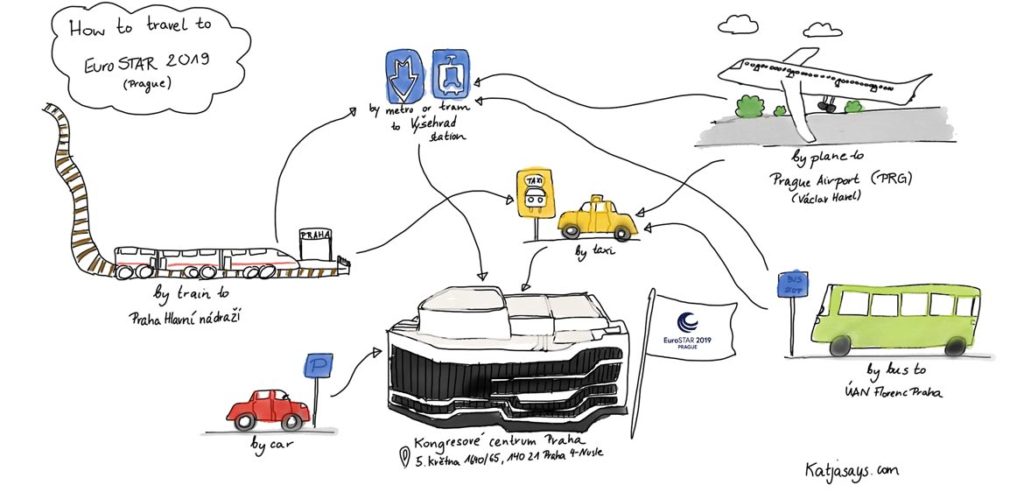
To begin her sketchnoting, Katja is shares how attendees can travel to the EuroSTAR Software Testing Conference in Prague, 11-14 Nov. If you are planning on flying, you will be well served by flight options. Fifty two airlines fly into Václav Havel Airport Prague from 110 destinations in 42 countries. There are lots of rail options too and if you are in central Prague, you can join us at the Prague Congress Centre by hopping on the metro line C (red line) to station “Vyšehrad”, which is right in front of the congress centre.

For Prague accommodation options at delegate rates see the EuroSTAR Hotel Page.

We look forward to welcoming you to the 27th EuroSTAR Software Testing Conference.

Getting to the EuroSTAR Conference


See more of Katja’s sketchnotes on her website Katjasays and you can follow her on twitter for updates.

Filed Under: EuroSTAR Conference, Uncategorized Tagged With: EuroSTAR Conference

  • « Previous Page
  • Page 1
  • …
  • Page 5
  • Page 6
  • Page 7
  • Page 8
  • Next Page »
  • Code of Conduct
  • Privacy Policy
  • T&C
  • Media Partners
  • Contact Us

part of the