• Skip to main content
EuroSTAR 2027 - Sign up for early access

EuroSTAR Conference

Europe's Largest Software Testing Conference.

  • Programme
    • Call for Speakers
    • 2026 Programme
    • Community Hub
    • Awards
  • Attend
    • Why Attend
    • Bring your Team
    • Testimonials
  • Sponsor
    • Sponsor Opportunities
    • Sponsor Testimonials
  • About
    • About Us
    • Our Timeline
    • FAQ
    • Blog
    • Organisations
    • Contact Us
  • Book Now

EuroSTAR Conference

Acing an interview in the new normal

June 25, 2021 by Fiona Nic Dhonnacha

The ‘new normal’ means many things to many people. In all walks of life, we have to re-learn how to do simple things, and that’s no different in business.

One of the major changes many people have to contend with is the traditional interview process. How do we navigate interview etiquette when such an important part of an interview is about physical contact, facial cues and getting a “feeling” for the person we’re interviewing (or is interviewing us)?

Here are the 5 most important things you need to know about acing an interview in the new normal.

Replacing the handshake

Prior to the ‘new normal’, we would walk into a room and shake the hand of the interviewer, or the panel of interviewers, to establish rapport and introduce ourselves. But unfortunately, nowadays, we can’t do that. Instead, we now have to do this virtually. The good news is that we can still make that great first impression, and it’s all about making sure the first image of you, when you appear on the video screen, is what you want it to be. This will set the scene for the rest of your interaction.

For example, you can show ‘openness’ with a gentle and friendly raising of your hand, along with a gentle smile, while greeting the people on the other side of the screen. I’m not talking about a wave, just a gentle raising of either your left or right hand, followed by a polite greeting. This shows you are happy to be there, that you’ve got a warmness about you, and that you’re comfortable talking to the rest of the panel.

Technology can be your friend (or your enemy)

It is absolutely imperative to understand, and know how to use, the virtual platform. Some organisations use Teams, some use Skype, some use Zoom. One of the biggest challenges that I find is candidates only acquaint to the platform at the time of the interview, which can be a problem, especially in making that all-important first impression.

I’ve had instances where candidates couldn’t find the video toggle button, or something as simple as the unmute button. Which means they have to essentially try navigate their way through a ‘new’ piece of software for the first time, when it’s actually supposed to be interview time.

My suggestion: do a dry run and test the link a day or two before. It’s all about knowing what the process is to going to be like, so you’re fully prepared.

Secondly, and more importantly, is the hardware that you use. I strongly suggest you don’t use a cellphone for a video interview. Rather use a fixed device, either a laptop or a desktop. Remember, an interview is not the same as having a Whatsapp call; the image of you needs to be professional, which means stabilised and properly framed. There have been times where I’ve had interviews with candidates who use their cellphones, and all I could see was an image up their nose. This is not a good look.

Know your own CV

This point for me is probably one of the most important and in fact doesn’t only apply to the new normal but to any interview situation. This is where most candidates fail interviews, because they’ve actually lost familiarity with their own CVs and struggle to answer questions around tasks and duties that they themselves have put on the CVs.

Your CV is your textbook; learn it, study it and know it well. It is about you, after all. Being unable to respond quickly and effectively about your own capabilities will create doubt in the mind of any interview panel.

Maintaining focus during your interview

One of the most important techniques to learn for physical interviews is how to look at people, to maintain eye contact, and to be able to respond and look at different people in an interview panel inside the room. This is difficult, if not impossible to do in a virtual interview, but you can do the next best thing: maintain your focus on the screen at all times.

To simulate eye contact, keep your eyes focused just below the eye of the camera on your device, and it will appear to the viewer that you’re looking directly at them. When listening to the interviewer or anyone that’s posing questions, you are welcome to look at his or her face on your screen, but when you respond, always focus your eye just below your camera. Even though there may be multiple attendees on the chat, it will give every single person the impression that you are looking at and talking directly to them.

Integrate your surroundings

In a virtual call, each participant will be seated at various settings and locations. Some are at home, some at the office, some in their cars. However, it is up to you to invite the panel into your setting.

I have no problem with fixed backgrounds on Teams and other platforms for most video calls, but this is a problem when it comes to interviews. I once interviewed a candidate who used the standard office background on Microsoft Teams, which at first glance, looked absolutely fine. However, when he moved around, I could actually see that he was sitting up in bed, not a good look for a professional interview.

You can actually use your background to your advantage. Create a natural setting that reflects who you are as a person, not just a professional. For example, you can display your highest qualification behind you, or maybe a professional interest that you may have. Perhaps you’re a tennis lover, or a cricket player, a music listener, an animal activist; include some visual elements to represent that without you having to openly discuss it in the interview. Be careful not to be too controversial, by including visuals of specific sports teams for example. Rather keep it neutral and conversational.

Remember, interviews in the new normal can be just as exciting (or scary) as they were in the ‘old days’. By learning to adapt, using the guidelines above, and working with – rather than against – the technology, you can make an even better impression than before.

Good luck! 

Inspired Testing is exhibiting at EuroSTAR 2021 Online. Check out the EuroSTAR 2021 programme, and join us September 28-30th.

Author

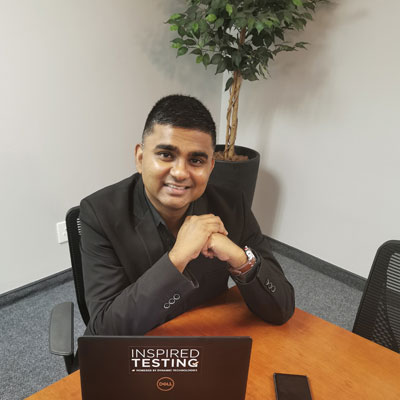
Greg Naidoo, Head of Talent Acquisition at Inspired Testing

Greg has been leading Talent Acquisition efforts in Technology for more than 15 years. He has enabled organisations across South Africa to effectively attract and acquire top talent in Quality Engineering and Testing. He is passionate about growing the existing compliment of brand ambassadors at Inspired Testing to showcase their world class software quality engineering solutions..

Filed Under: EuroSTAR Conference, People Tagged With: EuroSTAR Conference

EuroSTAR Summer Tutorials

April 13, 2021 by Ronan Healy

Over almost 30 years EuroSTAR Conferences has been a indispensable source of learning and connections for the software testing community in Europe. Through live events in Europe EuroSTAR Conferences have supported software testers in exploring the realms of software testing through our live events. One part of these live events that always prove to be the most popular and (for many) the most beneficial are the EuroSTAR Tutorials. The opportunity to engage with others and learn from real experts has always proven to be a really popular experience for EuroSTAR attendees.

Now get ready for your chance to attend EuroSTAR Tutorials wherever you are. The EuroSTAR Summer Tutorials take place virtually on 11th, 12th, and 13th May. Running all day from 9am to 4:30pm, each tutorial promises to be an immersive experience. Places are limited to allow for real interaction with the speaker. This will not be a lecture. This is a immersive experience. Let’s take a look at what is taking place at the EuroSTAR Summer Tutorials.

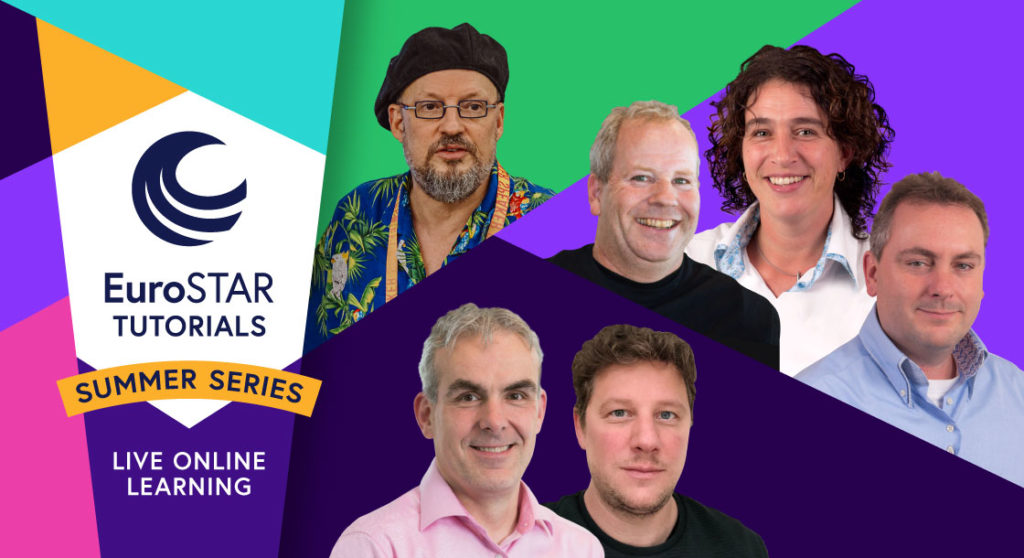
EuroSTAR Tutorials Summer Series

The first tutorial to take place on Monday 11th May is with Michael Bolton on Test Reporting. Michael Bolton needs no introduction. Co-author of  Rapid Software Testing (RST), he has taught and educated testers all over the world. In this session titled “What’s The Story? Powerful Test Reporting” Michael will examine the elements of test reporting, what to include, what to exclude, how to justify what you include and more.

Then on Tuesday 12th May, the topic of Test Management – An Overview (in many different phases) will be explored with the help of three world class speakers. Join trainers Iris Pinkster O’Riordian, Bob van de Burgt and Bart Knaack as they explore test management skills you should be using. Utilising theory, discussion and exercises, the trainers will look not just at “standard” tools like Risk Based Thinking, Stakeholder Management and Test Approach but also the skills required to manage your environment. With real work examples from the trainers own experiences, there will be takeaways that you can apply to your own work.

Finally on Wednesday 13th May to round off a great three days of learning, Agile coach Huib Schoots with Martijn Langhorst will deep dive into risk. With the aim of sharpening your skills as a strategic thinker, “How Should We Test This? Practical Risk Analysis and Test Strategy Skills” will explore evaluating context, risk analysis and modelling products. You will get the opportunity to jump into groups to discuss risk using heuristics. Huib and Martijn have promised a fast-paced session with lots of fun included so you better get booking now. Even if you have not written risk strategy before, the session will welcome you to learn and explore in a engaging environment.

Live online learning is here. Join us and these great speakers for three days of in-depth exploration of these topics. Learn from thought leaders, get new ideas and explore with like minded professionals. We will see you there. Find out more how you can attend here.


Filed Under: EuroSTAR Conference, Virtual Conference Tagged With: EuroSTAR Conference

Preventing Burnout While Working in the Tech Industry

March 31, 2021 by Fiona Nic Dhonnacha

‘Preventing Burnout While Working in the Tech Industry’ is a talk given by Raj Subrameyer at EuroSTAR Online 2020. Raj is an international speaker, author, and tech career coach. He helps people in the industry find their dream job, and become successful leaders.

Now, Raj has put together his tried and tested strategies in a blog post – packed with information to help you prevent burnout in work (and in life); including tips, tricks, and tools he’s used on himself and his coaching clients.

Here’s Raj’s talk from the conference:

Where it started

Growing up, I was a shy and introverted kid. I was also average – in everything from academics, to sports, to dating. So, I put a lot of pressure on myself to emulate the overachievers around me – I wanted to be recognised, and for other people to see me as worthy. My biggest fear was being ignored.

When I started my career, I made a vow to myself: I would be famous, a recognised name. So I said ‘yes’ to every opportunity that came my way, and put in a lot of hard work. I tried to push myself out of my comfort zone constantly, in order to get the recognition that I wanted. What happened? Well, I got the fame, money and credibility I desired. Life was good.

Burnout

Then, in June 2018, something happened: one night, I suddenly blacked out while I was going to the bathroom. The next thing I knew, I was in the ER, undergoing lots of tests. The diagnosis?  Severe anxiety, depression, dehydration, and burnout.

Burnout is a serious issue, and it’s attributed to a lot of mental and physical health issues. About 60% of people in tech have burnout on some level – but they just don’t realize it.

Let’s ensure this doesn’t happen to you. I am sharing strategies to help you prevent burnout, including tips, tricks, and tools I’ve used on myself and the clients I coach, who are leaders in the tech industry.

Trust me, these things work! So let’s start your transformation process…

Pick up a book

There are two books which were instrumental for me at the start of my journey to productivity and mindfulness.

Deep work by Cal Newport

Deep work is focused time block sessions on cognitively demanding tasks, without any interruption. Research has found that we check our emails 30 times per hour, and it takes us, on average, 23 minutes and 15 seconds to regain concentration after this kind of interruption. That’s why doing deep work is really important in order to be highly productive. If you want to know more about my deep work process, check out my blog, 72-Hour ‘Deep Work’ Week.

Procrastinate on Purpose by Rory Vaden

Everyone talks about time management, but no one talks about self-management. The thing is, you cannot manage time, because time moves no matter what you do. The one thing you can manage is how you prioritize your work and tasks within a given time. The system I have in place to prioritize tasks is the focus funnel, which is detailed in this book. It’s been very influential in my transformation process.

Pick a task, and ask 3 questions.

  1. Can it be eliminated?
  2. If it can’t be eliminated, can it be automated?
  3. If it can’t be automated, can I delegate it to someone else?

If all three of these answers don’t work, then you have to make a decision on whether to do that task later on, or work on the task right now, because that’s the highest priority task.

This is a good decision-making system because it incorporates priority dilution, which means that you are focusing on the lower priority task compared to the higher priority ones.

Then, you have priority concentrate – where you’re trying to concentrate on the most important task at that moment right now.

Hack your week

You can implement planning hacks and mindfulness hacks in your daily life to help increase your productivity significantly. Have you ever had an overwhelmingly huge to do list? I was always overwhelmed with my to do list, because it always had around 30 tasks on it. But there’s only so much time in a day, and you need to know where to start and what to focus on. So I came up with a system – a daily and weekly planning routine.

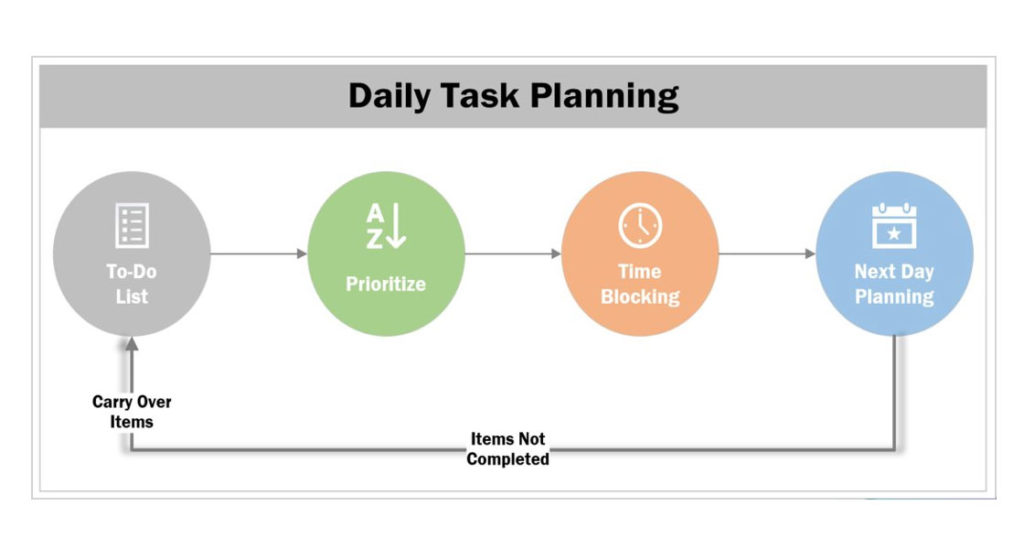
Daily planning routine

Every day, I spend 5-10 minutes coming up with a to-do list of different things I want to accomplish that day.

I then prioritize my to-do list from 1-10 in order of importance. My motto is to finish 3 top things every day. I started blocking my calendar to do focus work on these priority tasks. When the time comes, my mind does not need to think about what task I have to do, because it’s already there in the agenda.

At the end of the day, I spend 5- 10 minutes reviewing what I’ve accomplished that day. What I haven’t done gets carried over to the next day. That’s a simple way you can prioritize your work on a daily basis.

Weekly planning routine

I run my own business, and as part of my job, I have five tasks to do, no matter what: learning, reading, content creation, career coaching, and speaking. I already know how much time I have to invest in each of these buckets.

I spend about half an hour every Sunday on my weekly planning routine, and then schedule time blocks throughout the week, for example 2 time blocks for learning and reading, 4 for content creation, 8 for career coaching.

These buckets will be different for you, but make sure you are spending time in every priority task.

Meetings, meetings, meetings

Meetings are one of the most unproductive things you can do at work.

  • on average, 92% of the people in meetings multitask.
  • $219 billion dollars per year is spent on unproductive meetings.
  • 72% of the meetings which happen in the world are unproductive.

I highly recommend a Ted Talk on unproductive meeting from David Grady, How to save the world (or at least yourself) from bad meetings to get more insights on unproductive meetings.

Unproductive meetings suck the time, effort and life out of people and the company. So how do we prevent this from happening?

Pizza, anyone?

Amazon implements what’s called the Two Pizza Rule: no meeting should be longer than it would take to eat two boxes of pizza, which would be enough for approximately eight people. Printouts are given to attendees beforehand, and the first 20 minutes of a meeting is spent going over information before the meeting begins. This is a great way to ensure meetings run as productively as possible.

Another way to help avoid unproductive meetings is to ask yourself, do you really need that meeting? Could it be solved just by talking to someone via chat or email, or a phone call?

Try to avoid having more than 7-8 people in your meeting. If you have 15 to 20 people in attendance, it’s not a meeting, it’s a conference. You need to have a clear agenda, and ensure everyone comes prepared for the meeting, and then start and finish on time. The most important thing to ensure an effective meeting is to follow up on the action items, and make sure they’re completed.

Remote meetings

Have you ever joined a meeting remotely, where nobody announces who is in attendance? Or had to endure the slurping of coffee, munching, rustling, and other office noises? It might sound trivial, but if you’re wearing noise-cancelling headphones, then you know what I’m talking about.

People often start presenting something for people in the room, without sharing their screen for the remote attendees. There are also many little conversations happening in the room throughout the meeting – very annoying for the person who’s attending remotely.

How do we solve these problems? There are some simple steps you can employ: Announce who is there in the room. Have a webcam to project the room to remote attendees. Make sure to keep conversations to a minimum, and be cognizant about the different sounds which people make. The mute button can be very effective here!

Get good at email

Every year, close to 219 billion emails are sent. Research shows that by end of 2021, that number is going to increase to 316 billion emails per year. There are going to be around 4.1 billion email users by the end of 2021. The way we use email is going to be really, really important for companies, especially if you’re working in high-performance teams.

Here are some effective email strategies:

  • Ensure there’s a clear subject line
  • Don’t write long emails – just have three to four bullet point hitting on the main topic. When you have five or six paragraphs in an email, it’s hard to get your point across to people. One rule which I follow is that your email should fit within a 11-13 inch laptop screen. If it’s more than that, then you have to sharpen it.
  • Emails with more than two email threads are a red flag, because that’s the sign that you have to pick up the phone and talk to the person directly, or do something else instead of continuously emailing the person.

Set reminders for everything

I work on multiple projects, including writing, work, consulting, and coaching work. So how do I manage all these things? Reminders. Set reminders for yourself, and make use of project management tools like Trello and Asana, to help send you reminders and make sure you follow up on different tasks.

Mindfulness

Mindfulness can be an immense help in productivity. Research has found that the human mind can concentrate for an average of 45 minutes to an hour. If it’s more than that, you start losing focus. The mind also has to refocus for 5-10 minutes before you start a new task.

So throughout your work day, you need to practice focus and de-focus. Make sure you take breaks, and do something to reset your mind after every 1 hour time block. I take 5 minutes to do push-ups!

Find your appy place

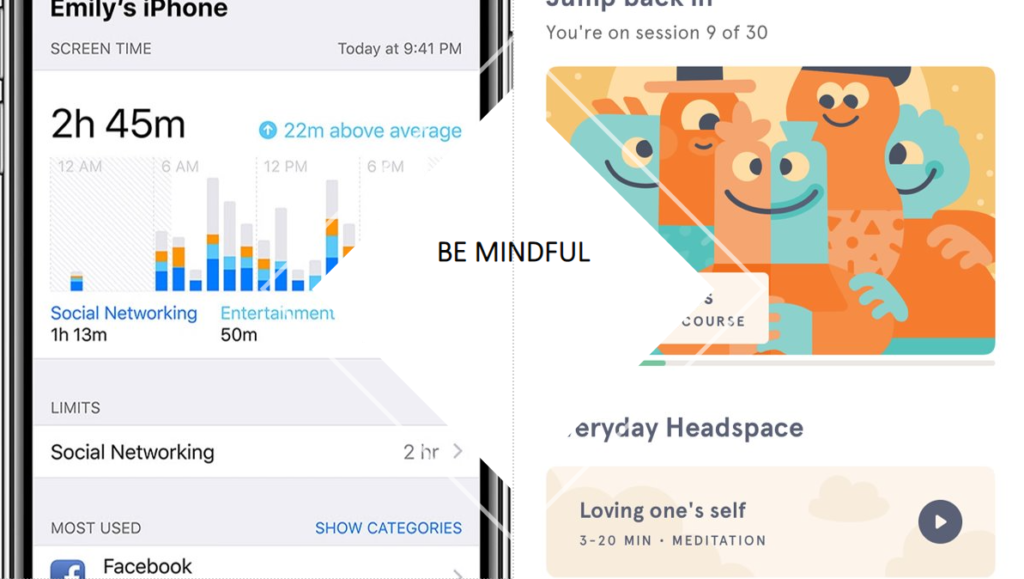
On your lunch break, try to go for a walk, watch TV, read, listen to podcasts, or just sit in silence! You need to recharge your mind properly. Studies find that on average, we spend 4 hours per day checking our smartphones. That amounts to 20 hours per day in a 40-hour work week.

Try out meditation apps like Headspace to take breaks between work, whether it’s one minute, 10, or 20 minute sessions.  Make sure your phone is on ‘Do Not Disturb’ during focus work. You could also create a playlist specifically for doing creative work.

Join a community

When I started off in my career, I found it really hard to find groups of like-minded people who wanted to discuss the same things as me – career advancement, leadership, motivation. So I created my own private Facebook group called Skyrocket your Career. This now has over 150 people, and all our testers and developers who want to share resources can learn from each other. If you want to be part of our community, check it out, because we’d love to welcome you!

Start living!

To quote Confucius, “we all have two lives. The second one starts when we realize we have only one.” So make sure you follow some of these hacks, implement them in your life, and see what works for you. That’s when the real transformation happens – and that’s how you can prevent burnout.

Even more resources:

Skyrocket Your Career

EuroSTAR Conference takes place online, September 28-30th. The 2021 programme will be released very soon – sign up to be the first to hear all the details.

Raj Subrameyer

Author: Raj Subrameyer

Raj Subrameyer actively contributes thought leadership and enrichment to the software community through conference talks, contributed articles, blogs, and YouTube videos; where he shares his experiences in development, testing, leadership and productivity. Contact Raj on LinkedIn  or Get career advice

Filed Under: EuroSTAR Conference, Leadership, People Tagged With: EuroSTAR Conference

EuroSTAR Programme Review Process

March 1, 2021 by Suzanne Meade

Ever wonder how conference submissions are reviewed or how the overall review process works? Well we can tell you that the EuroSTAR Conference Programme is the culmination of a community wide collaboration.

Led and crafted by the EuroSTAR Committee, who first call for submissions in line with a theme chosen by the Programme Chair. In 2021, this is Fran O’Hara. Testers far and wide then submit their suggested talks. Each year, there are hundreds of submissions to be reviewed, and, in order to create a balanced and varied programme, each submission is reviewed by up to 5 people (anonymously i.e. talk details viewed, not the submitters’ name).

This is where the community get involved and each year, the EuroSTAR team welcome reviewers from the testing community. Some are past speakers, some have been involved with shaping EuroSTAR since the beginning and all are valued members of the EuroSTAR family.

This is time intensive and we are very grateful to each of our reviewers for their time and dedication. Following the community review, the Programme Committee will then come together to start crafting this year’s programme of talks.

This blog is a behind the scenes introduction to a first time reviewers experience, written by Sérgio Freire of Xray, and details how he approached his reviews.

EuroSTAR Behind the Scenes – Sérgio’s Experience

I was invited to review some submissions for EuroSTAR 2021 testing conference. I had never done it before, and even if time is scarce I understand that this is important for many who submit during the Call For Speakers; it’s also a learning experience for me. But how have I tackled this task? How can I make sure I’m fair enough to everyone? Can I test my review process somehow? This is the story of how I tested my review process. Let’s check it out.

Background

Before starting, it’s important to understand the conference context. EuroSTAR 2021 theme is “Engage”. Engagement is a broad topic. It’s about involvement, commitment, challenging, seeking understanding. We deep dive problems and challenges, we embrace them and we overcome them, no matter if they live within us or in our teams. Engaging is, in my perspective, about giving a step forward.

Infrastructure and supporting assets

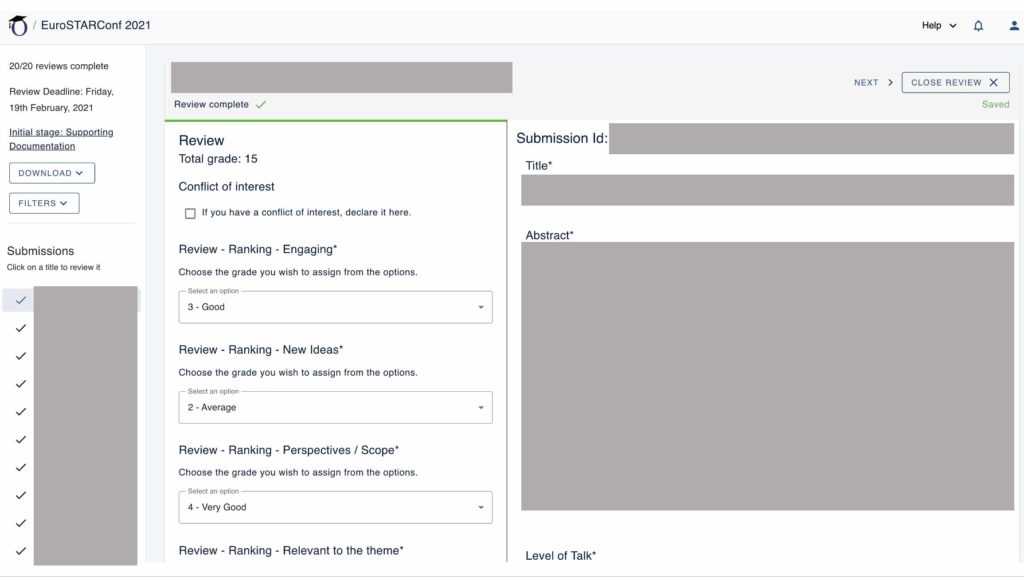
The review was done using an online tool where we can easily jump between submissions. The tool itself has an interesting and scary bug that may mislead you to think that your already reviewed submissions/scores are lost… however, I found out that it is just a UI glitch 🙂 a forced browser refresh solved the issue.

EuroSTAR Programme Submission tool


To assist me as a reviewer, I had scoring instructions that I read before starting reviewing the submissions. These instructions were always open in one of my screens.

Criteria

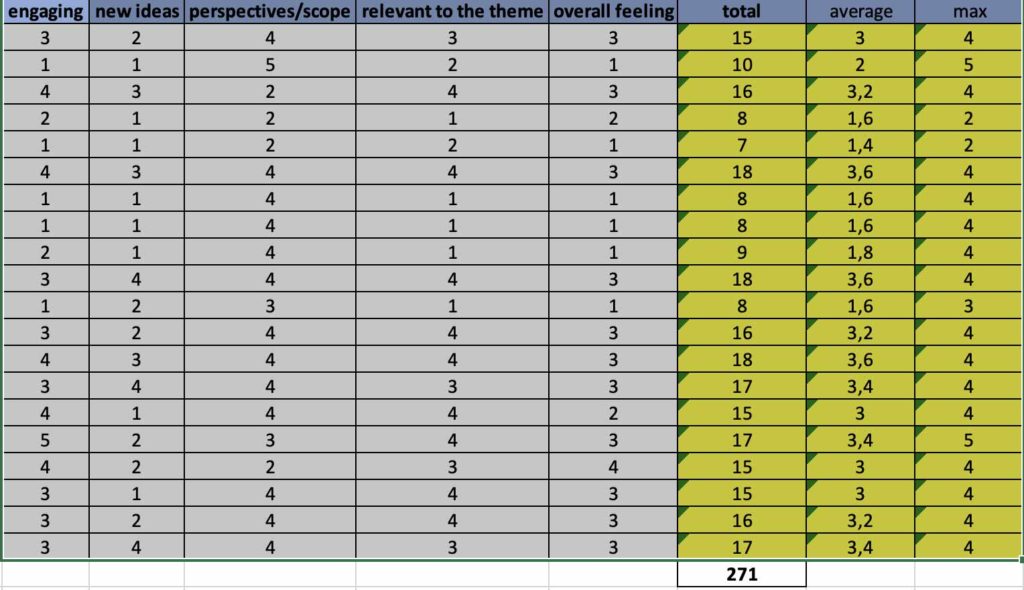
There were 5 main criteria for me to score:

  • engaging
  • new ideas
  • scope
  • relevant to theme
  • overall feeling


I felt a bit of doubts on “engaging” vs “relevant to theme”, as the theme is “engaging” and thus some overlap exists. I used the scoring instructions several times, to decide how to score each one of them. Nevertheless, I would prefer a more clear separation between them as they’re not independent variables. The “scope” criterion also left me some doubts, as we’ll see ahead. Finally, there was an open text field “comments” where we could leave a qualitative assessment.

How I did it?

Day 1

I had a setup a quiet room (i.e. my office), so I could read and think carefully. I went over each one of the submissions and scored them; I skipped the “comments” section on purpose so I could not loose much time with them in the first iteration but also to try avoid a bit of bias. Whenever scoring, I regularly looked the scoring instructions if some criteria was not clear to me. I noticed that I was probably assigning “scope” not the meaning it should, as the scoring values were almost identical. Even so, I decided to look at it more carefully on a second iteration. Besides leaving the scores on the online tool, I also took notes in a spreadsheet; thus, I would have a backup 🙂 and I could use it for analysis.

EuroSTAR Programme Review Process

After scoring all submissions, I decided to go over the submissions once again to leave qualitative comments, that I structured in these bullets:

  • First impressions: Mostly based on the title and takeaways.
  • Takeaways & The Day After: Is it clear what to learn in the end of this session?
  • Final assessment: My overall feeling, i.e. a brief summary.
  • Would I attend: A yes or no, or eventually a perhaps.
  • Cliffhanger/invite to discover: Was there any mystery left? Any invite to learn something intesting during the session?
  • Suitable for: beginner, intermediate, advanced.


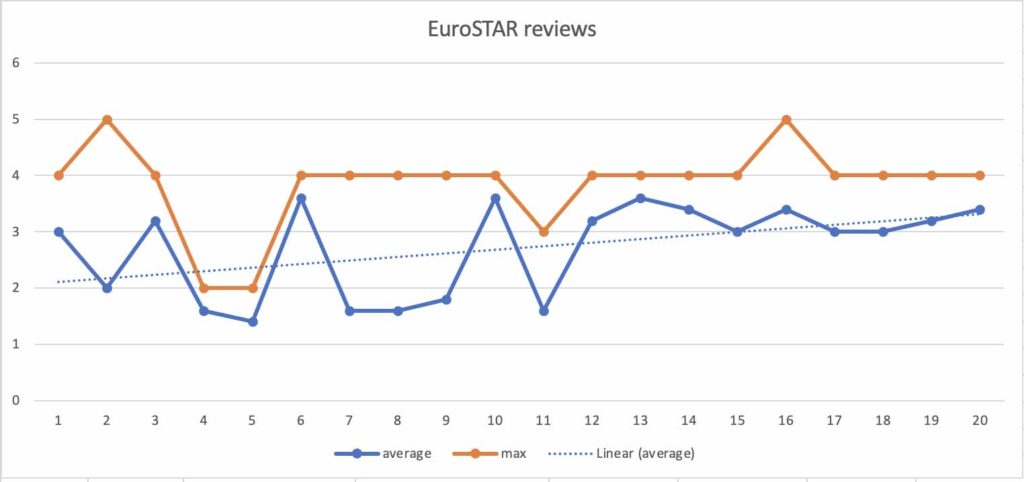
I was curious to understand if I had some bias that would be reflected more towards time. Thus, I traced a chart with the average scored and a trend line. The result was not shocking. I also made a column with the max score I add assigned in a specific criterion… and I didn’t see any relevant change with time.

Sergio's review process

I slept over and I was curious to see what would happen whenever I iterated on this.

Day 2

I went over the submissions once again, but in reversed order. Why? To avoid some possible bias related with time and exhaustion.

In terms of criteria, I also did a subtle change. While in the first day I considered “scope” as the criterion for being adequate for the time slot, in the second day I considered more the message clarity because it would be a factor that would help the fit for the available time slot.

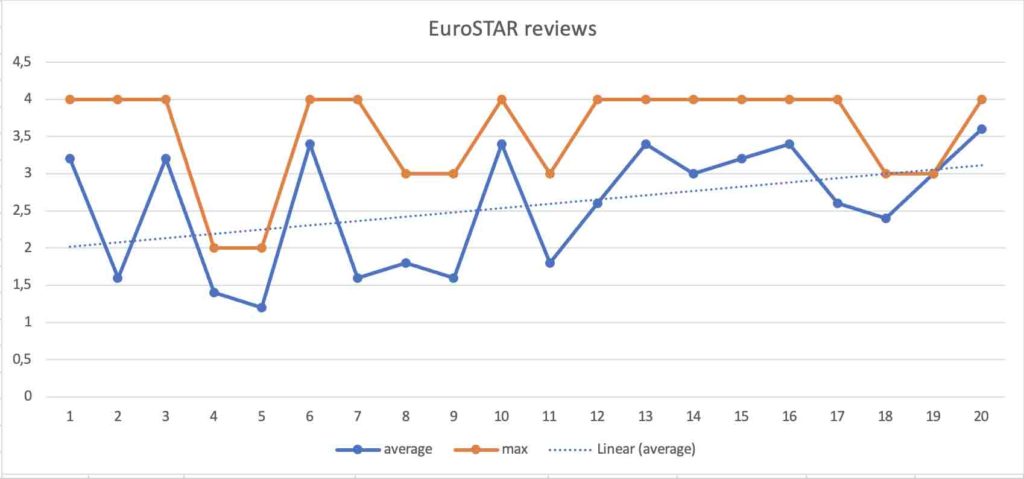
Even though overall scoring is a bit lower, the results are not very different from the 1st iteration, where the chart shows also a similar trend line.

EuroSTAR Programme Review

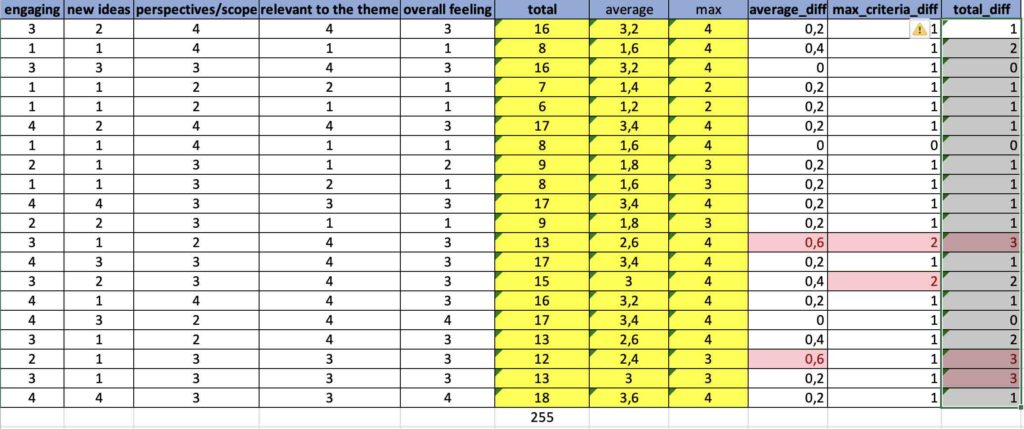
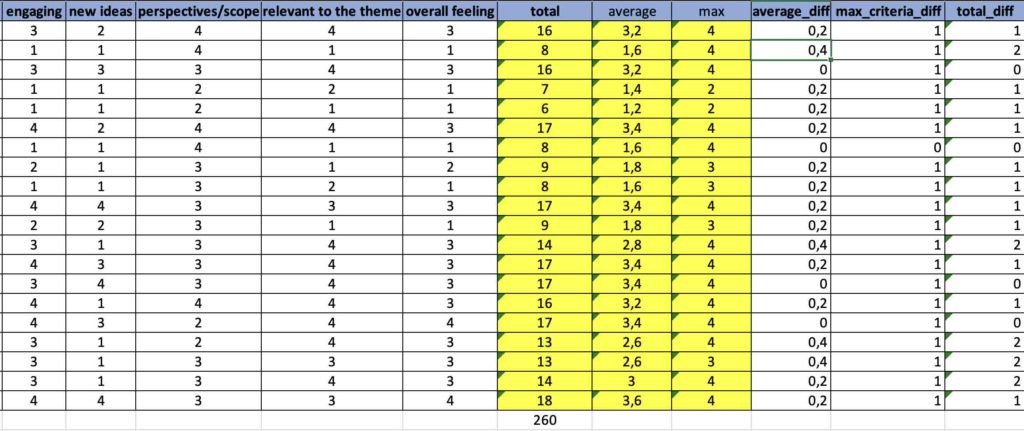
In the spreadsheet, I calculated the absolute difference on the average and on the total score.

Sergio's blog

I flagged in red suspicious cases, that would affect my confidence:

  • absolute average scoring difference >= 0.5
  • absolute difference in individual scores > 1
  • absolute total scoring difference > 2


Gladly, only a few reviews appear that I need to have a look at once again. After going over them (i.e. scoring) in this localized 3rd iteration, I seem to be in my confidence interval except for one submission that remains flagged. Why? Well, because in the total score it had 3 points of difference. I read that submission all over and scored it once again. In the end, it was once again in my confidence interval.

sergio review process chart

Remember the “Comments” section? Well, I decided to go over it and look at “would I attend” bullet and compare it with the “overall feeling” criterion, that implictly should have that reflected. I notice that my decision to attend was correlated with the “overall feeling” criterion but it was not a consequence of it.

Conclusions and final thoughts

On the review process

I had quite a few doubts at start, especially this one: am I going to be fair? But also, I had doubts about how I would perform in this task, my biases, etc.

After looking at the results, my first iteration was trustworthy. I scored the submissions a bit lower during the second day, when I performed the 2nd, 3rd and 4th iterations. However, my first iteration was balanced and scores should reflect that.

I don’t assign 5 or 0 easily. I need to be quite impressed or reject something completely, which for me was not the case.

Scoring talks can be relatively fast but if you want to implement a process such as this one or your own, you’ll spend a lot more time. Even if you don’t, if you consider all the points that can affect a single criterion then it will consume more time indeed.

This whole process of revieweing submissions is also a discovery process about how each one of us works and is able of handling tasks. What works for someone, may not work for someone else.

On submitting a talk

Talks touch us in subtle different ways, so we value them differently. It makes sense, from a quality perspective: we assign value accordingly with our own definition of quality.

There are some generic rules that apply though in most cases and questions that you can think of:

  • Having a clear message, not that long not that short is crucial; if we get lost, we tend do discard it rightaway.
  • Why should we attend? What can we expect from it?
  • How will that talk help the attendee?
  • How does that talk align with conference?
  • Is it presenting something new, or your own learnings and challenges?


I’ve done a few submissions on the past and I have been unlucky most times. Yes, true. Therefore, I still have much to learn in this matter. I remember when I did a scientific submission for a Usenix conference few years ago, and even though it was a different audience, I had to iterate on the paper a couple of times before it was accepted and I was invited to present. Therefore, as everything, we need to iterate and learn.

Going over this review process, being on the other side of the fence, made even more clear some points mentioned above. By understanding the challenges a reviewer faces, when looking at dozens of submissions, I am a bit more aware of the things I need to have in mind for any submissions I may perform in the future.

It was an interesting thing to do and I’ve learned a bit more on the overall process of submitting (and reviewing) talks for testing conferences. I also appreciate the effort reviewers and program committees have to make, no matter what conference we’re talking about, because this is a process that requires considerable effort if you want to do it right and make it fair.

Note: the 2021 EuroSTAR Conference is taking place 28-30 September this year instead of November and the programme is usually launched at the end of April.

RECEIVE EUROSTAR PROGRAMME NEWS


Sérgio Freire reviewersSérgio Freire – Xpand IT – Portugal

Sérgio Freire is a solution architect and testing advocate, working closely with many teams worldwide from distinct yet highly demanding sectors (Automotive, Health, and Telco among others) to help them achieve great, high-quality, testable products. By understanding how organizations work, their needs, context and background, processes and quality can be improved, while development and testing can “merge” towards a common goal: provide the best product that stakeholders need.

Sérgio spoke at EuroSTAR 2020 and you can check out his personal blog at www.sergiofreire.com

Filed Under: Community Spotlight, EuroSTAR Conference, Virtual Conference Tagged With: Call for submissions, EuroSTAR Conference, software testing conference, Submission Process

Why Speak at the EuroSTAR Conference

January 21, 2021 by Suzanne Meade

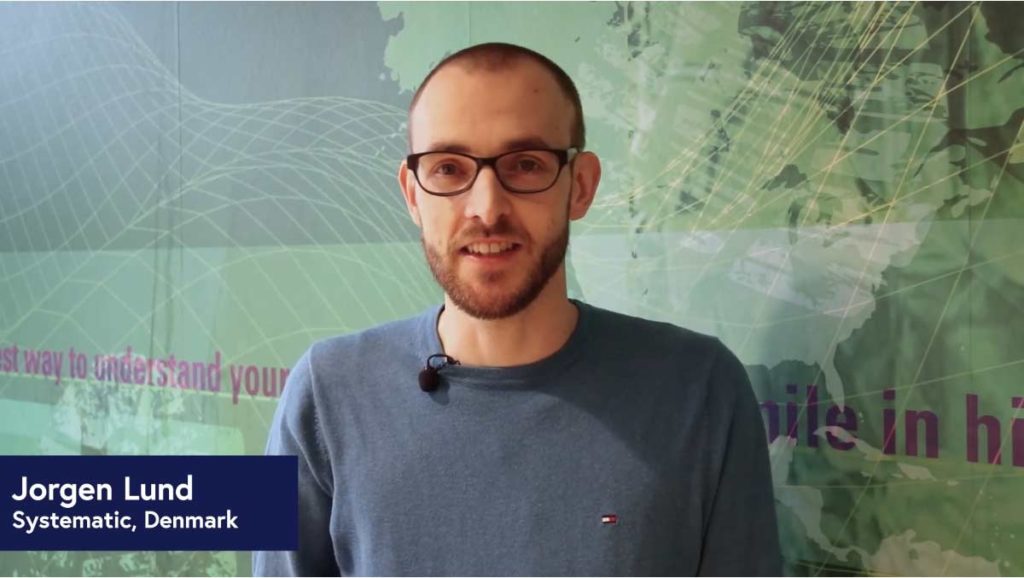
An experience talk from EuroSTAR 2020 speaker, Jorgen Lund:

Speaking at a conference is a daunting task for most people. There are so many inner voices telling you why you can’t or shouldn’t do it. I want to be that outer voice, telling you why you CAN and why you SHOULD!

My name is Jørgen. I’m a two-time, moderately successful speaker at EuroSTAR. I’m also suffering from some undiagnosed stage fright/anxiety.

Being anxious about doing public presentations is a common phobia – but we all experience it in different ways. I’ll tell you my story, and hopefully you can relate.

In school, I was a really obnoxious child. Sitting in the front row, raising my hand every time the teacher asked a question, and never being shy about pointing out others’ mistakes. I was also the smallest boy in the class, had a funny voice and some front teeth that were eager to see the world, until I had dental correction done in the 8th grade – making me an easy victim for kids to get back at me. Being good at school stuff was my one thing to hang my hat on.

But answering questions is one matter – you can pop your head up when you have something to say. Attending oral exams – when you’re in front of people who don’t know you, but judge you based on your knowledge and ability to present it, is another. I worried for days ahead. And in the moment, I couldn’t think clearly, my heart was racing, my speech stumbled, and my mouth dried up in seconds. In high school for an oral exam, I got so nervous that I vomited in a trash bin when I had to pick the exam question (fun fact: a friend told me, when I told this story, she had done the same thing – you’re not alone out there!).

I’m 40 now – and while school and high school are a long time ago, those traits are still part of me today. Every public speaking engagement is a new exam.  The good news is that it hasn’t stopped me from doing what I wanted to do. When I’ve opened up about my anxiety, I have found nothing but empathy and understanding – and I may have finally started realizing that many of the small mistakes that pile up in my head, are sometimes imperceptible to those listening.

I hope that by sharing my story and offering a few hints about my own EuroSTAR presentation, I can encourage you to quiet your inner critic for a short while and submit your story – big or small!

Why you CAN

First, a few words on psychology that has helped me see the world in a different way. I’m no expert – I only hold a YouTube degree in basic psychology. It helps me to understand my responses to certain situations – which is a good way for me to ‘hack’ my anxiety. I also have the attention span of a TED talk, so instead of recommending some books to collect dust on the shelf, I’ve included a few inspirational videos.

At EuroSTAR 2019, I was introduced to Carol Dweck’s theory on growth mindset vs. fixed mindset and the impact of a growth mindset’s ability for kids to thrive and succeed in school. A central part of a growth mindset is understanding that you’re always on a journey towards something. I think in many ways EuroSTAR embodies a growth mindset. Nobody attends to test if you know your stuff. People come to the conference to learn, connect, share, inspire and be inspired. I’ve met nothing but curious, helpful, friendly and compassionate people – from the delegates to the speakers, and the whole EuroSTAR staff. If you’re selected to speak, you are among friends all the way, who only want to help you succeed.

https://youtu.be/hiiEeMN7vbQ

The second part is about Imposter Syndrome. If you feel like you’re not skilled enough, not eloquent enough, or your ideas are not interesting to others to stand on that stage – there’s an above average chance that you’re doing just fine, and you’re just suffering from this common condition. Don’t let that nagging doubt convince you that you shouldn’t give it a go. Mike Cannon-Brookes, who’s the CEO of a ‘small’ Aussie tech company called Atlassian made a TED talk on the subject here:

https://youtu.be/ZkwqZfvbdFw

Jorgen Lund preview video of EuroSTAR 2021 talk - Why Speak at EuroSTAR

Why you SHOULD

Are you passionate about testing or other aspects of your work life? Then I’m sure there is someone out there who wants to hear about your passion!

EuroSTAR is a very diverse crowd. Some attendees have been around since the beginning – others are attending their first conference. Their projects and organizations are diverse as well. What’s trivial to some, will be a real eye-opener to others. Each year, the programme committee put together a program that has something for everybody – which means that what is near to your heart, is likely to appeal to somebody else as well.

Another reason why you should apply is, it’s good for you! You get to practice a lot of useful skills – writing a good abstract, creating a video to present your idea and showcase your speaking style (unless you’re part of the Tik Tok generation who grew up recording yourself) – and if you get selected, putting together a good presentation, and getting some experience under your belt in front of a crowd of wonderful people. And if you don’t get selected, maybe your idea will mature for another year and you’ll be clearer on your message, or you’ll get a new and even better idea that might not have come if you didn’t submit the first one!

It is likely to put you out of your comfort zone – but you’re never in too deep, and you’re always among friends. You don’t grow as a person if you don’t occasionally push the boundaries a bit!

My EuroSTAR Experience

By some miracle, I got selected to speak at EuroSTAR back in 2014. It wasn’t a great performance by any means, and the feedback reflected as much. It’s been nagging at the back of my head for a while. After some years of shying away, I applied again in 2019 where I didn’t get selected. I did attend the conference in 2019 as a delegate and really got hit by the EuroSTAR bug again. I wanted to go back! When the theme for 2020 was announced at the end of the conference, I was all in. Testing in the Wild. My biggest passion, making software that works for our military customers in the wild, was right in line with the theme.

I put all my energy into making a good abstract. I solicited help from some colleagues to zoom in on the key points of my presentation. I’ve shared my ideas with testers in my own department, testers in other departments, and colleagues in other job functions as well. It helped me get a better grasp of what was important, and whether it would be relevant to others as well.

JOrgen Luns Why Speak at EuroSTAR

The EuroSTAR team highly recommends submitting a video along with your abstract. This was another one of those mental barriers for me, but I enlisted the help of some colleagues in our marketing department to help me record it. Being comfortable in front of a camera and a crowd of one was a good, first step for me. I also sent the final result to my parents to see – for some reason it’s less scary for me to get up in front of a crowd of strangers than to present it to the people close to me.

I went into the registration system early to learn what information was required. At first, it was a bit overwhelming for me, so taking the time to letting the sections materialize really helped. I maintained an offline copy of the registration formular until I was ready to submit. The system does allow you to save a draft online, but I found it more accessible in a separate document – and easier to get feedback from my colleagues. There’s also some bits in there, like writing a bio and summarizing your speaking experience that takes a little time – don’t let it linger till the last minute.

It was a nerve-racking period for me, trying to put together the best possible presentation, and then enduring the excruciating waiting period until the speakers were announced. I had poured my heart and soul into it, and if it wasn’t gonna happen this year I would have been at a loss of what I could have done better. But in the end, it was all worth it, and getting accepted was a great confidence booster.

Since this post is already getting very long, I’ll spare you the details of how the preparation and presentation itself went – but in the end it turned out alright. I got a very respectable grade for my presentation. As a true imposter, I of course don’t trust any of the nice things people say to me – but anonymous reviews is a small window of truth!

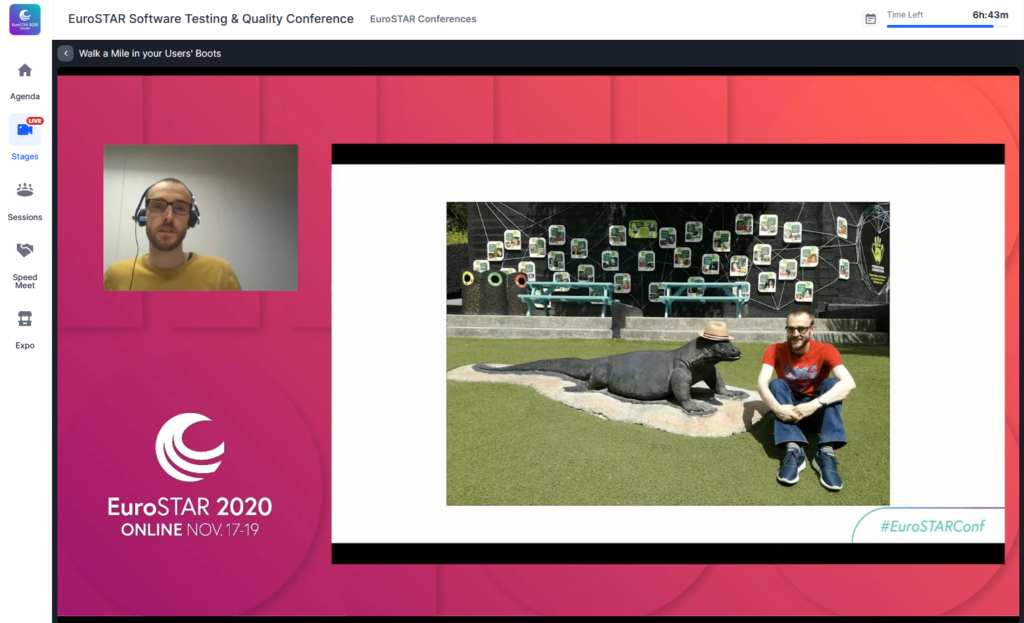
After EuroSTAR, my colleagues in the marketing department were kind enough to put together a small video spot (shameless self/company promo alert). I can tell that I’m nervous in the video, but I feel that I’ve managed to not sound like a complete idiot – which is a major milestone for me! So even if it was a long and stressful journey, I can see the progress I’ve made

https://www.linkedin.com/posts/systematic_walk-a-mile-in-your-users-boots-activity-6737715389016375296-vGZ_

To sum it all up in the immortal words of the British speed metal band Dragonforce:

We all face our fears in the world,

We all hold our place in the (EuroSTAR) universe,

For eternity…

Check out the EuroSTAR Call for Speakers and consider submitting for this year. Submissions close on November 15th.

Author

JOrgen Lund EuroSTAR 2021 Speaker - Blog authorJørgen Lund, Systematic A/S, Denmark

After graduating with a master’s degree in Computer Science, I found my way into testing. Over the past 12 years, I have been part of building, testing, training, deploying and supporting software for our users – and I have used all of the knowledge gathered to become a better tester. Today, I work as a Senior Test Manager where I coach other Test Managers and Testers, implement strategic initiatives and train new employees in testing.

Filed Under: EuroSTAR Conference, People, Virtual Conference Tagged With: EuroSTAR Conference, software testing conference, speakers

Sing with your Community

September 25, 2020 by Ronan Healy

Sing with your Community

Open to Singers of All Levels

What better way to connect with your community than by coming together to sing in a virtual choir? Yes you read that correctly, the EuroSTAR Community Choir is coming soon to a screen near you!

This year, when we all need it most, we invited the testing community to come together & sing in a virtual choir, led by an experienced Choir Master who is well versed in virtual rehearsals.

We had our first virtual rehearsal on Sept. 23rd, and it’s fair to say everyone was beaming with ear-to-ear smiles after a fantastic evening!

You will bey surprised about how easy and causal it is, and not as scary as you might have anticipated! You couldn’t hear everyone else singing, so there was nothing to be self-conscious about. Sean, the choir Master is absolutely fantastic and has a video to explain the easy process involved.

Do you want to hear the good news? 😀

You can still take part, and we can send you the recording of the first rehearsal so you can see what it was like.

So come on, sign up today and we’ll send you all the music, lyrics and how to guides. It’s going to be amazing!

Sign me up for the EuroSTAR Community Choir

Never Sung Before?

Everyone can sing and a choir is about the mix of voices and harmonies over individual abilities so why not give it a go and surprise yourself? We’ve an incredible choir master who is well versed at bringing the best out of people, even in a virtual setting.

What’s Involved?

  1. Register your interest HERE.
  2. Join for 3 x 1 hour rehearsals – 23rd Sept, 30th Sept & 7th Oct @ 19.30 BST
  3. Record the chosen song as a group

You’ll be amazed at what a community can achieve in just three rehearsals!

Sony Music Australia hello yeah thumbs up guy GIF

Filed Under: EuroSTAR Conference Tagged With: EuroSTAR Conference

“Dear Younger Me…” Letters from the community

September 23, 2020 by Fiona Nic Dhonnacha

It’s hard to believe, but this year we’ll celebrate the 28th edition of the EuroSTAR Software Testing Conference. Since 1993 we’ve gathered testers from all over Europe to connect, learn and test.

Every year, we got a little bigger – and now we’re thrilled to celebrate 28 years of the testing community coming together in an inclusive space, to share knowledge, support each other, and grow. We couldn’t do it without you!

There has been such incredible community spirit, shaped and nurtured by every single tester and quality professional that has been part of this wonderful journey. To mark our 28th anniversary, we have invited many of those instrumental in the creation and ongoing development of our community to write an open letter to their 28-year-old selves.

“The year is 1983, and it is a long time ago – 37 years. I remember how frustrated you were a few years earlier, trying to figure out how your working life should be.”  (Anne Mette)

Each letter is a unique personal reflection, and pens what the writer deems most important to tell their 28-year-old-self – and to remind their younger self what is worth fighting for! Topics range from advice on navigating career decisions and challenges to personal adventures and triumphs.

We’ve got sage advice our programme chair Rik Marselis, Anne Mette describes her eye-opening first time at EuroSTAR, Dorothy Graham highlights the importance of taking opportunities, and more!

Check out our series below. What would you say to your 28-year-old self?


Dorothy Graham – 1st EuroSTAR Programme Chair                     Rik Marselis – 2020 EuroSTAR Programme Chair


Shmuel Gershon – EuroSTAR speaker and 2016 Programme Chair        Anne Mette Hass – 11th European Testing Excellence Award Winner


Join the global Testing Community at EuroSTAR Online

Once you’re suitably inspired after reading, it’s time to check out our EuroSTAR programme. We’ve taken the entire programme online this year – so we’re going global.

Join us anywhere, on any device. It’s 3 days of learning, networking, testing – with lots of opportunities to connect, meet your fellow testers from around the world and make new friends.


EuroSTAR is going online

Filed Under: EuroSTAR Conference Tagged With: Community Huddle, EuroSTAR Conference

EuroSTAR Keynote Spotlight: 5 talks you can’t miss

August 21, 2020 by Fiona Nic Dhonnacha

Our EuroSTAR keynote speakers are testing experts in automation, agile, DevOps, security, test strategy and much more. Don’t miss their online talks this November.

1. Develop a ‘Quality Narrative’ that Communicates the True Value of Quality | Ronald Cummings-John

EuroSTAR keynote Ronald Cummings-John dives into quality and asks some key questions: how can we change the way that people think and talk about quality in our business? What are the best ways to influence people within our company to ensure everyone has bought into the idea of quality?

Using worldwide companies such as Google, Etsy, Airbnb and Twitter as inspiration, he will take you through developing an internal narrative around quality that will help you build incredible products.

Key Takeaways:

  1. Learn how to develop a quality narrative that communicates the true value of your quality team throughout the company
  2. Influence those around you to buy into your narrative
  3. Align the different teams and their activities towards a shared goal to contribute to the overall growth of the company

View Talk

2. Unlock the Power of Testing in Production with Observability | Abby Bangser

Join Abby for examples and explanations on leveraging the dynamic duo of observability and testing in production: it’s the next step for empowering software teams to deliver high quality, high impact software with speed and confidence.

Abby believes in empowering delivery team members to contain, and track, the impact of changes as they make them.

Key Takeaways:

  1. Everyone is testing in production, but some people are looking at the results
  2. Testing in production can be done with care for a large impact
  3. Observability is another form of testability

View Talk

3. Let’s Talk About Problems | Michael Bolton

“Don’t come to me with problems; come to me with solutions.”

“Failure is not an option.”

“I don’t want to focus on finding bugs; I want to focus on preventing bugs.”

At one time or another, you’ve probably heard all of the above. As testers, we encounter bugs, issues, and obstacles every day. Yet, talking about problems can be uncomfortable, controversial, and embarrassing.

Michael Bolton will discuss how testers can talk about those things courageously and deal with them reasonably and responsibly.

View Talk

4. Real Life Stories of Microservices Testing | Tomasz Dubikowski 

Cloud-based microservice architecture has seized our tech world. The new approach promises a quick, convenient development of modular, reliable and, most importantly, easily scalable systems. Microservices, when done alright, solve a significant amount of issues we face while working with monolithic applications.

However, done incorrectly, it can bring more harm than good to your project. And that’s a quite common case, as we don’t have much experience with the new architectural approach, and we are still learning how to use microservices properly.

Key Takeaways:

  1. Get to grips with common testing challenges while moving to cloud-based, microservice architecture
  2. Learn about contract testing in microservice architecture
  3. Learn about end to end, performance and infrastructure testing

View Talk

5. AI Testing in the Wild | Jason Arbon

AI is impacting the world of testing today. AI-based test automation is testing everything from games, gig-economy and finance apps, platforms, app stores, and thousands of top apps every day. AI is testing desktop, mobile, and web apps. AI has been commercially compared with the value of manual regression testing teams from 10 to 100–and it’s come out on top. AI is starting to give people the time to focus on the more creative and fun testing problems.

Jason shares real-world examples demonstrating the limitations and pains of some AI approaches, as well as ways in which AI is doing testing even humans couldn’t have performed.

Key Takeaways:

  1. Visually see AI testing real-world apps, in the wild
  2. Understand the limitations and superpowers of AI-based testing today
  3. Understand how AI-based testing stacks up against traditional manual and automated testing

View Talk

Ready to learn more? Book your online ticket now and save €150.

Filed Under: EuroSTAR Conference, Virtual Conference Tagged With: EuroSTAR Conference

  • « Previous Page
  • Page 1
  • …
  • Page 13
  • Page 14
  • Page 15
  • Page 16
  • Page 17
  • …
  • Page 19
  • Next Page »
  • Code of Conduct
  • Privacy Policy
  • T&C
  • Media Partners
  • Contact Us

part of the