• Skip to main content
EuroSTAR 2027 - Sign up for early access

EuroSTAR Conference

Europe's Largest Software Testing Conference.

  • Programme
    • Call for Speakers
    • 2026 Programme
    • Community Hub
    • Awards
  • Attend
    • Why Attend
    • Bring your Team
    • Testimonials
  • Sponsor
    • Sponsor Opportunities
    • Sponsor Testimonials
  • About
    • About Us
    • Our Timeline
    • FAQ
    • Blog
    • Organisations
    • Contact Us
  • Book Now

Software Testing

5 Steps to help build your load testing strategy

July 10, 2023 by Lauren Payne

Thanks to Gatling for providing us with this blog post.

You might have already started load testing, which is awesome! But if you haven’t, and you’re wondering when, where and how to start the answers are all here for you. To help you get set up we’re going to give you a few tips and tricks to build your load testing strategy and make sure that you’re set for success. Ready to dive in? Read on!

Know Your User

The most important part of load testing is knowing your user but more specifically what you need to know are the answers to a few key questions.

How are your users using your site/application? 

Most enterprises have an idea of how they’d like their users to use their site or products but for many how they’re actually using it and the journeys they take when they’re using it are a bit of a mystery. By using different tracking software such as Mixpanel or Amplitude though you can get a very detailed idea of what journeys your users are taking on your site and craft simulations to match and replicate this.

Understanding Your Traffic

Crafting great user journeys is the first step in building a scenario. Understanding your traffic though will help you decide what kind of tests you need to create. By using tools like Google analytics, Google Search Console, SEM rush or just monitoring your server usage you should be able to get an idea of what kind of traffic you’re receiving and how you’re receiving it. Are you getting sudden surges of traffic? Run a stress test! Are you getting long durations of constant traffic? Run a soak test. For every traffic scenario you can run a battery of different tests to ensure that your website is resilient enough to withstand the traffic it’s receiving. To learn more about the different kinds of load tests you can run and get an idea about what might work best for you check out our post here.

Continuous Integration

You’ve built your tests and run them, you’re doing great! However, most websites and applications are constantly changing and upgrading. How can you be sure that the changes you’re making aren’t going to change the performance of your project? By introducing load testing into your CI/CD project. We wrote a detailed post on the benefit of using Gatling Enterprise Cloud to integrate load testing into your CI/CD process. Gatling’s Enterprise version allows you to integrate with almost any CI/CD software, whether you’re using one of our dedicated integrations or using our CI Script to create your own.

Plan For The Unexpected

One of the great things about load testing is its ability to prepare you for any eventuality. You might not have thousands of users hitting your application today but by creating tests, and running them you can be sure that if it does happen you’re prepared. So when creating your testing strategy and examining your traffic it’s important not to just consider what is happening right now but also what could happen. What’s the worst/best case scenario? Are you prepared? Make sure by testing and you’ll know that whatever happens you’ll be ready.

By following these tips, this will help ensure that your websites and applications are able to handle the traffic and workloads that they will encounter in the real world, and it will help prevent performance issues that could impact the user experience. 

LINKS
or just monitoring your server https://hubs.ly/Q01DYDSv0 
sudden surges of traffic?https://hubs.ly/Q01DYH_L0 
out our post herehttps://hubs.ly/Q01DYK9B0 
Gatling Enterprise Cloud to integrate load testing into your CI/CD process.https://hubs.ly/Q01DYL720 

Author

Pete Dutka, Customer Success Manager, Gatling.

Gatling Enterprise provides advanced features to help you get ahead of downtime and technical issues related to your website traffic. Our advanced reports allow you to dive into the details and discover your application’s limits and performance bottlenecks. We offer both on-premise and SaaS solutions to meet your business needs, whatever they may be.

Gatling is an EXPO exhibitor at EuroSTAR 2023, join us in Antwerp
Filed Under: Software Testing Tagged With: 2023, EuroSTAR Conference

Did We Do the Right Tests?

June 26, 2023 by Lauren Payne

Experiences with Test Gap Analysis in Practice

Thanks to CQSE for providing us with this blog post.

Most errors occur in code that has been changed lately (e.g., since the last release of a software system) [1,2]. This is of little surprise to practitioners, but how do we ensure that our tests cover all such changes, in order to catch as many of these defects as possible?

Do Tests Cover Code Changes in Practice?

In order to better understand to which degree tests actually cover changes made to a software system, we tracked development and testing activity on an enterprise information system, comprising of about 340k lines of C# code, over a period of 14 months, corresponding to two consecutive releases [1].

Through static code analysis, we determined that for each of these releases, about 15% of the source code were either newly developed or changed. Using a profiler, we recorded the code coverage of all testing activities, including both automated and manual tests. This data showed that approximately half of the changes went into production untested – despite a systematically planned and executed testing process.

To quantify the consequences of untested changes for users of the software, we then reviewed all errors reported in the months following the releases and traced them back to their root causes in the code. We found that changed, untested code contains five times more errors than unchanged code (and also more errors than changed and tested code).

This illustrates that, in practice, untested changes very frequently reach production and that they cause the majority of field errors. We may, thus, systematically improve test quality, if we manage to test changes more reliably.

Why Do Changes Escape Testing?

The amount of untested production code we found in our study actually surprised us, when we originally conducted this study. Therefore, we wanted to understand why this many changes escape testing.

We found that the cause of these untested changes is – to the contrary of what you may assume – not a lack of discipline or commitment on the testers’ part, but rather the fact that it is extremely hard to reliably identify changed code manually, when testing large systems.

Testers often rely on the description of individual issues from their issue tracker (e.g., from Jira or Azure DevOps Boards), in order to decide whether some change has been sufficiently tested. This works well for changes made for functional reasons, because the issues describe how the functionality is supposed to change and it is relatively easy to see which functionality a test covers.

However, there are two reasons why issue trackers are not suitable sources of information in consistently finding changes:

  • First, many changes are technically motivated, for example, clean-up operations or adaptations to new versions of libraries or interfaces to external systems. Respective issue descriptions do not clarify which functional test cases make use of the resulting changes.
  • Second, and more importantly, the issue tracker often simply does not document all important changes, be it because someone forgot or did not find the time to update the issue description or because someone made changes they were not supposed to make, e.g., due to a policy that is currently in place.

Thus, we need a more reliable source to determine what has been changed. Only then, we can reason about whether these changes have been sufficiently tested.

Test Gap Analysis to the Rescue!

Test Gap Analysis is an approach that combines static analysis and dynamic analysis to identify changed-but-untested code.

First, static code analysis compares the current state of the source code of the System under Test to that of the previous release in order to determine new and changed code areas. In doing so, the analysis filters out refactorings, which do not modify the behavior of the source code (e.g., changes to documentation, renaming of methods or moving of code) and, thus, cannot cause new errors. The remaining code changes lead to a change in the behavior of the system.

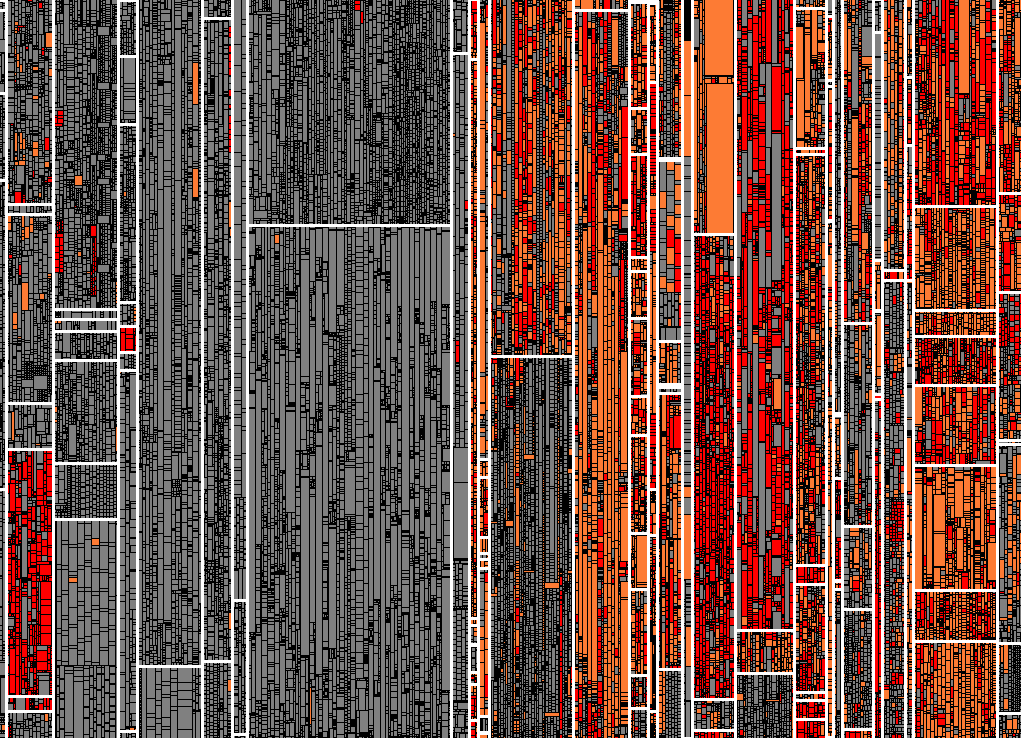
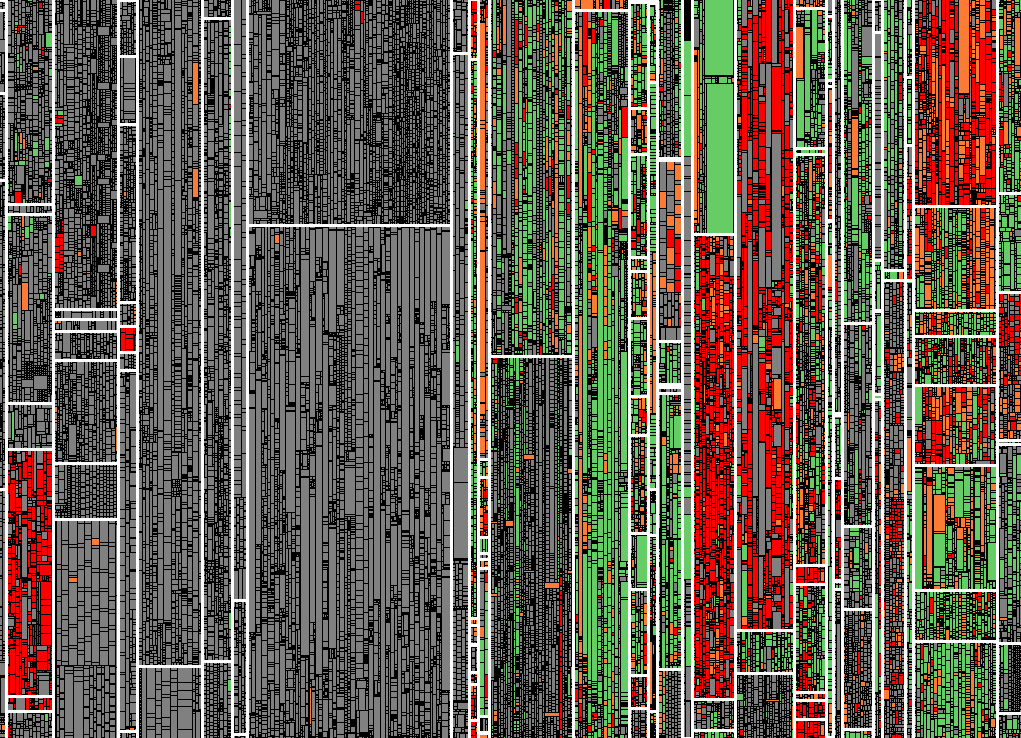
For the enterprise information system from before, all changes for one of the releases we analyzed are depicted on the following tree map. Each rectangle represents a method in the source code and the size of the rectangle corresponds to the method’s length in lines of source code. We distinguish unchanged methods (gray), from new methods (red) and modified methods (orange).

Figure 1: A treemap showing all changes made to an enterprise information system for a single release. About 15% of the code was added (red) or modified (orange), while the rest remained unchanged (gray).

Second, dynamic analysis captures code coverage (usually through a coverage profiler). The crucial factor here is that all tests are recorded, across all test stages and regardless of whether they are automated or manually executed.

We use the same tree map as above, to visualize the aggregated code coverage at the end of the test phase. This time, we distinguish between methods that were executed by at least one test (green) and methods that were not (gray).

Figure 2: A treemap showing the aggregated code coverage of all tests (manual and automated) performed on an enterprise information system. Methods that were executed by at least one test (green) and methods that were not (gray).

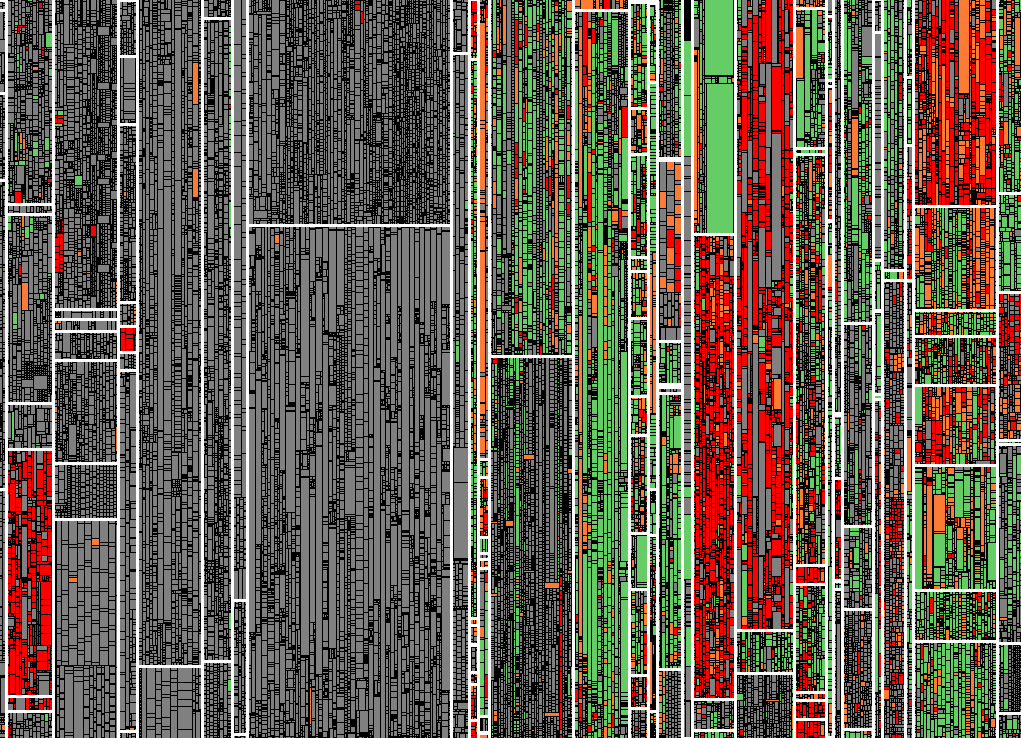
Third, Test Gap Analysis detects untested changes by combining the results of the static and dynamic analyses. Again, we use our tree map to visualize the results, distinguishing methods that remain unchanged (gray) from changed-and-tested methods (green), untested new methods (red) and untested changed methods (orange).

Figure 3: A treemap showing the results of a Test Gap Analysis on an enterprise information system. A large part of the code remained unchanged (gray), while about 15% changed (in color). Of the changes, about half was tested (green), while the other half remained untested (red and orange) – despite a systematically planned and executed testing process.

It is plain to see that whole components containing new or changed code were not executed by even a single test in the testing process. No errors contained in this area can have been found in the tests!

Using Test Gap Analysis

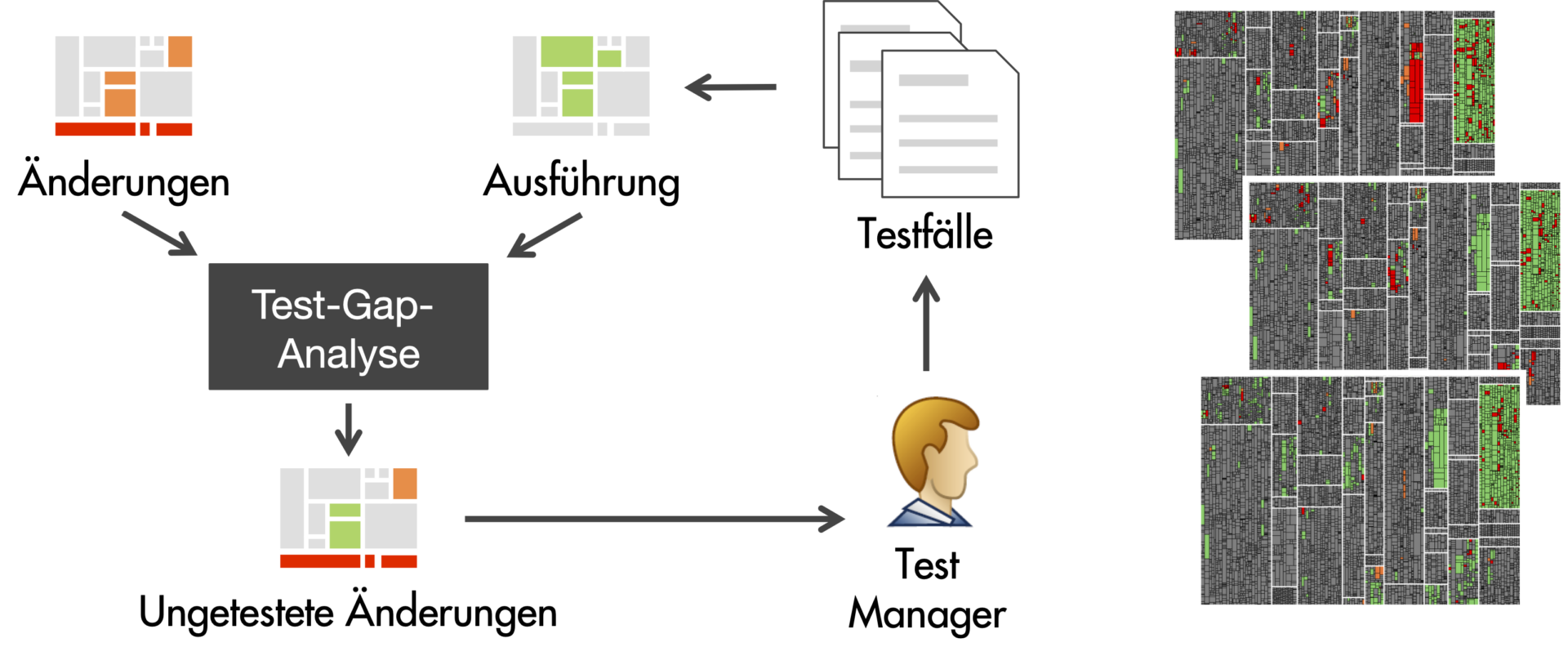
Test Gap Analysis is useful when executed regularly, for example, every night, to gain insights each morning into the executed tests and changes made up until the previous evening. Each day, an updated Test Gap treemap, e.g., on a dashboard, then helps test managers decide whether further test cases are necessary to run through the remaining untested changes. This creates an ongoing feedback loop to steer the testing efforts and make informed decisions.

Figure 4: Test Gap Analysis gives continuous feedback to help test managers steer the testing efforts.

Which Projects Benefit from Test Gap Analysis?

We have used Test Gap Analysis on a wide range of different projects: from enterprise information systems to embedded software, from C/C++ to Java, C#, Python and even SAP ABAP. Factors that affect the complexity of the introduction are, among others:

  • Execution environment. Virtual machines (e.g., Java, C#, ABAP) simplify the collection of test coverage data.
  • Architecture. The test-coverage data for a server-based application has to be collected from fewer machines than that for a fat-client application, for example.
  • Testing process. Clearly defined test phases and environments facilitate planning and monitoring.

Using Test Gap Analysis During Hotfix Testing

The objectives of hotfix tests are to ensure that the fixed error does not re-occur and that no new errors have been introduced. To achieve the latter, we should at least ensure we tested all changes made in the course of the hotfix. Usually, there is very little time to achieve this.

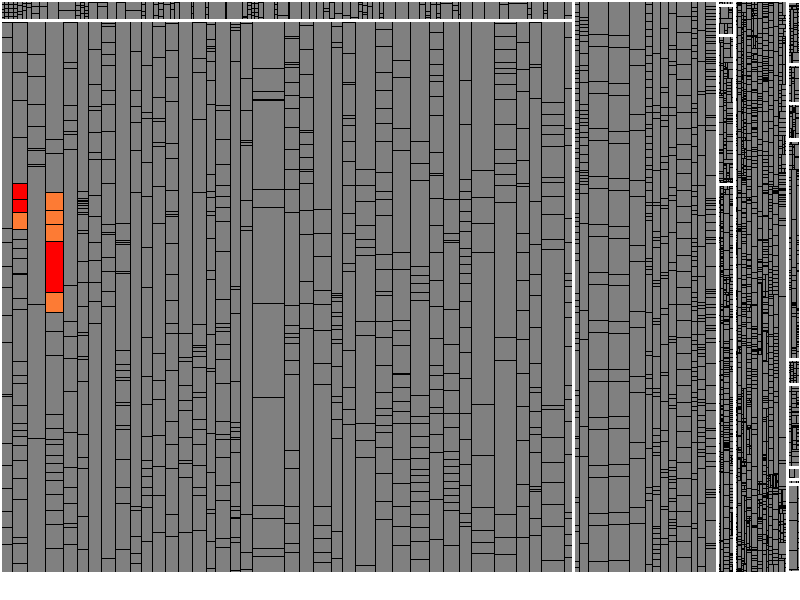
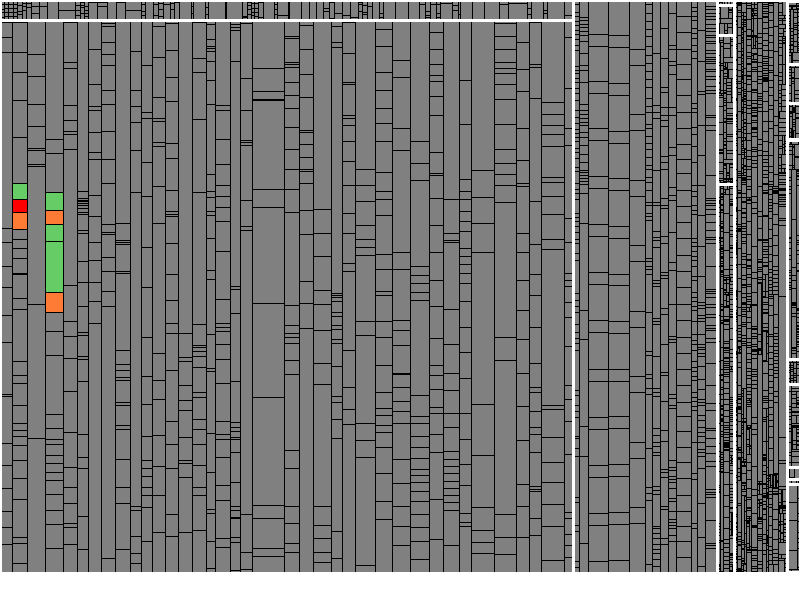
With Test Gap Analysis, we may define the release state (before the hotfix) as the reference version and detect all changes made due to the hotfix (for example, on a dedicated branch). We then determine whether all changes were actually tested during confirmation testing. A Test Gap tree map immediately shows whether there are any untested changes left.

Figure 5a: Changes made during a hotfix (in color).
Figure 5b: Remaining untested changes (orange & red) and tested changes (green).

In our experience, Test Gap Analysis specifically helps avoid new errors that are introduced through hotfix changes.

Using Test Gap Analysis During a Release Test

For this scenario, we define a release test as the test phase prior to a major release, which usually involves both testing newly implemented functionality and executing regression tests. Often, this involves different kinds of tests on multiple test stages.

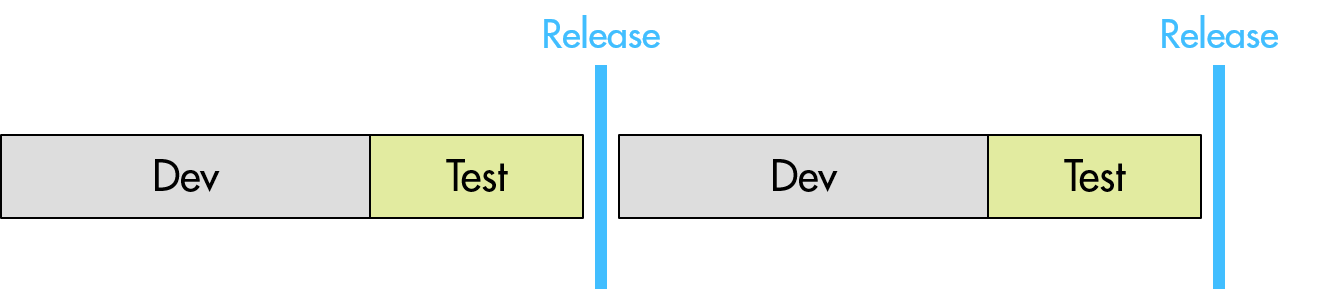
Figure 6: Split of development and release-test phases.

In the introduction to Test Gap Analysis above, we’ve looked at the results of running Test Gap Analysis at the end of a release test of an enterprise information system. These results revealed glaring gaps in the coverage of changes, after a test phase without using Test Gap Analysis to guide the testing efforts.

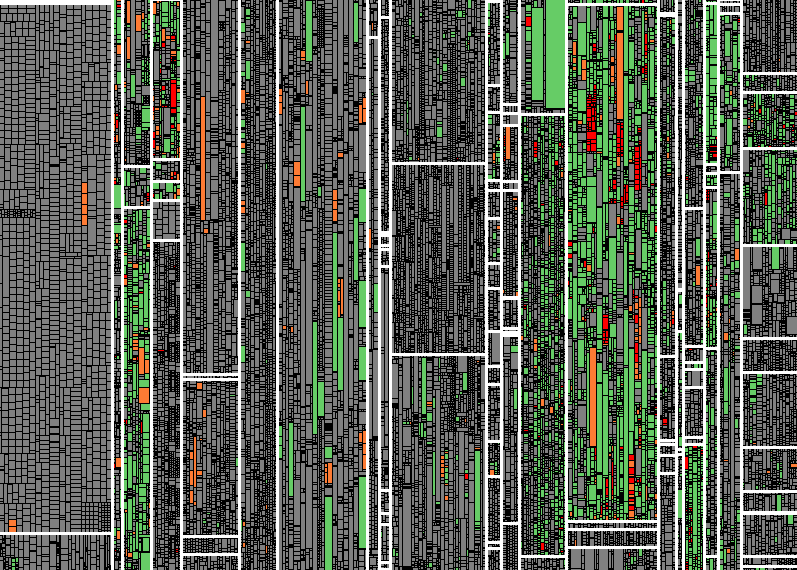
From that point onwards, Test Gap Analysis became an integral part of the testing process and was executed regularly during subsequent release tests. The following is a snapshot of the Test Gap Analysis during a later release test. It is plain to see that it contains much fewer Test Gaps.

Figure 7a: Test Gaps after a release test without Test Gap Analysis.
Figure 7b: Test Gaps after a release test guided by Test Gap Analysis.

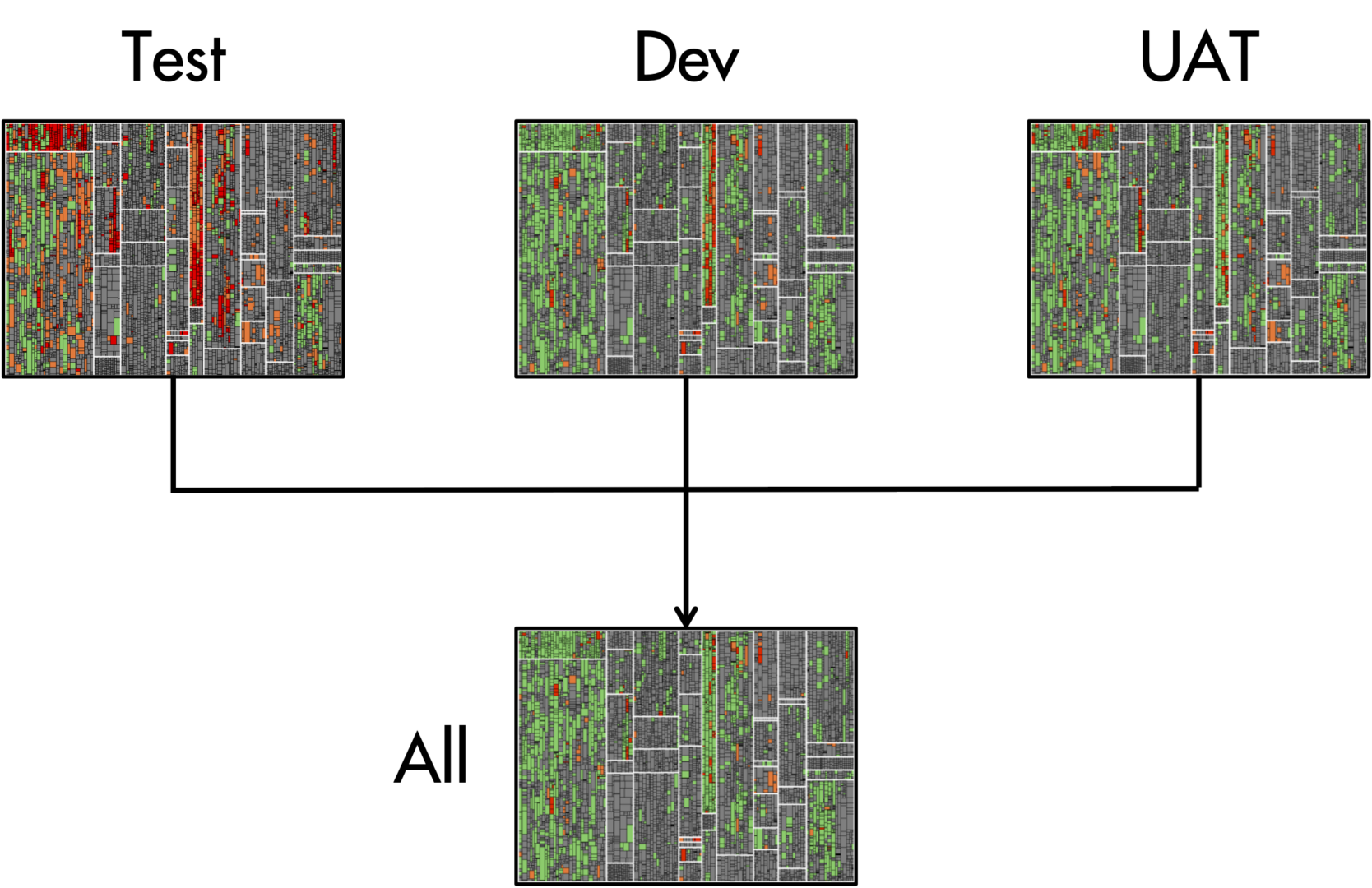
If testing happens in multiple environments simultaneously, we may run Test Gap Analysis for each individual environment separately. And at the same time, we may run Test Gap Analysis globally, to assess our combined testing efforts. The following example illustrates this for a scenario with three test environments:

  • Test is the environment in which testers carry out manual test cases.
  • Dev is the environment where automated test cases are executed.
  • UAT is the User Acceptance Test environment, where end users carry out exploratory tests.
  • All combines the data of all three test environments.
Figure 8: Results of Test Gap Analysis by test environment and aggregated over all environments.

We observed that, in many cases, some Test Gaps are accepted, for example, when the corresponding source code is not yet reachable via the user interface. The goal of using Test Gap Analysis is not to test every single change at all cost. The key is that we can make conscious and well-founded decisions with predictable consequences about what to test.

In our experience, Test Gap Analysis significantly reduces the amount of untested changes that reach production. In a study with one of our customers, we found that this reduces the number of errors in the field by as much as 50%.

Using Test Gap Analysis Alongside Iterative Development

Today, fewer and fewer teams work with dedicated release tests, like in the previous scenario. Instead, issues from their issue trackers move into the focus of test planning, to steer testing efforts alongside iterative development.

In this scenario, testers are responsible to test individual issues in a timely manner after development finishes. As a result, development and testing interleave and dedicated test phases become obsolete or much shorter.

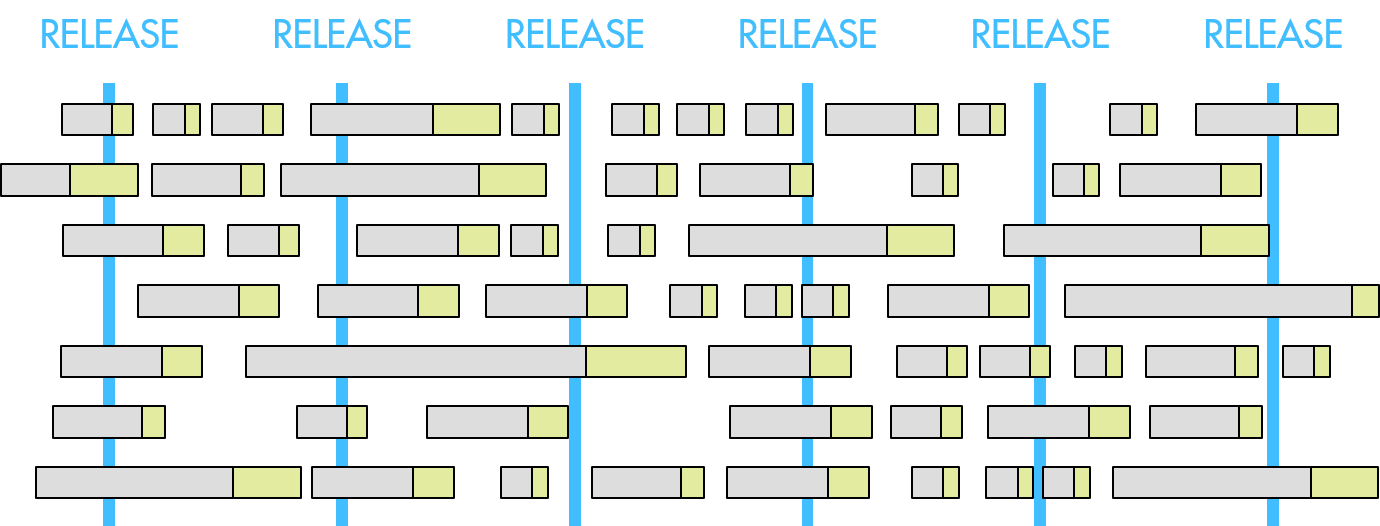
Figure 9: Development and test phases in iterative development processes.

At the same time, it becomes even harder to keep an eye on all changes, because much of the work typically happens in isolation, e.g., on dedicated feature branches, and gets integrated into the release branch only on very short notice. All the more, we need a systematic approach to keep track of which changes have been tested and in which test environments.

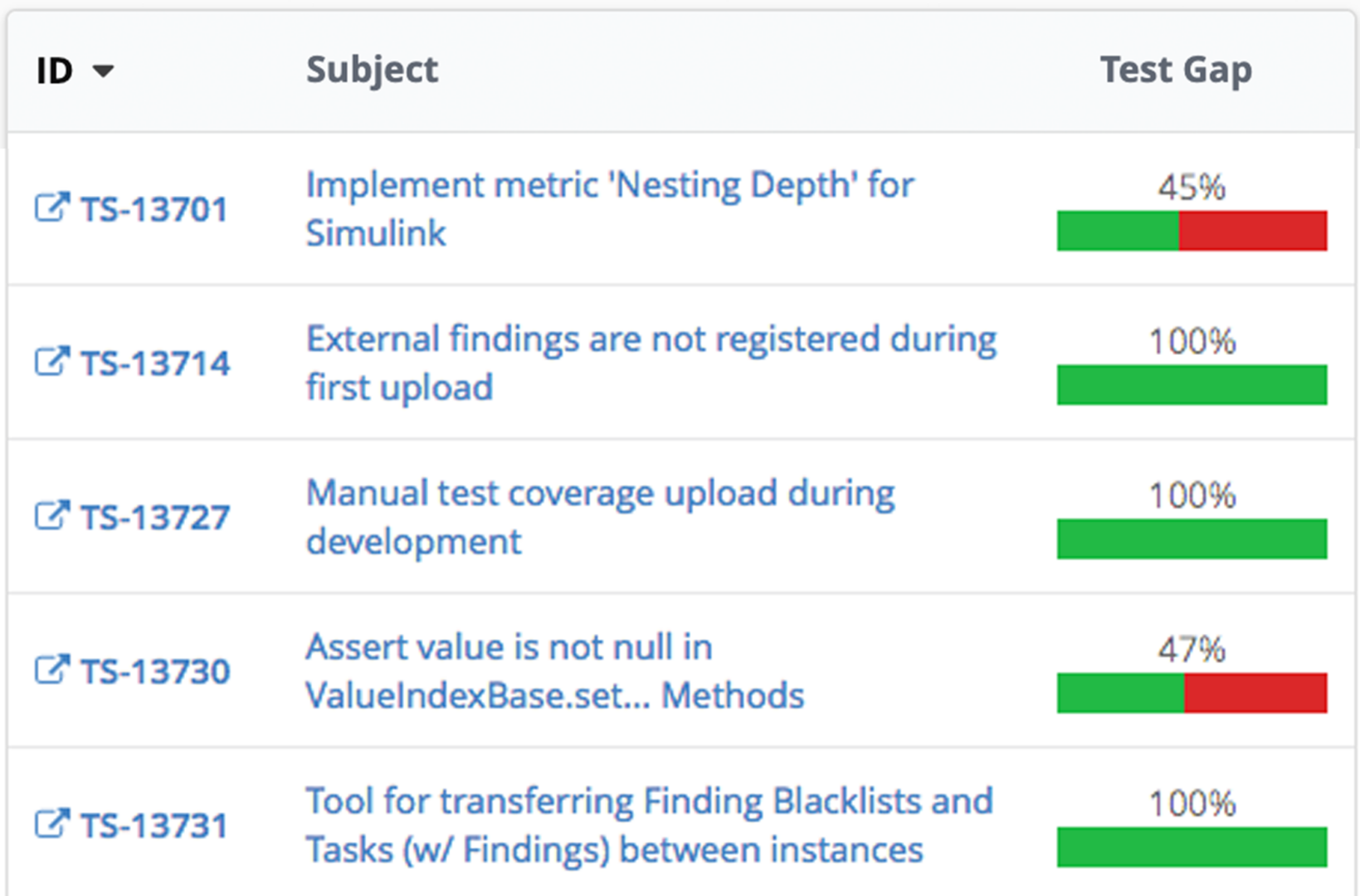
Fortunately, we may run Test Gap Analysis also on the changes made in the context of individual issues. All we need to do is single out the changes that happened in the context of any particular issue, which is straightforward, e.g., if all changes happen on a dedicated feature branch or if developers annotate changes with the corresponding issue numbers when committing them to the version control system. Once we grouped the changes by issue, we simply run Test Gap Analysis for each of them.

Figure 10: Overview of Issue Test Gaps for the issues in the current development iteration.

Limitations of Test Gap Analysis

Like any analysis method, Test Gap Analysis has its limitations and your knowledge of them is crucial for making the best use of the analysis.

One of the limitations of Test Gap Analysis are changes that are made on the configuration level without changing the code itself. These changes remain hidden from the analysis.

Another limitation of Test Gap Analysis is the significance of processed code. Test Gap Analysis evaluates which code was executed during the test. It cannot figure out how thoroughly the code was tested. This potentially leads to undetected errors despite the analysis depicting the executed code as “green”. This effect increases with the coarseness of the measurement of code coverage. However, the reverse is as simple as it is true: red and orange code was not executed in tests, thus, no contained errors can have been found.

Our experience in practice shows that the gaps brought to light when using Test Gap Analysis are usually so large that we gain substantial insights into weaknesses in the testing process. With respect to these large gaps, the limitations mentioned above are insignificant.

Further Information

Test Gap Analysis may greatly enhance the effectiveness of testing processes. If you would like to learn more about how Test Gap Analysis works in our analysis platform Team scale, the first tool that offered Test Gap Analysis and, to date, the only tool providing Test Gap tree maps, as you have seen them above, check out our website on Test Gap Analysis or join our next workshop on the topic (online & free)!

References

[1] Sebastian Eder, Benedikt Hauptmann, Maximilian Junker, Elmar Juergens, Rudolf Vaas, and Karl-Heinz Prommer. Did we test our changes? assessing alignment between tests and development in practice.
In Proceedings of the Eighth International Workshop on Automation of Software Test (AST’13), 2013.

https://www.cqse.eu/publications/2013-did-we-test-our-changes-assessing-alignment-between-tests-and-development-in-practice.pdf

[2] N. Nagappan, Th. Ball, Use of relative code churn measures to predict system defect density, in: Proc. of the 27. Int. Conf. on Software Engineering (ICSE) 2005

Authors

Dr Elmar Juergen EuroSTAR 2023 Speaker

Dr. Elmar Jürgens

(juergens@cqse.eu) is founder of CQSE GmbH and consultant for software quality. He studied computer science at the Technische Universität München and Universidad Carlos III de Madrid and received a PhD in software engineering.

Dr. Dennis Pagano

(pagano@cqse.eu) is consultant for software and systems engineering at CQSE. He studied computer science at Technische Universität München and received a PhD in software engineering from Technische Universität München. He holds two patents.

Dr. Sven Amann

(amann@cqse.eu) is a consultant of CQSE GmbH for software quality. He studied computer science at the Technische Universität Darmstadt (Germany) and the Pontifícia Universidade Católica do Rio de Janeiro (Brazil). He received his PhD in software technology from Technische Universität Darmstadt.

CQSE is an EXPO exhibitor at EuroSTAR 2023, join us in Antwerp.

Filed Under: Software Testing Tagged With: 2023, EuroSTAR Conference

Why Test Reporting Should be a Top Priority in Your Software Development Process

June 21, 2023 by Lauren Payne

Thanks to b.ignited for providing us with this blog post.

In the world of software development, testing is an essential part of the process. It is through testing that we can ensure that the software being developed is fit for use, meets requirements, and is ready for release. However, there are some situations where test reporting does not reach management, which is a problem. Do you wonder why this might happen? What are the consequences? Because believe me, there are consequences! And most importantly, what can be done to avoid all of this?
To understand the importance of test reporting, it is important to understand what a good test report consists of. The report summarizes the results and findings of a testing process. It provides a comprehensive view of the testing activities, including the objectives, scope, and methodology of the testing, as well as the test cases, test scripts, and test data used. It serves as a formal record of the testing activities and provides stakeholders with a clear understanding of the quality of the product or system being tested. It is an important tool for decision-making, as it can help stakeholders determine whether the product or system is ready for release or further testing is required.

Why does test reporting not reach management?

There are a few reasons why test reporting might not be available to management.
One reason is that the testing team does not have the necessary resources to produce reports. This could be due to a lack of personnel, time or funding. Another reason could be that they do not recognize the value of producing reports. They may believe that their work speaks for itself, and that there is no need to provide additional documentation.


Another reason could be that the development team is focused on meeting deadlines and releasing software quickly. In this case, the testing team may not have enough time to produce reports and meet their other responsibilities.
Or it could be that the team is not aware of the importance of test reporting to management. They may not realize that management needs this information to make informed decisions about the software development process.

What are the consequences of not reporting?

There are several consequences of not reporting test results to management. One of the most significant consequences is that management will not have a clear view of the quality of the software being developed. Without this information, they may make decisions that are not in the best interest of the company. For example: releasing software that has not been adequately tested leads to customer complaints, negative reviews and even legal action.


Another consequence of not reporting is that the testing team may not receive the recognition they deserve for their hard work. When management is not aware of the effort of the testers, they may not appreciate the value of their work, leading to lower morale and decreased job satisfaction.

Not reporting test results can lead to a breakdown in communication between the testers and the other members of the development team. This can make it more difficult to identify and fix bugs, leading to longer development times and higher costs.

How can you avoid not reporting test results?

There are 4 simple steps:

  • The first step is to ensure that the testing team has the necessary resources to produce reports. This might involve hiring additional personnel, providing more time for reporting, or increasing funding for testing activities.
  • The second step is to educate the testers about the importance of test reporting to management. By explaining how this information is used, the testing team will be more motivated to produce reports.
  • The third step is to make sure that reporting is integrated into the software development process. This might involve using automated tools to generate reports or creating templates that make it easy for the testing team to produce reports quickly.
  • And the fourth and final step is to ensure that there is open communication between the testers and the other members of the development team. By sharing test results and collaborating on solutions, the development process can be more efficient and effective.

Test-Automation-as-a-Service: your test reporting solution

At b.ignited, we are convinced that there is yet another solution to ensure that test reporting is always up-to-date, namely using ‘b.ignition’. b.ignition is an in-house developed tool, with an underlying cloud architecture to provide test reporting. Users can log in via a portal and thus view and compare all information of current and historical test results. There is always an overview available of the test results status across projects. If necessary, a new test run can be started from the same portal, and the results are immediately included in the overview. b.ignition is set up in such a way that the customer can choose between a private or a public cloud, depending on the desired data security.

Understanding the value of test reporting

In conclusion, not reporting test results to management can have significant consequences for the software development process. By understanding why this might happen and taking steps to avoid it, you can ensure that the software being developed is of the highest quality and meets the needs of the customer. It is essential to recognize the value of test reporting to management and to make it a priority in the software development process.

Author

Patrick-Van-Ingelgem

Patrick Van Ingelgem, Managing Partner at b.ignited

Founded the company in 2018 after several years of experience in Test automation, -coordination and -management. He motivates his colleagues from b.ignited to always be on top of technology, and strongly believes in the power of knowledge and information. That’s why the topic on Test reporting is so important for him.

 b.ignited is an EXPO Exhibitor at EuroSTAR 2023, join us in Antwerp.

Filed Under: Software Testing Tagged With: 2023, EuroSTAR Conference

Efficient Software Testing in 2023: Trends, AI Collaboration and Tools

May 31, 2023 by Lauren Payne

Thanks to JetBrains Aqua for providing us with this blog post.

In the rapidly evolving field of software development, efficient software testing has emerged as a critical component in the quality assurance process. As we navigate through 2023, several prominent trends are shaping the landscape of software testing, with artificial intelligence (AI) taking center stage. We’ll delve into the current state of software testing, focusing on the latest trends, the increasing collaboration with AI, and the most innovative tools.

Test Automation Trends

Being aware of QA trends is critical. By staying up to date on the latest developments and practices in quality assurance, professionals can adapt their approaches to meet evolving industry standards. Based on the World Quality Report by Capgemini & Sogeti, and The State of Testing by PractiTest, popular QA trends currently include:

  • Test Automation: Increasing adoption for efficient and comprehensive testing.
  • Shift-Left and Shift-Right Testing: Early testing and testing in production environments for improved quality.
  • Agile and DevOps Practices: Integrating testing in Agile workflows and embracing DevOps principles.
  • AI and Machine Learning: Utilizing AI/ML for intelligent test automation and predictive analytics.
  • Continuous Testing: Seamless and comprehensive testing throughout the software delivery process.
  • Cloud-Based Testing: Leveraging cloud computing for scalable and cost-effective testing environments.
  • Robotic Process Automation (RPA): Automating repetitive testing tasks and processes to enhance efficiency and accuracy.

QA and AI Collaboration

It’s no secret that AI is transforming our lives, and ChatGPT’s collaboration can automate a substantial portion of QA routines. We’ve compiled a list of helpful prompts to streamline your testing process and save time.

Test Case Generation

Here are some prompts to assist in generating test cases using AI:

  • “Generate test cases for {function_name} considering all possible input scenarios.”
  • “Create a set of boundary test cases for {module_name} to validate edge cases.”
  • “Design test cases to verify the integration of {component_A} and {component_B}.”
  • “Construct test cases for {feature_name} to validate its response under different conditions.”
  • “Produce test cases to assess the performance of {API_name} with varying loads.”
  • “Develop test cases to check the error handling and exceptions in {class_name}.”

Feel free to modify these prompts to better suit your specific testing requirements.

Example
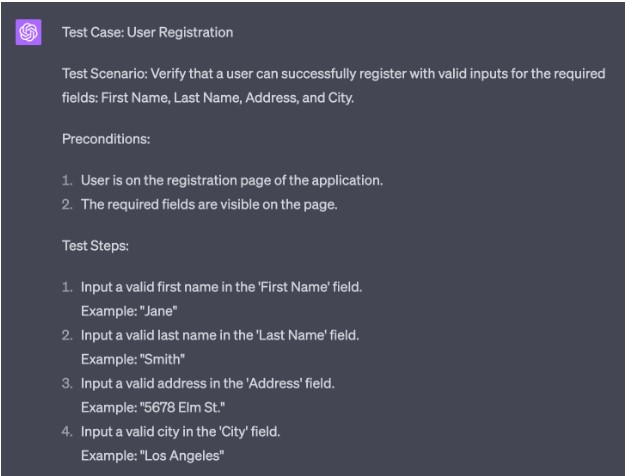
We asked for a test case to be generated for a registration process with specific fields: First Name, Last Name, Address, and City.

AI provided a test case named “User Registration” for the scenario where a user attempts to register with valid inputs for the required fields. The test case includes preconditions, test steps, test data, and the expected result.

Test Code Generation

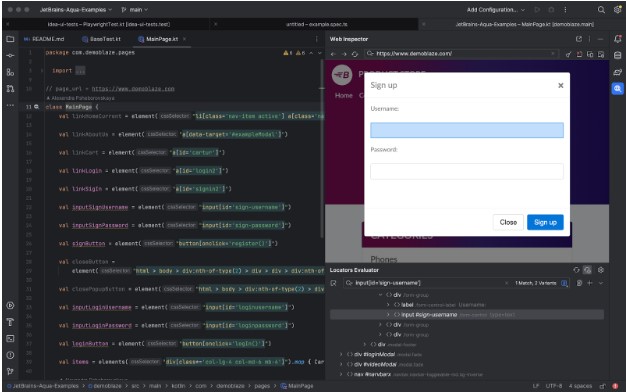
In the same way, you can create automated tests for web pages and their test scenarios.

To enhance the relevance of the generated code, it is important to leverage your expertise in test automation. We recommend studying the tutorial and using appropriate tools, such as JetBrains Aqua, to write your tests that provide tangible examples of automatically generating UI tests for web pages.

Progressive Tools

Using advanced tools for test automation is essential because they enhance efficiency by streamlining the testing process and providing features like test code generation and code insights. These tools also promote scalability, allowing for the management and execution of many tests as complex software systems grow.

UI Test Automation

To efficiently explore a web page and identify available locators:

  • Open the desired page.
  • iInteract with the web elements by clicking on them.
  • Add the generated code to your Page Object.

This approach allows for a systematic and effective way of discovering and incorporating locators into your test automation framework.

Code Insights

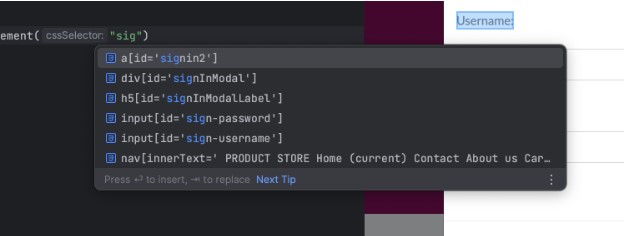
To efficiently search for available locators based on substrings or attributes, you can leverage autocompletion functionality provided by the JetBrains Aqua IDE or plugin.

In cases where you don’t remember the location to which a locator leads, you can navigate seamlessly between the web element and the corresponding source code. This allows you to quickly locate and understand the context of the locator, making it easier to maintain and modify your test automation scripts. This flexibility facilitates efficient troubleshooting and enhances the overall development experience.

Test Case As A Code

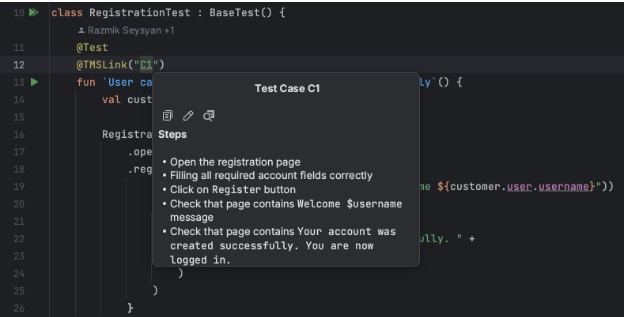
The Test Case As A Code approach is valuable for integrating manual testing and test automation. Creating test cases alongside the code enables close collaboration between manual testers and automation engineers. New test cases can be easily attached to their corresponding automation tests and removed once automated. Synchronization between manual and automated tests to ensure consistency and accuracy is a challenge that does not need to be addressed. Additionally, leveraging version control systems (VCS) offers additional benefits such as versioning, collaboration, and traceability, enhancing the overall test development process.

Stay Tuned

The industry’s rapid development is exciting, and we are proud to be a part of this growth. We have created JetBrains Aqua, an IDE specifically designed for test automation. With Aqua, we aim to provide a cutting-edge solution that empowers testers and QA professionals. Stay tuned for more updates as we continue to innovate and contribute to the dynamic test automation field!

Author

Alexandra Psheborovskaya, QA Lead and Product Manager at JetBrains

Alexandra works as a SDET and a Product Manager on the Aqua team at JetBrains. She shares her knowledge with others by mentoring QA colleagues, such as in Women In Tech programs, supporting women in testing as a Women Techmakers Ambassador, hosting a quality podcast, and speaking at professional conferences.

JetBrains is an EXPO Platinum partner at EuroSTAR 2023, join us in Antwerp

Filed Under: Software Testing, Uncategorized Tagged With: 2023, EuroSTAR Conference

Reduce e-waste by using device farms

May 24, 2023 by Lauren Payne

Thanks to 42Gears for providing us with this blog post.

Did you know that around 50 million tonnes of e-waste is generated every year across the globe, and only 20% is recycled through organised and regulated channels? “If e-waste continues to accumulate in the future, it may pose a serious threat to the environment, society, and economy.”

What is e-waste?

E-waste refers to any electrical or electronic equipment that is unwanted, not working, and has been discarded by its owner as waste without the intent of re-use. E-waste includes a wide array of products. As might be expected, screens, monitors, laptops, tablets, smartphones, computers, printers, telephones, and mobile phones can all be e-waste. However, e-waste can also include household or business items that have electrical components with power or battery supply. For example, temperature exchange equipment such as refrigerators, freezers, and air conditioners can become e-waste.

E-waste contains toxic components such as mercury, cadmium, lead, polybrominated flame retardants, lithium, and barium. Unfortunately, these components can be very dangerous to human health. They can adversely affect the respiratory system, lungs, kidneys, and brain.

Trends driving e-waste creation

Perhaps the biggest reason for increased e-waste is new users joining the Internet for the first time. Internet access is expanding worldwide to more people than ever before, driving demand for devices that will eventually become e-waste. According to Internet Growth Statistics, 69% of the world’s population used internet in 2022, and going by the trend, two-thirds of the world’s population will be online by the end of 2023.

Another major culprit is planned obsolescence – the practice of intentionally having devices become outdated so users will need to purchase new ones. Global increases in disposable income mean that many consumers are eager to replace older devices with new ones. Plus, many business apps and services are designed to work best on powerful, recently-made devices. In order to stay up-to-date, companies and workers must purchase new devices and discard old ones. Because of these trends, consumers and businesses are constantly getting rid of older, slower devices, creating e-waste.

What companies are doing to reduce e-waste

It is important that businesses recognize the role they play in generating e-waste. Several major companies have begun taking steps to reduce e-waste, and many others will likely follow suit.

For example, beginning with the 2020’s iPhone 12 line, Apple chose not to include headphones and chargers with its phones. This can help to reduce unnecessary EEE (electrical and electronic equipment), according to Teresa Domenech of University College London’s Institute for Sustainable Resources. Domenech also notes this initiative will also reduce environmental damage because Apple will need to extract fewer primary raw materials, perform less manufacturing, and ship fewer products overall.

Owing to the fact that discarded charges are contributing to 11,000 metric tons of e-waste in Europe annually, European Union Lawmakers have made it mandatory for mobile manufacturers to provide universal chargers.

Another way of reducing e-waste is recycling old electronics. LG’s India subdivision operates a network of 40 recyclers in India. In order to maximize the number of people participating in the program, LG picks up e-waste directly from the user’s home. Between 2017 and 2020, LG collected and recycled almost 100,000 metric tons of e-waste in India.

Of course, many technology enterprises do not manufacture their own devices, so they cannot use these techniques to reduce e-waste. Still, there are other ways to reduce e-waste; for example, investing in device farms. Let’s explore how this works.

How device farms help reduce e-waste

While the impact of e-waste is alarming across the globe, companies are researching new ways to reduce e-waste and prevent health and safety hazards. As a result, many companies have begun implementing new methods and processes that combat the rise of e-waste.

Using a device farm is one of the most innovative ways through which companies can reduce e-waste. Often, companies require large device inventories consisting of multiple devices and multiple versions of the same device for their DevOps and QA teams. Unfortunately, these devices may not be accessible to all the team members; if someone needs to test an app on a device in the office, but that person works remotely, connecting to the device will be a challenge.

However, if these devices are enrolled into a device farm, anyone on DevOps and QA teams can easily access them remotely, no matter where they are located.

This is the key to reducing e-waste with a device farm. By purchasing a single device and connecting it to a device farm, a company can make that device accessible to anyone in the company worldwide. This substantially improves ROI on a given device and removes the need to purchase multiple devices for multiple offices.

Device farms can be of two types – public device farms, or private device farms. Public device farms are third-party platforms that allow businesses to access devices owned by a third party. Companies rent these devices for a particular time slot and pay accordingly.

On the other hand, a private device farm is owned and managed by the company itself. This setup empowers all approved company employees to access enrolled devices at any time from anywhere.

There are a few companies that help organizations to set up a private device farm. 42Gears is one of them. AstroFarm by 42Gears is a great tool that helps organizations to set up their private device farms. AstroFarm offers many benefits, allowing companies to get more value from the devices they already own, making devices available worldwide in real time, and providing global teams with an easier way to coordinate app development. For more information, please refer here.

Summary

E-waste has become a global challenge and needs to be addressed as soon as possible. While the abstract statistics are alarming, the real concerns are the growing environmental and health hazards associated with e-waste.

While consumers should work to reduce the e-waste they generate, enterprises are the biggest contributors to the problem of e-waste. As such, companies need to do their part to reduce e-waste by using better technology, processes, and products. Implementing AstroFarm by 42Gears can help you reduce e-waste by setting up your own device farm and getting the maximum ROI out of each device you purchase.

Author

42Gears

42Gears is a leader in enterprise mobility management, offering cutting-edge solutions designed to transform the digital workplace. Delivered from the cloud and on-premise, 42Gears products support all major mobile and desktop operating systems, enabling IT and DevOps teams to improve frontline workforce productivity as well as the efficiency of software development teams.

42Gears products are used by over 18000 customers across various industries in more than 115 countries and are available for purchase through a global partner network. For more information, please visit https://www.42gears.com

42Gears is an EXPO Gold partner at EuroSTAR 2023, join us in Antwerp
Filed Under: Software Testing Tagged With: 2023, e-waste, EuroSTAR Conference

Unlocking ROI of Testing through Better Software Toolset

May 3, 2023 by Lauren Payne

Thanks to Lambdatest for providing us with this blog post.

Since the global pandemic, companies worldwide have rapidly accelerated their digital transformation initiatives. As more and more consumers are interacting with brands digitally, it has now become a strategic priority for every business to ensure that their digital products and services meet the expectations of their customers. This made testing of these digital products very essential as a negative digital experience will have a direct impact on the revenue stream. According to Forrester, prioritizing CX helps 66% of businesses enhance retention, and 60% of businesses increase customer lifetime value.

Software quality assurance (QA) ensures that your digital products are error-free, which helps in ensuring a positive customer experience, builds trust, and helps maintain brand reputation in the competitive online landscape. Yet, testing may be an expensive and time-consuming operation that drains a company’s resources significantly. Businesses must analyze ROI to effectively manage testing resources, prioritize activities that give the highest return, and identify areas for improvement. Businesses can make informed decisions using data-driven insights. Constant ROI tracking allows them to optimize their results and increase the quality of their digital products, ultimately leading to favorable outcomes.

In this blog post, we will look at why calculating ROI is important, and how a stronger software toolset can assist in unlocking the ROI of testing.

Why is ROI Important for Digital Testing?

ROI is an essential indicator for digital testing since it allows firms to calculate their testing process’s financial advantages and costs. Assessing ROI will enable organizations to make educated decisions about their testing efforts.

Organizations may assess the total return on investment of testing by comparing costs and benefits and making data-driven decisions about where to devote resources, what improvements to make to the testing process, and which initiatives to prioritize by comparing prices and benefits. Measuring ROI identifies which tests and modifications have the most significant impact on the customer experience and business outcomes, allowing companies to improve and enhance the testing process to boost the impact and ROI of future testing efforts.

Monitoring the ROI of digital testing allows firms to justify their time and money while proving to stakeholders the value of their testing program. If ROI analysis demonstrates that testing efforts boosted customer happiness, conversion rates, and revenue, this provides a compelling justification for future testing expenditure. Assessing ROI on digital testing can also aid in performance improvement by demonstrating which testing activities have the greatest influence on customer experience and business outcomes.

As a result, quantifying ROI is critical for businesses trying to enhance their online presence, improve user experience, and boost conversions and revenue through digital testing.

Increase ROI with a better Toolset

1. Test Automation

One of the most important advantages of a software toolset is the ability to automate testing. Test automation can reduce the time and effort required for manual testing, allowing resources to be focused on more important tasks. Automation can also improve testing accuracy by removing human errors and guaranteeing consistent test execution. Companies can achieve faster time-to-market and lower overall testing expenses by lowering the time and effort necessary for testing.

2. Test Infrastructure

Faster time-to-market, improved quality, lower costs, and higher customer satisfaction can all be achieved with better test infrastructure, which can raise ROI. It’s critical to invest in a strong and scalable infrastructure, make use of automated testing technologies, develop a thorough test plan, and have a dedicated testing staff in order to reap these benefits.

3. Test Intelligence and Observability

By identifying problems more quickly, prioritizing defects, doing risk assessments, enhancing testing effectiveness, raising quality, and improving customer happiness, test intelligence and observability can increase ROI. Investing in test intelligence and observability technologies to ensure the testing infrastructure provides real-time insights and data, and having a qualified testing team to continuously monitor the infrastructure are necessary to maximize ROI.

4. Better Test Coverage

A software toolset can also aid in increasing test coverage. Test coverage is the percentage of software code that is covered by tests. The greater the test coverage, the greater the trust in the software’s quality. A toolkit can assist in identifying parts of code that are not covered by tests and making recommendations for new tests to increase coverage. This can aid in ensuring that essential portions of the software are adequately tested, lowering the likelihood of defects or errors in production.

5. Integration with other tools

Integrating a software toolset with other tools is another advantage. Integration with project management solutions like JIRA, for example, can help to speed the testing process by automatically issuing tickets for failing tests. Integrating with version control systems such as Git can aid in the management of test code and the tracking of changes over time. Companies can develop a more effective and streamlined testing process by combining it with other solutions.

How to Calculate the ROI of Digital Testing

To calculate the ROI of digital testing, organizations must follow three key steps:

  1. Establish Objectives: The first stage is to define the testing program’s objectives. Companies should determine the particular objectives they hope to achieve through digital testing. For example, the goal could be to boost conversions, improve user experience, or lower bounce rates.
  2. Determine Costs: The next step is to figure out how much the testing will cost. This includes direct and indirect costs such as software license fees, testing equipment, and employee pay. Organizations should also consider the amount of time and resources needed for each testing activity.
  3. Benefits Assessment: The final phase is to assess the benefits of the testing process. Key metrics like conversion rates, bounce rates, time on site, and customer happiness must be tracked. By weighing the costs and advantages, organizations can determine the overall ROI of their digital testing program.

Formula to Calculate ROI: (Benefits – Costs) / Costs

Organizations can calculate the ROI of their digital testing efforts using this approach. A positive ROI implies that the advantages of the testing process outweigh the disadvantages, whereas a negative ROI suggests that the disadvantages outweigh the benefits.

Benefits of Measuring ROI for Digital Testing

Calculating ROI on digital testing has various advantages for businesses:

  1. Justification of Time and Money: By quantifying ROI, firms may justify to stakeholders the time and money spent on digital testing. ROI analysis enables firms to make informed decisions about where to deploy resources and prioritize efforts. According to Forrester Analytics survey data, 33% of global developers at the manager level or higher consider speeding up cycle time to be a top-three priority; 30% said the same about increasing the automation of software development lifecycle (SDLC) tasks.
  2. Assessing ROI on digital testing allows businesses to understand which testing activities have the most significant influence on customer experience and business outcomes, allowing them to improve the testing process continuously. Gartner predicts that by 2023, 40% of product and platform teams will have cut unexpected downtime by 20% by incorporating AIOps into their DevOps pipelines for automated change risk assessments. By intelligently combining the stack’s functionality, the AIOps platform organizes and integrates domain-specific IT monitoring and management tools. Connecting various tools to the AIOps platform acts as a coordinating layer, serving as the brain.
  3. Future Planning: Measuring ROI helps firms plan for future testing costs and align testing efforts with company goals. By prioritizing high-return activities, companies can allocate resources accordingly. Firms might allocate additional resources to evaluating a feature or capability that has a high ROI. A low ROI may prompt organizations to rethink their approach and either optimize the process or reallocate resources elsewhere. Businesses can guarantee their testing approach is successful and efficient by making data-driven decisions, which improves the quality of their digital products and services and drives positive outcomes.

Conclusion

In conclusion, by automating testing, connecting with other tools, enhancing test coverage, performing performance testing, and conducting security testing, a better software toolset can help unlock the ROI of testing. Companies can increase the quality of their software, lower the chance of defects or errors in production, and achieve a faster time-to-market by investing in a software toolset.

Author

Mudit Singh, Director, Marketing, LambdaTest.

A product and growth expert with 12+ years of experience in building great software products. A part of LambdaTest’s founding team, Mudit Singh has been deep diving into software testing processes working towards the aim of bringing all testing ecosystems to cloud. Mudit currently leads marketing and growth for LambdaTest as Director – Marketing.

Lambdatest is an EXPO Platinum partner at EuroSTAR 2023, join us in Antwerp
Filed Under: Software Testing Tagged With: 2023, EuroSTAR Conference

Trends Software Testers Should Watch In 2023

April 12, 2023 by Lauren Payne

Thanks to Mabl for providing us with this blog post.

The digital experience has become a core aspect of the enterprise, forever linked to customer experience and business outcomes. Customers are online more than ever before, and enterprises have to offer reliable, high-quality capabilities that facilitate engaging and inclusive digital experiences. To exceed this elevated bar in 2023, software test teams should be aware of the trends in DevOps, cloud migration, and digital transformation that will continue to be enabled by strong quality practices.

DevOps Adoption Continues to Grow

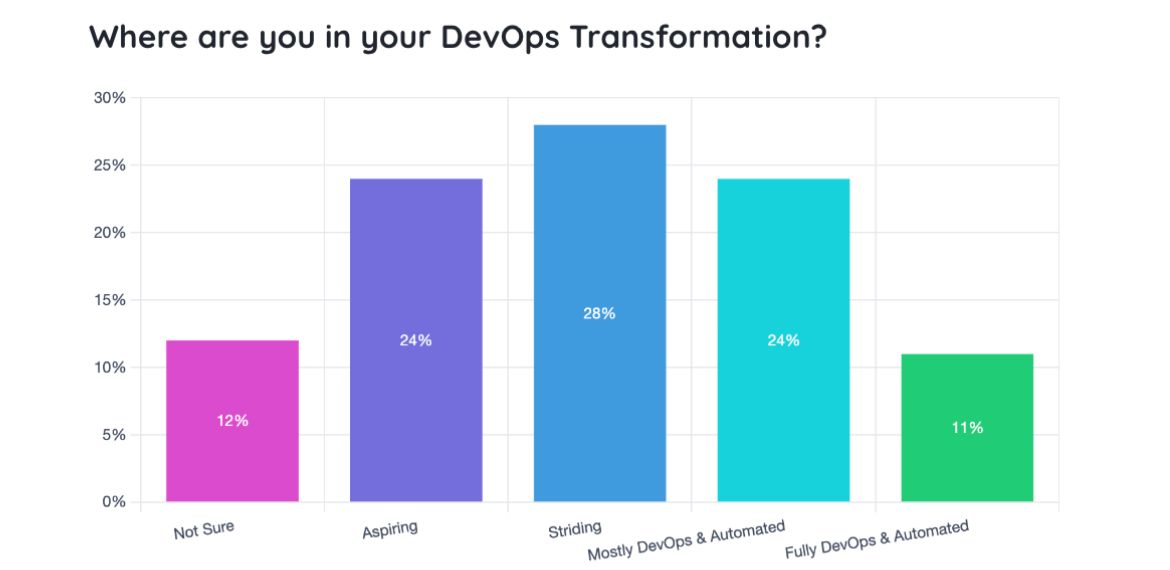
DevOps redefines how teams, processes, and technology are aligned within an enterprise to make software development faster and more collaborative through automation. According to the 2022 Testing in DevOps Report, enterprises of all sizes are pursuing full DevOps adoption with automated workflow pipelines. Embracing DevOps practices successfully requires a continuous view of quality, which requires elevated, automated testing.

DevOps pays off. Google’s 2022 Accelerate State of DevOps Report reveals that high-performing software teams are more likely to embrace DevOps practices like version control (33%), continuous integration (39%), and continuous delivery (46%).

Teams leveraging these practices are quickly maturing in a way that improves overall product velocity, and overall application quality as well. Mature organizations where quality is at the center of their DevOps transformation will achieve these DORA metrics faster while delighting customers with the frequent delivery of new battle-tested features.

Adoption of Cloud Technologies is Accelerating

With the massive shift to cloud-based architecture, software testers must be mindful of controlling quality throughout the migration. Often, the migration to the cloud goes together with DevOps adoption. As development cycles increase, QA teams should investigate cloud testing solutions to quickly scale up test execution – without the limitations of managing on-premise infrastructure.

More Reliance on APIs

Enterprises are becoming more connected and integrated – all possible via APIs. As with cloud computing, this makes the infrastructure more dynamic. It also presents the problem of having to contend with the quality of third-party APIs that may not be properly updated and secure and determining how it will affect the status and quality of the enterprise’s applications. Prioritizing quality with continuous API testing for integrated services allows test teams to detect issues before they affect customers.

Digital Transformation Initiatives are Increasing

Digital transformation remains a top priority for enterprises. In fact, according to one survey, 94% of CFOs recognize the need to maintain or accelerate the already-intense pace of transformation incited by the pandemic. To continue the digital transformation momentum, quality must become a foundation of software development and delivery.

To help enable digital transformation, QA teams can embed quality throughout the software development lifecycle while finetuning processes and QA support. Outside of ensuring the functional correctness of your application, QA teams can start embedding end-to-end, performance, and accessibility tests in the pipeline as well. This way, you confidently deliver better experiences for customers throughout your organization’s transformation.

Ensure Great CX with Low-code Test Automation

Quality is the differentiating factor among competing organizations. Software QA teams have the opportunity to transform technologies, develop new processes, and contribute to excellent customer experiences if they are successful in building a culture of quality in their organization during transformational times.

Once you’ve built a culture of quality and set up the right team and processes, QA leaders need the right tools to execute. These transformations are enabled by intelligent, low-code test automation like mabl. Mabl allows anyone, regardless of coding experience, to create, execute, and maintain tests, integrate those tests into your development pipeline, and share insights into the holistic quality of your application back to the entire software team.

Mabl helps teams scale their testing with 90% less effort, giving QA teams time back to grow test coverage and focus on testing activities that positively impact the customer experience.

Author

Leah Pemberton

Director, Marketing at Mabl

Leah is the Director of Marketing at  Mabl, writing frequently about quality engineering and building a culture of quality.

 Mabl is an EXPO Gold partner at EuroSTAR 2023, join us in Antwerp
Filed Under: DevOps, Software Testing, Test Automation Tagged With: 2023, DevOps, EuroSTAR Conference

How 2023 IT Trends Impact Software Testing

March 17, 2023 by Lauren Payne

Thanks to OpenText / MicroFocus for providing us with this blog post.

[Disclaimer: The future described in this article is the author’s personal view and is by no means any indication of OpenText products’ direction.]

Happy 2023 to the community! The beginning of a year is always the time to think big and look into the future. Last year, I wrote about three 2022 trends that’ll change test management, all of which continue to gain momentum. So far, you’ve heard 2023 predictions from analyst firms, consulting firms, and others. Among those trending IT keywords, I picked a few important ones to share with you. These words may not be new. But they have become even more important in today’s challenging business environment. Putting them together, we can see new ways of developing, testing, and measuring software.

Industry Cloud Booms

Gartner defines industry cloud platforms as modular, composable platforms supported by a catalogue of industry-specific packaged business capabilities. Packaged business suites are not new. The ERP suites from SAP, Oracle, and other vendors are well-known examples. Industry cloud platforms offer a rich set of industry-specific capabilities from many vendors and a place to compose and deliver business applications faster. Enterprise integration PaaS gives you the tools to easily integrate those industry components to form your application with low code or no code.

Cloud is the marketplace of other good stuff too, including AI and data analytics capabilities. Container technologies let you deploy your applications easier and swap out a defective module quickly.

Leveraging the industry cloud shortens the cycle to deliver value and lets you focus on innovation instead of the underlying mundane tasks. Some industry cloud platforms are already full-fledged, including the SAP Industry Cloud and Microsoft Cloud for industries. Companies with deep industry knowledge, like Deloitte, also join the play with their industry solutions.

When your application is built in this way, a focus of testing is verifying the business processes—the “wiring” you composed—and the testers are likely business users. Tools to efficiently verify business processes will find many new places to shine. Testers of all skill levels will appreciate the ability to manage complex interdependencies and save efforts with a component- or model-based approach. Model-based testing directly generates test cases from your business process model and automates them. Expect it to become more common in 2023.

With cloud platforms for building applications fast, you won’t want to lose momentum in the testing part. That’s why cloud-based testing and device farm are your choice.


Observability-Driven Development

The concept of observability has been around for decades. But it recently got popular in the cloud world because it allows people to observe the health of cloud-based systems by analyzing logs and correlating events. Now observability has come to software too, with observability-driven development (ODD). By adding a small amount of code for instrumentation, the development team can observe what’s happening when the application runs in the production environment in the cloud. When there is any issue with the app, observability helps identify the cause quickly and accurately—pinpointing the specific code in question.

ODD is yet another way to strengthen the feedback loop from Ops to Dev. ODD is also said to be a way to test in production, i.e., shift-right testing. The biggest advantage of testing in production is that you have real data and the same environment as customers use. Such observability is also valuable when you test in staging environments. We’ll see more test management or DevOps governance tools incorporate observability data into their data repository for analytics and insights in 2023.

FinOps Meets Value Stream Management

The word FinOps combines “Finance” and “DevOps,” stressing collaboration between business and engineering teams.

FinOps started when cloud service providers and other vendors wanted to provide a way of managing finances for a company’s cloud-based systems. It’s meant to help organizations find the best spending model for achieving their business goals. OpenText HCMX supports FinOps.

I expect to see FinOps and value stream management (VSM) converge sometime in the future. Both are extensions of DevOps. FinOps focuses on managing your costs against business value, while VSM focuses on eliminating bottlenecks and wastes during the process of delivering business value. With both sets of data, you can optimize the cost performance of your application. For example, when you’re unsure whether it’s more efficient to outsource a certain part—such as testing—FinOps and VSM data will likely give you a clear answer.

What’s Next?

You may have noticed that all of the above are related to the cloud. Why? Challenges in the global economy are driving more cloud adoption. The cloud has become the frontier of innovation. Every enterprise that wants to win and lead must embrace the cloud. OpenText software quality solutions went the SaaS model to serve customers who are moving to the cloud in two ways—reducing tooling cost and increasing speed.

Stay tuned on what’s happening with OpenText cloud solutions, especially the ValueEdge platform, in which you will find the most innovative software quality capabilities from OpenText at the earliest.


What is your organization’s cloud initiative? We are here to help. Contact us to discuss details.

Author

Ying Lei

Ying Lei is a senior product marketing manager at OpenText who specializes in test management, application lifecycle management, DevOps and value stream management.

OpenText is an EXPO Gold partner at EuroSTAR 2023, join us in Antwerp
Filed Under: Agile, DevOps, Software Testing Tagged With: 2023 trends, agile, ALM, Cloud Testing, DevOps, SaaS, software testing, Test Management, Value Stream Management

  • « Previous Page
  • Page 1
  • Page 2
  • Page 3
  • Page 4
  • Page 5
  • Next Page »
  • Code of Conduct
  • Privacy Policy
  • T&C
  • Media Partners
  • Contact Us

part of the